

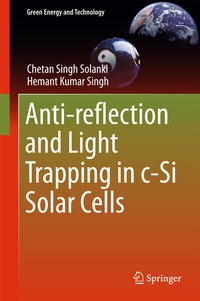
Anti-reflection and Light Trapping in c-Si Solar Cells
Description

More details
Other editions
Additional editions
Persons
Dr. Chetan Singh Solanki is currently a professor at the Department of Energy Science and Engineering at the Indian Institute of Technology Bombay (IITB), India. He is an expert on crystalline Si technology, Si-nanostructures (including quantum dots), thin film Si solar cells, PV concentrator systems and carbon nanotubes. He received his Ph.D. from the specialist silicon laboratory, IMEC (Inter-university Micro-electronics Center, Catholic University of Leuven, Belgium). He has worked on several state-sponsored and private-sector projects exploring crystalline Si solar cells, both wafer based and thin film nanomaterial based variants. The Ministry of New and Renewable Energy has sponsored a project titled "National Center for Photovoltaic Research and Education (NCPRE)", in which he is one of the Principal Investigators. He is also one of the Principal Investigators of "Localization of Solar Energy through Local Assembly, Sale and Usage of 1 Million Solar Urja Lamps (SoUL)". He has been the recipient of many awards as an investigator, has authored several books on solar PV and more than 100 international and national publications, and holds 11 patents.
Dr. Hemant Kumar Singh has more than six years of experience in the research and development of Solar Photovoltaic Technologies. He also has industry experience of in-line 6 inch multi c-Si wafer based solar cell manufacturing. Dr. Singh worked towards his Ph.D. thesis at the Department of Energy Science and Engineering (DESE) under the MNRE, Government of India funded project "National Center for Photovoltaic Research and Education (NCPRE)" at the IIT Bombay, India. His R & D work was in fabrication and characterization of solar cells. His Ph.D. thesis focused on plasmonics based advanced light trapping structures for next-generation thin c-Si solar cell applications. Prior to his Ph.D., he completed his M.Tech in Solid State Technology from IIT Kharagpur, West Bengal, India. During his M.Tech course, his research focus was on CIGS-CdS based hetero-junction for solar applications. He also holds an M.Sc. degree in Physics with a specialization in Electronics from D.D.U. Gorakhpur University, Gorakhpur, Uttar Pradesh, India.
Content
Solar cells: Overview.- c-Si cell: Physics and Technology.- Principle of dielectric based anti-reflection and light trapping.- Principle of texturization for enhanced light trapping.- Texturing process of c-Si wafers.- Anti-reflection coatings with textured surface for c-Si solar cells.- Advancement in traditional lighting trapping structures.- Plasmonics based advanced anti-reflection and light trapping: Principles and Technology.- Plasmonics based light trapping for c-Si solar cell applications.- Future scope in advanced lighting trapping structure development.
