

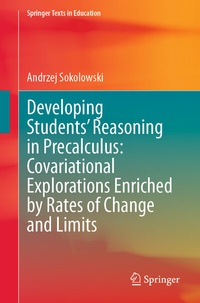
Developing Students' Reasoning in Precalculus: Covariational Explorations Enriched by Rates of Change and Limits
Description

This book aims to develop high school and undergraduate students' covariational reasoning and algebraic skills to succeed in calculus and STEM subjects. The book reflects on contemporary research in math education where students explore algebraic tools and reason mathematically to construct new knowledge. The volume is made up of six chapters covering polynomial, rational, and transcendental functions. An early introduction of limits to support the analyses of linear functions progresses to other book chapters ensuring consistency, parallelism, and a scaffold knowledge delivery. A gradual introduction to function rates of change along with function monotonicity and concavity intertwines with modeling techniques that merge students' mathematical reasoning with scientific contexts. A forthcoming online component of the book consists of ready-to-download exploratory modeling activities and worksheets that further solidify students' fluency in understanding how to apply abstract math concepts to gain a deeper understanding of natural and social sciences.
More details
Other editions
Additional editions
Person
Dr. Andrzej Sokolowski, a researcher, author, and professor of mathematics and physics has an international track record of developing innovative teaching strategies in mathematics and STEM. His research focuses on integrating the methods of these disciplines through modeling to produce independent thinkers ready to delve deeper into how nature works. Andrzej is the author of "Scientific Inquiry in Mathematics - Theory and Practice", and "Understanding Physics Using Mathematical Reasoning" published by Springer, Inc., as well as several book chapters and numerous articles published, among others, in the International Journal of Mathematical Education in Science and Technology, IAFOR Journal of Education, Australian Senior Mathematics Journal, The Physics Teacher and Physics Education. He is also an active reviewer for several periodicals, including the Mathematical Association of America (MAA), IOPscience, and the American Journal of Educational Research.
Content
1. Function, an Entity Relating Variables and Parameters.- 2. Linear and Quadratic Functions.- 3. Analysis of Higher Degree Polynomial Functions.- 4. Rational Functions.- 5. Exponential Functions.- 6. Logarithmic Functions.
