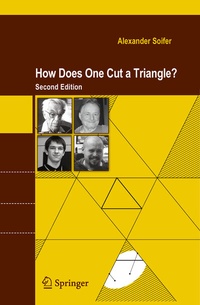
How Does One Cut a Triangle?
Description

This second edition of Alexander Soifer's How Does One Cut a Triangle? demonstrates how different areas of mathematics can be juxtaposed in the solution of a given problem. The author employs geometry, algebra, trigonometry, linear algebra, and rings to develop a miniature model of mathematical research.
How Does One Cut a Triangle? contains dozens of proofs and counterexamples to a variety of problems, such as a pool table problem, a fifty-dollar problem, a five-point problem, and a joint problem. By proving these examples, the author demonstrates that research is a collection of mathematical ideas that have been developed throughout the course of history.
The author brings mathematics alive by giving the reader a taste of what mathematicians do. His book presents open problems that invite the reader to play the role of the mathematician. By doing so, the author skillfully inspires the discovery of uncharted solutions using his solutions as a guide.
Reviews / Votes
From the reviews of the second edition:
"In the second edition of an engagingly written book . addressed to bright high school students and undergraduates, whose contributions are very nicely incorporated into the narrative, the author presents problems belonging to discrete and combinatorial geometry." (Victor V. Pambuccian, Zentralblatt MATH, Vol. 1180, 2010)
"How does one cut a triangle? is a charming little book intended for that most rare of readers: one with little or no knowledge of mathematics above the high school level . . For such a reader, this book constitutes an opportunity to learn a number of mathematical tools and problem-solving techniques. . overall there is much in this book to commend it to both expert and novice . ." (Michael Weiss, Mathematical Reviews, Issue 2011 c)
More details
Other editions
Additional editions