

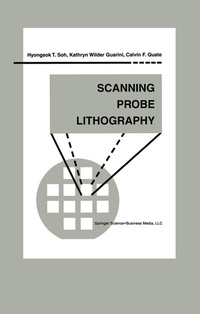
Scanning Probe Lithography
Published on 14. March 2013
XXIII, 197 pages
978-1-4757-3331-0 (ISBN)
Description

Scanning Probe Lithography (SPL) describes recent advances in the field of scanning probe lithography, a high resolution patterning technique that uses a sharp tip in close proximity to a sample to pattern nanometer-scale features on the sample. SPL is capable of patterning sub-30nm features with nanometer-scale alignment registration. It is a relatively simple, inexpensive, reliable method for patterning nanometer-scale features on various substrates. It has potential applications for nanometer-scale research, for maskless semiconductor lithography, and for photomask patterning.
The authors of this book have been key players in this exciting new field. Calvin Quate has been involved since the beginning in the early 1980s and leads the research time that is regarded as the foremost group in this field. Hyongsok Tom Soh and Kathryn Wilder Guarini have been the members of this group who, in the last few years, have brought about remarkable series of advances in SPM lithography. Some of these advances have been in the control of the tip which has allowed the scanning speed to be increased from mum/second to mm/second. Both non-contact and in-contact writing have been demonstrated as has controlled writing of sub-100 nm lines over large steps on the substrate surface. The engineering of a custom-designed MOSFET built into each microcantilever for individual current control is another notable achievement. Micromachined arrays of probes each with individual control have been demonstrated. One of the most intriguing new aspects is the use of directly-grown carbon nanotubes as robust, high-resolution emitters.
In this book the authors concisely and authoritatively describe the historical context, the relevant inventions, and the prospects for eventual manufacturing use of this exciting new technology.
The authors of this book have been key players in this exciting new field. Calvin Quate has been involved since the beginning in the early 1980s and leads the research time that is regarded as the foremost group in this field. Hyongsok Tom Soh and Kathryn Wilder Guarini have been the members of this group who, in the last few years, have brought about remarkable series of advances in SPM lithography. Some of these advances have been in the control of the tip which has allowed the scanning speed to be increased from mum/second to mm/second. Both non-contact and in-contact writing have been demonstrated as has controlled writing of sub-100 nm lines over large steps on the substrate surface. The engineering of a custom-designed MOSFET built into each microcantilever for individual current control is another notable achievement. Micromachined arrays of probes each with individual control have been demonstrated. One of the most intriguing new aspects is the use of directly-grown carbon nanotubes as robust, high-resolution emitters.
In this book the authors concisely and authoritatively describe the historical context, the relevant inventions, and the prospects for eventual manufacturing use of this exciting new technology.
More details
Other editions
Additional editions
Hyongsok T. Soh | Kathryn Wilder Guarini | Calvin F. Quate
Scanning Probe Lithography
Book
12/2010
Springer
€106.99
Shipment within 15-20 days
Hyongsok T. Soh | Kathryn Wilder Guarini | Calvin F. Quate
Scanning Probe Lithography
Book
06/2001
Kluwer Academic Publishers
€106.99
Shipment within 15-20 days
Content
1: Introduction to Scanning Probe Lithography.- 2: SPL by Electric-Field-Enhanced Oxidation.- 3: Resist Exposure Using Field-Emitted Electrons.- 4: SPL Linewidth Control.- 5: Critical Dimension Patterning Using SPL.- 6: High Speed Resist Exposure With a Single Tip.- 7: On-Chip Lithography Control.- 8: Scanning Probe Tips for SPL.- 9: Scanning Probe Arrays for Lithography.- Epilog.- List of Publications.
