

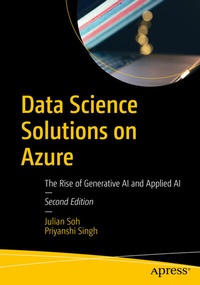
Data Science Solutions on Azure
Description

This revamped and updated book focuses on the latest in AI technology-Generative AI. It builds on the first edition by moving away from traditional data science into the area of applied AI using the latest breakthroughs in Generative AI.
Based on real-world projects, this edition takes a deep look into new concepts and approaches such as Prompt Engineering, testing and grounding of Large Language Models, fine tuning, and implementing new solution architectures such as Retrieval Augmented Generation (RAG). You will learn about new embedded AI technologies in Search, such as Semantic and Vector Search.
Written with a view on how to implement Generative AI in software, this book contains examples and sample code.
In addition to traditional Data Science experimentation in Azure Machine Learning (AML) that was covered in the first edition, the authors cover new tools such as Azure AI Studio, specifically for testing and experimentation with Generative AI models.
What's New in this Book
- Provides new concepts, tools, and technologies such as Large and Small Language Models, Semantic Kernel, and Automatic Function Calling
- Takes a deeper dive into using Azure AI Studio for RAG and Prompt Engineering design
- Includes new and updated case studies for Azure OpenAI
- Teaches about Copilots, plugins, and agents
What You'll Learn
- Get up to date on the important technical aspects of Large Language Models, based on Azure OpenAI as the reference platform
- Know about the different types of models: GPT3.5 Turbo, GPT4, GPT4o, Codex, DALL-E, and Small Language Models such as Phi-3
- Develop new skills such as Prompt Engineering and fine tuning of Large/Small Language Models
- Understand and implement new architectures such as RAG and Automatic Function Calling
- Understand approaches for implementing Generative AI using LangChain and Semantic Kernel
- See how real-world projects help you identify great candidates for Applied AI projects, including Large/Small Language Models
Who This Book Is For
Software engineers and architects looking to deploy end-to-end Generative AI solutions on Azure with the latest tools and techniques.
More details
Other editions
Additional editions
Previous edition
Persons
Julian Soh
is a software engineer and a cloud architect with Microsoft, focusing in the areas of artificial intelligence and advanced analytics for independent software vendors
(ISVs) who develop software solutions based on the Microsoft technology stack. Prior to his current role, Julian worked extensively in major public cloud initiatives, such as
SaaS (Microsoft 365), IaaS/PaaS (Microsoft Azure), and hybrid private-public cloud implementations.
Priyanshi Singh
is a senior artificial intelligence and machine learning technical specialist at Microsoft, specializing in designing end-to-end cloud solutions that leverage generative AI models and AI implementation best practices. She holds a master's degree in data science from New York University and has a robust background as a data scientist, focusing on machine learning techniques for predictive analytics, computer vision, and natural language processing. Priyanshi is dedicated to helping the public
sector and independent software vendors (ISVs) transform citizen services through artificial intelligence. She has been recognized as Microsoft's FY24 State and Local
Government Pinnacle Winner for her exceptional contributions to AI adoption and the growth of Azure business. Additionally, Priyanshi is a sports enthusiast, excelling in
badminton and enjoying golf and billiards.
Content
Chapter 1: Introduction and Update of AI in the Modern Enterprise.- Chapter 2: Generative AI and Large Language Models.- Chapter 3: Deploy and Explore Azure OpenAI.- Chapter 4: Designing a Generative AI Solution.- Chapter 5: Implementing a Generative AI Solution.- Chapter 6: Prompt Engineering Techniques, Small Language Models, and Fine Tuning.- Chapter 7: Semantic Kernel.- Chapter 8: Structured Data, Codex, Agents, and DBCopilot.- Chapter 9: Azure AI Services.
