

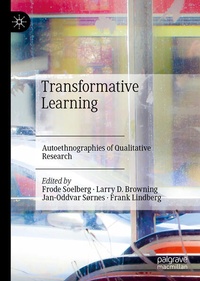
Transformative Learning
Description

This book contains a series of autoethnographies written by participants of a program on qualitative methods. It offers the stories of students-turned-professors and what they learned via autoethnographic writing as part of the course. The chapters provide insight into the application of a range of qualitative research techniques and, unlike typical works on qualitative methods, in a nonprescriptive method that reflects a personal learning process.
This book will be of interest to students and academics engaged in qualitative research, as well as scholars of transformative learning, teaching pedagogy and broader educational studies.
More details
Other editions
Additional editions
Persons
Frode Soelberg is an Associate Professor at the Nord University Business School, Norway.
Larry D. Browning is Professor Emeritus at the Moody College of Communication, University of Texas at Austin, USA and Adjunct Professor of Management at Nord University Business School, Norway.
Jan-Oddvar Sørnes is a Professor at the Nord University Business School, Norway.
Frank Lindberg is a Professor at the Nord University Business School, Norway.
Content
1. Transformative Learning.- Part I. Heuristics.- 2. Mining for Outliers in Qualitative Research to Develop Interviewing Strategies.- 3. Researching the Market Violence of Counterfeit Medicines: Insights from Qualitative Camp.- 4. Studying Processes in Organizations Lessons Learned from Limbo Situations.- Part II. Confessional.- 5. Self-Observation of Sublime Experience.- 6. Harvesting Foreign Fields, the Researcher as a Solitary Reaper Away from Home.- 7. Contrasting Norwegian and American Prison Systems: Becoming (Un)broken.- Part III. Peer Learning.- 8. Observing Cultural Differences: Dismantling Ethnocentrism in a Multicultural Environment.- 9. What's going on here, or Welcome on board of No Escape.- 10. How Natural Is "Natural" in Field Research?.- Part IV. Sensemaking.- 11. Moving Qualitative Data from Little Pieces of Colored Glass to an Elegant Stained-Glass Window.- 12. Walking out of the Shadow.- 13. Finding the Human Story in a Cultural of Secrecy.- 14. Observational Methodology and Ecological Economics.- Part V. Epilogue.- 15. A Grounded Theory of Qcamp.
