

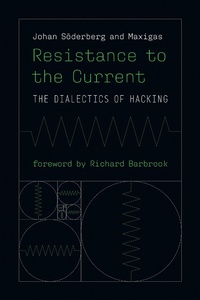
Resistance to the Current
The Dialectics of Hacking
Published on 22. November 2022
240 pages
978-0-262-37201-5 (ISBN)
Description

How hacking cultures drive contemporary capitalism and the future of innovation.
In Resistance to the Current, Johan Söderberg and Maxigas examine four historical case studies of hacker movements and their role in shaping the twenty-first-century's network society. Based on decades of field work and analysis, this intervention into current debates situates an exploding variety of hacking practices within the contradictions of capitalism. Depoliticized accounts of computing cultures and collaborative production miss their core driver, write Söderberg and Maxigas: the articulation of critique and its recuperation into innovations.
Drawing on accounts of building, developing, and running community wireless networks, 3D printers, hackerspaces, and chat protocols, the authors develop a theoretical framework of critique and recuperation to examine how hackers-who have long held a reputation for being underground rebels-transform their outputs from communal, underground experiments to commercial products that benefit the state and capital. This framework allows a dialectical understanding of contemporary social conflicts around technology and innovation. Hackers' critiques of contemporary norms spur innovation, while recuperation turns these innovations into commodified products and services. Recuperation threatens the autonomy of hacker collectives, harnessing their outputs for the benefit of a capitalist system.
With significant practical implications, this sophisticated multidisciplinary account of technology-oriented movements that seek to challenge capitalism will appeal to science and technology readers interested in innovation studies, user studies, cultural studies, and media and communications.
In Resistance to the Current, Johan Söderberg and Maxigas examine four historical case studies of hacker movements and their role in shaping the twenty-first-century's network society. Based on decades of field work and analysis, this intervention into current debates situates an exploding variety of hacking practices within the contradictions of capitalism. Depoliticized accounts of computing cultures and collaborative production miss their core driver, write Söderberg and Maxigas: the articulation of critique and its recuperation into innovations.
Drawing on accounts of building, developing, and running community wireless networks, 3D printers, hackerspaces, and chat protocols, the authors develop a theoretical framework of critique and recuperation to examine how hackers-who have long held a reputation for being underground rebels-transform their outputs from communal, underground experiments to commercial products that benefit the state and capital. This framework allows a dialectical understanding of contemporary social conflicts around technology and innovation. Hackers' critiques of contemporary norms spur innovation, while recuperation turns these innovations into commodified products and services. Recuperation threatens the autonomy of hacker collectives, harnessing their outputs for the benefit of a capitalist system.
With significant practical implications, this sophisticated multidisciplinary account of technology-oriented movements that seek to challenge capitalism will appeal to science and technology readers interested in innovation studies, user studies, cultural studies, and media and communications.
More details
Other editions
Additional editions
Book
11/2022
MIT Press
€32.40
Article exhausted; check different version
Persons
Johan Söderberg is Associate Professor in the Department of Philosophy, Linguistics and Theory of Science at the University of Göteborg and Associate Editor of Science as Culture. He researches the development of alternative addiction treatments and the hacking of medicine.
Maxigas is Senior Lecturer in the Department of Media at the University of Amsterdam. His research on hacking, cybernetics, and old social media has been published in academic journals including the Social Studies of Science and the Internet Policy Review.
Maxigas is Senior Lecturer in the Department of Media at the University of Amsterdam. His research on hacking, cybernetics, and old social media has been published in academic journals including the Social Studies of Science and the Internet Policy Review.
Content
Series Editor's Introduction ix
Foreword xiii
1 Introduction: The Dialects of Hacking 1
2 Theorizing Critique and Recuperation 15
3 Community Wireless Networks: A Darknet of Light 59
4 Open-Source 3D Printing: Reproducing Machines and Social Relations 87
5 Hackerspaces: Memory and Forgetting Through Generations of Shared Machine Shops 123
6 Internet Relay Chat: A Time Machine that Stood the Test of Time 159
7 Conclusion: The Struggle Ahead 189
Notes 203
References 207
Index 231
Foreword xiii
1 Introduction: The Dialects of Hacking 1
2 Theorizing Critique and Recuperation 15
3 Community Wireless Networks: A Darknet of Light 59
4 Open-Source 3D Printing: Reproducing Machines and Social Relations 87
5 Hackerspaces: Memory and Forgetting Through Generations of Shared Machine Shops 123
6 Internet Relay Chat: A Time Machine that Stood the Test of Time 159
7 Conclusion: The Struggle Ahead 189
Notes 203
References 207
Index 231
