

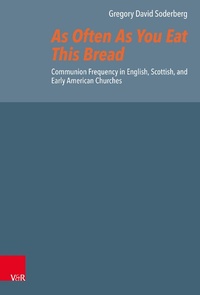
As Often As You Eat This Bread
Communion Frequency in English, Scottish, and Early American Churches
1st Edition
Published on 14. November 2022
280 pages
978-3-647-56070-0 (ISBN)
Description

Why can't Christians agree about communion? Why is it that in some churches all worship services culminate in a holy meal whereas other churches celebrate this 'holy supper' only once in a while? Theologian Gregory Soderberg has researched this question, excavating patterns of communion frequency within one of the bigger Christian families: the Reformed tradition. Despite being the sacrament of unity, the eucharist has often been a cause of strife in Christian churches. In his study, Gregory David Soderberg is the first to focus in depth on communion frequency in the Reformed tradition. He concludes that, although the 16th century Reformers desired more frequent communion, this was balanced by their desire to create mature Christian communities. So, preachers and church leaders stressed the priority of moral conduct and the importance of understanding what the eucharist meant for Protestants. The study analyses sources from the very beginnings of this tradition in 16th century Zürich and Geneva, and it follows its trajectories through England and Scotland all the way down to 19th century USA. Ultimately, it is hoped that understanding the polemics of the past will help churches today to celebrate the sacrament of unity more meaningfully.
Gregory Soderberg received a doctorate in Historical Theology from the Vrije Universiteit Amsterdam. He teaches at both Logos Online School and the Bible Mesh Institute.
Gregory Soderberg received a doctorate in Historical Theology from the Vrije Universiteit Amsterdam. He teaches at both Logos Online School and the Bible Mesh Institute.
More details
Other editions
Additional editions
Gregory David Soderberg
As Often As You Eat This Bread
Communion Frequency in English, Scottish, and Early American Churches
Book
11/2022
1st Edition
Vandenhoeck & Ruprecht
from
€130.00
Shipment within 5-7 days
Person
Gregory Soderberg received a doctorate in Historical Theology from the Vrije Universiteit Amsterdam. He teaches at both Logos Online School and the Bible Mesh Institute.
Content
- Intro
- Tilte Page
- Copyright
- Table of Contents
- Acknowledgements
- Chapter 1 Communion Frequency and Reformed Identity
- 1.1 Introduction
- 1.2 Research Goals, Methodology, and the Significance of the Project
- 1.3 Scope of Research
- Chapter 2 Communion Frequency in the Late Medieval Period and the Sixteenth-Century Continental Reformed Reformation
- 2.1 Introduction
- 2.2 Aspects of Communion Frequency in the Context of the Protestant Reformation
- 2.3 Reforming Communion Frequency
- 2.4 Johannes Oecolampadius (1482-1531)
- 2.5 Martin Bucer (1491-1551)
- 2.6 Huldrych Zwingli (1484-1531)
- 2.7 Heinrich Bullinger (1504-1575)
- 2.8 John Calvin (1509-1564)
- 2.9 Church Discipline and Communion Frequency
- 2.9.1 Zurich, Basel, and Strasbourg
- 2.9.2 Worship and Church Discipline in Geneva
- 2.10 Conclusion
- Chapter 3 Communion Frequency in the Reformation in England and Scotland (1536-1603)
- 3.1 Introduction
- 3.2 Reformation and Communion Frequency in England
- 3.2.1 Key Aspects of the English Reformation
- 3.2.2 Communion Frequency in the English Reformation
- 3.3 Reformation and Communion Frequency in Scotland (1556-1603)
- 3.3.1 Scottish Ecclesial Documents and Communion Frequency
- 3.3.2 Rhythms of the Scottish Reformed Community
- 3.3.3 The Role of Preaching and Catechesis
- 3.3.4 The Role of Church Discipline, Penance, and Reconciliation
- 3.4 Conclusion
- Chapter 4 Communion Frequency and Church Discipline in Post-Reformation England and Scotland (1603-1689)
- 4.1 Post-Reformation and the Question of Definitions
- 4.2 Communion Frequency in Post-Reformation England and Godly Communities
- 4.3 Preparation and Purity in Godly Communities
- 4.4 Case Studies: Puritans, Preparation, and Communion Frequency
- 4.4.1 Lewis Bayly (1575-1631)
- 4.4.2 Arthur Hildersham (1563-1632) and William Bradshaw (1570-1618)
- 4.4.3 Stephen Charnock (1628-1680)
- 4.4.4 Westminster Assembly: Frequency and Church Discipline (1643-1653)
- 4.4.5 Thomas Doolittle (1630?-1707)
- 4.4.6 Matthew Henry (1662-1714)
- 4.4.7 Conclusion
- 4.5 Scottish Reformed Communion Frequency
- 4.5.1 Infrequent Communion: Theological and Liturgical Factors
- 4.5.2 Political, Economic, and Practical Factors
- 4.5.3 Scottish Communion Seasons and Sacramental Festivity
- 4.6 Conclusion
- Chapter 5 Communion, Preparation, and Ecclesial Identity in American Reformed Churches (1620-1758)
- 5.1 The Allure of Purity in the New World
- 5.2 Frequency and Sacramental Boundaries in Colonial Puritanism
- 5.3 Communion and Preparation in the Colonial Period
- 5.4 Solomon Stoddard (1643-1729)
- 5.5 Edward Taylor (c. 1645-1729)
- 5.6 Samuel Willard (1640-1707)
- 5.7 Cotton Mather (1663-1728)
- 5.8 Jonathan Edwards (1705-1758)
- 5.9 Scots-Irish Influence in Early America and the Seedbed of Revivalism
- 5.10 Conclusion
- Chapter 6 Scottish Reformed Communion Frequency Debates: A Trans-Atlantic Perspective (1716-1840)
- 6.1 Theological Voices and Texts
- 6.1.1 John Willison (1680-1750)
- 6.1.2 John Erskine (1721-1803)
- 6.1.3 Thomas Randall (1710-1780)
- 6.1.4 John Mitchell Mason (1770-1829)
- 6.1.5 John Thomson (1799)
- 6.1.6 John Anderson (c. 1748-1830)
- 6.1.7 Alexander Duncan (1777-1844)
- 6.1.8 John Brown of Haddington (1722-1787)
- 6.1.9 James W. Alexander (1804-1859)
- 6.2 Comparative Analysis of Arguments
- 6.2.1 Biblical and Theological Arguments
- 6.2.2 Theological Arguments
- 6.2.3 Historical Arguments
- 6.2.4 Frequency, Preparation, and Solemnity
- 6.2.5 Legacies of the Frequency Debates
- Conclusion
- Bibliography
- Index
- Index of person
- Index of subjects
- Body
