


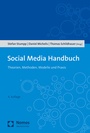
Social Media Handbuch
Theorien, Methoden, Modelle und Praxis
Nomos (Publisher)
4th Edition
Published on 19. May 2021
402 pages
978-3-7489-0746-6 (ISBN)
Description

Das Social Media Handbuch begleitet langfristige Entwicklungen im sich ständig wandelnden Social Media Bereich und erklärt grundsätzliche Zusammenhänge. Es beschreibt ein Strategiemodell für die Entwicklung eigener Lösungen, fasst Theorien, Methoden und Modelle führender Autoren zusammen und zeigt deren praktische Anwendung. Auch aktuelle Entwicklungen werden aufgeführt. Es wird das Thema Datenverarbeitung in Sozialen Medien behandelt. Eine Betrachtung der Plattformökonomie mit ihren ökonomischen Funktionsweisen erleichtert die Einordnung von Geschäftsmodellen in Sozialen Medien. Es wird zudem dargelegt, wie Plattformen und ihre Algorithmen unser Handeln und unsere Meinungsbildung beeinflussen können.

More details
Other editions
Additional editions
Book
05/2021
4th Edition
Nomos
€44.00
Article exhausted; check for reprint
Persons
Herausgegeben von
- Dr. Stefan Stumpp,
- Prof. Dr. Daniel Michelis,
- Prof. Dr. Dr. Thomas Schildhauer,
Mit Beiträgen von
- Prof. Karin Bjerregaard Schlüter,
- Andrea Braun,
- Franziska Geue,
- Tobias Knopf,
- Markus Korbien,
- Prof. Dr. Daniel Michelis,
- Stefan Pfaff,
- Thanh H. Pham,
- Tom Reichstein,
- Prof. Dr. Anna Riedel,
- Michael Sarbacher,
- Prof. Dr. Dr. Thomas Schildhauer,
- Prof. Dr. Hendrik Send,
- Dr. Stefan Stumpp,
- Prof. Dr. Sebastian Volkmann,
- Jan-Benedikt Weber,
- Julia Weißhaupt,
- Norman Wiebach und
- Prof. Dr. Christian Wissing.
Content
- Cover
- Einleitung
- Teil 1 Grundlagen
- Kapitel 1 Einführung in die Sozialen Medien
- Kapitel 2 Strategischer Leitfaden
- Kapitel 3 Social Media Canvas
- Kapitel 4 Das Geschäftsmodell hinter den Sozialen Medien. Die Plattformökonomie als normativer Rahmen
- Kapitel 5 Datenschutz in Sozialen Medien durch gemeinsame Verantwortlichkeit
- Teil 2 Theorien, Methoden und Modelle
- Kapitel 6 Die Sprache der Neuen Medien (Lev Manovich)
- Kapitel 7 Tipping Point (Malcolm Gladwell)
- Kapitel 8 Cluetrain Manifest (Levine, Locke, Searls, Weinberger)
- Kapitel 9 Naked Conversations (Robert Scoble, Shel Israel)
- Kapitel 10 Die Weisheit der Vielen (James Surowiecki)
- Kapitel 11 Organisieren ohne Organisationen (Clay Shirky)
- Kapitel 12 The Long Tail (Chris Anderson)
- Kapitel 13 Free (Chris Anderson)
- Kapitel 14 POST-Methode (Charlene Li, Josh Bernoff)
- Kapitel 15 Mit dem HERO-Konzept Angestellte für den digitalen Wandel identifizieren (Josh Bernoff, Ted Schadler)
- Kapitel 16 Open Leadership (Charlene Li)
- Kapitel 17 Crowdsourcing (Jeff Howe)
- Kapitel 18 Dark Social - Entwicklung, Einordnung und Herausforderungen
- Kapitel 19 Social Bots - wie Algorithmen Meinungen beeinflussen
- Kapitel 20 Kultur der Digitalität (Felix Stalder)
- Kapitel 21 Algorithmen als Entscheidungsinstanz in Sozialen Medien (Christoph Drösser)
- Kapitel 22 Dystopie, Retropie und Utopie: Zukunftsvisionen für Soziale Medien (Richard David Precht)
- Teil 3 Anwendung
- Kapitel 23 Online-Kommunikation in Projekten lernen und vermitteln - Neue Arbeitsmodelle und soziale Kollaboration
- Kapitel 24 POST-Methode: Anwendungsfall Hochschule Anhalt
- Kapitel 25 Social Media Canvas: Anwendungsfall Lidl
- Stichwortverzeichnis
- Die Autorinnen und Autoren
