

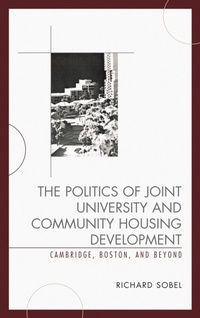
The Politics of Joint University and Community Housing Development
Cambridge, Boston, and Beyond
1st Edition
Published on 10. July 2014
228 pages
979-8-216-34711-8 (ISBN)
Description

The Politics of Joint University and Community Housing Development: Cambridge, Boston, and Beyond informs and encourages the understanding and creation of community/university housing. It reveals the political and technical dynamics of joint housing development involving both communities and universities. Community/university housing projects have been built in several cities and planned in others.
Since Cambridge, Masschusetts, home of Harvard and MIT, contains outstanding examples of community/university housing, the book focuses on the projects there since the 1960s. It also discusses a major project in Mission Hill near Harvard Medical School in Boston, along with brief examinations of a number of other projects.
Through the Cambridge and Boston cases, the author explores the historical, political, and economic reasons for developing community housing. There, residents asked the universities to help solve the city housing problems to which the institutions had contributed. Since community housing involved a process, as well as a result in describing how the housing was built, the book focuses on the role of community participation in the development process.
The study contributes to the understanding of the issues in several ways. First, two people well acquainted with community/university housing and politics introduce the study with insightful forewords. Second, the study provides details of the development process that will be useful to other community/university groups. Third, it explores university responsibility, rhetoric versus reality, and the educational values of community housing participation. Fifth, the lessons and suggestions provide insights and inspiration for others. Finally, the epilogue explains the development of the study.
This study will be particularly helpful for other cities and university/communities encountering housing problems. The features and information here will interest a wide range of community, university, and other urban groups. The issues discussed will become increasingly relevant as more people move into attractive areas near universities. It is also pertinent to institutions like hospitals that also have community and housing problems, and to civic groups that can help solve a range of housing problems. This book explains the politics of community/university housing development in ways that encourage others to address and solve similar problems.
Since Cambridge, Masschusetts, home of Harvard and MIT, contains outstanding examples of community/university housing, the book focuses on the projects there since the 1960s. It also discusses a major project in Mission Hill near Harvard Medical School in Boston, along with brief examinations of a number of other projects.
Through the Cambridge and Boston cases, the author explores the historical, political, and economic reasons for developing community housing. There, residents asked the universities to help solve the city housing problems to which the institutions had contributed. Since community housing involved a process, as well as a result in describing how the housing was built, the book focuses on the role of community participation in the development process.
The study contributes to the understanding of the issues in several ways. First, two people well acquainted with community/university housing and politics introduce the study with insightful forewords. Second, the study provides details of the development process that will be useful to other community/university groups. Third, it explores university responsibility, rhetoric versus reality, and the educational values of community housing participation. Fifth, the lessons and suggestions provide insights and inspiration for others. Finally, the epilogue explains the development of the study.
This study will be particularly helpful for other cities and university/communities encountering housing problems. The features and information here will interest a wide range of community, university, and other urban groups. The issues discussed will become increasingly relevant as more people move into attractive areas near universities. It is also pertinent to institutions like hospitals that also have community and housing problems, and to civic groups that can help solve a range of housing problems. This book explains the politics of community/university housing development in ways that encourage others to address and solve similar problems.
More details
Edition
1. Auflage
Language
English
Place of publication
United States
Publishing group
Bloomsbury Publishing Plc
Target group
Professional and scholarly
Illustrations
10 BW Photos, 8 Maps, 2 Tables
ISBN-13
979-8-216-34711-8 (9798216347118)
Copyright in bibliographic data and cover images is held by Nielsen Book Services Limited or by the publishers or by their respective licensors: all rights reserved.
Schweitzer Classification
Other editions
Additional editions

Richard Sobel
The Politics of Joint University and Community Housing Development
Cambridge, Boston, and Beyond
Book
07/2014
Lexington Books
€124.90
Shipment within 10-20 days
Persons
Richard Sobel has researched and taught at Princeton, Smith, University of Connecticut, Harvard, and Northwestern. He has been a fellow at Harvard's Kennedy, Medical, and Law Schools.
Content
Part I: The Cambridge Study
Chapter One: Cambridge and Responses to the Housing Crisis
Chapter Two: MIT Projects: 'A Housing Program in Cambridge'
Chapter Three: Harvard-Related Community Housing Projects in Cambridge
Chapter Four: Looking Back on Cambridge
Part II: Mission Park Housing in Boston
Chapter Five: Mission Park: The Roxbury Tenants and Harvard
Chapter Six: University Responsibility and Community Housing
Part III: Community/University Housing Elsewhere
Chapter Seven: Other Joint Developments
Part IV: New Saws for Building Community/University Housing
Chapter Eight: Conclusions, Suggestions, and Lessons
Epilogue and Reflections
Chapter One: Cambridge and Responses to the Housing Crisis
Chapter Two: MIT Projects: 'A Housing Program in Cambridge'
Chapter Three: Harvard-Related Community Housing Projects in Cambridge
Chapter Four: Looking Back on Cambridge
Part II: Mission Park Housing in Boston
Chapter Five: Mission Park: The Roxbury Tenants and Harvard
Chapter Six: University Responsibility and Community Housing
Part III: Community/University Housing Elsewhere
Chapter Seven: Other Joint Developments
Part IV: New Saws for Building Community/University Housing
Chapter Eight: Conclusions, Suggestions, and Lessons
Epilogue and Reflections
