

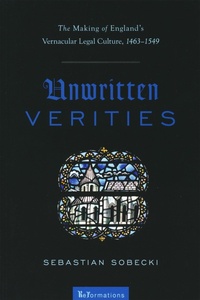
Unwritten Verities
The Making of England's Vernacular Legal Culture, 1463-1549
1st Edition
Published on 15. March 2015
277 pages
978-0-268-09290-0 (ISBN)
Description

In Unwritten Verities: The Making of England's Vernacular Legal Culture, 1463-1549, Sebastian Sobecki argues that the commitment by English common law to an unwritten tradition, along with its association with Lancastrian political ideas of consensual government, generated a vernacular legal culture on the eve of the Reformation that challenged the centralizing ambitions of Tudor monarchs, the scriptural literalism of ardent Protestants, and the Latinity of English humanists.
Sobecki identifies the widespread dissemination of legal books and William Caxton's printing of the Statutes of Henry VII as crucial events in the creation of a vernacular legal culture. He reveals the impact of medieval concepts of language, governance, and unwritten authority on such sixteenth-century humanists, reformers, playwrights, and legal writers as John Rastell, Thomas Elyot, Christopher St. German, Edmund Dudley, John Heywood, and Thomas Starkey. Unwritten Verities argues that three significant developments contributed to the emergence of a vernacular legal culture in fifteenth-century England: medieval literary theories of translation, a Lancastrian legacy of conciliar government, and an adherence to unwritten tradition. This vernacular legal culture, in turn, challenged the textual practices of English humanism and the early Reformation in the following century. Ultimately, the spread of vernacular law books found a response in the popular rebellions of 1549, at the helm of which often stood petitioners trained in legal writing.
Informed by new developments in medieval literature and early modern social history, Unwritten Verities sheds new light on law printing, John Fortescue's constitutional thought, ideas of the commonwealth, and the role of French in medieval and Tudor England.
Sobecki identifies the widespread dissemination of legal books and William Caxton's printing of the Statutes of Henry VII as crucial events in the creation of a vernacular legal culture. He reveals the impact of medieval concepts of language, governance, and unwritten authority on such sixteenth-century humanists, reformers, playwrights, and legal writers as John Rastell, Thomas Elyot, Christopher St. German, Edmund Dudley, John Heywood, and Thomas Starkey. Unwritten Verities argues that three significant developments contributed to the emergence of a vernacular legal culture in fifteenth-century England: medieval literary theories of translation, a Lancastrian legacy of conciliar government, and an adherence to unwritten tradition. This vernacular legal culture, in turn, challenged the textual practices of English humanism and the early Reformation in the following century. Ultimately, the spread of vernacular law books found a response in the popular rebellions of 1549, at the helm of which often stood petitioners trained in legal writing.
Informed by new developments in medieval literature and early modern social history, Unwritten Verities sheds new light on law printing, John Fortescue's constitutional thought, ideas of the commonwealth, and the role of French in medieval and Tudor England.
Reviews / Votes
"Sebastian Sobecki's lucid and lively study seeks to address a major lacuna in the current understanding of English vernacularity from the fourteenth to the sixteenth centuries: English common law. This huge body of knowledge and practice, written and unwritten, awaits focused attention from historians and literary historians, particularly in the light of new scholarship on Anglo-French vernacularity in this period. Sobecki's ambitious, original, and deeply considered account includes such figures as John Fortescue, John Rastell, and Christopher St. German and their investments in and influence on early Tudor commonality. The range and intelligence of his approach to this material, his ability to think beyond period and disciplinary boundaries, and his alertness to the complex bilingual condition of English intellectuals add a compelling dimension to the debate on the linguistic and political shapes of insular identity in these centuries." -Ardis Butterfield, John M. Schiff Professor of English, Yale University"Unwritten Verities proposes an arresting and original thesis: that the English common law's commitment to an oral tradition permitted it, on the eve of the Reformation, to become a transformative repository for notions of consensual government, of the inwardness of spiritual jurisdiction, and of the preeminence of English. This elegantly written and engagingly controversial book will stimulate literary scholars, legal historians, and historians of political thought to look afresh at some of their fundamental assumptions about English literature, politics, and the law at the turn of the fifteenth century." -Lorna Hutson, Berry Professor of English Literature, University of St. Andrews
"Unwritten Verities boasts persuasive and original arguments that genuinely reframe the ways we understand English humanism, the history of print, and vernacular culture. . . . [The book] will surely become an indispensable text for anyone working on English law and vernacularity." -H-Law, H-Net Reviews
"In this book, [Sobecki] delivers the sum of a wide range of parts and convey the importance of those pieces to a community of scholars accustomed to looking past them. Chapter after chapter features fresh, robust claims that shed light on authors rarely considered by critics and are sure to shape the direction of future scholarship." -The Medieval Review
"In his accessible and carefully researched book, Sobecki repositions Fortescue, St. German, and Rastell as thinkers concerned as much with the relationship between the English language and the common law as with England's constitutional arrangements. The result is an argument that is simultaneously controversial, thought-provoking, and wide-ranging in its implications." -Sixteenth Century Journal
"Unwritten Verities is an eloquently written work. In it, Sobecki's absorbing arguments as to the significance and impact of the developments in English legal vernacularity are presented eruditely. . . . Due to the varied nature of the source material selected for analysis and the arguments proffered, Sobecki's overarching discussion will be of undoubted value to those with interests as varied as medieval literature, early modern studies, constitutional law, social history and legal history in general." -Journal of Legal History
"As readers of Sobecki's earlier works already know, he is a very clever writer: both his general arguments and his asides are full of rich ideas. His literary analysis . . . is always clear and convincing. Indeed, it is an achievement to have written a book about literature that legal historians would find useful. . . The book [has] enduring value as a sharp explication of the textual and ideological complexities at work in the late-medieval and early modern common law." -Speculum
"Sebastian Sobecki makes the argument that English common law became the repository of consensual theories of government in the late fifteenth and early sixteenth centuries. Unwritten Verities challenges the view of common law as insular even though in the early seventeenth century it later became the conduit for the idea of English particularity." -Studies in English Literature
"Pointing to the thousands of men in the mid-sixteenth century England-from attorneys and clerks to scriveners and lay readers of legal publications-who would be engaged with vernacular legal culture on a regular basis, Sobecki makes a compelling case for the development by the mid-sixteenth century of a vibrant vernacular legal culture in England. . . . Socbecki rightly questions assumptions that this period saw a turning away from the medieval and toward the modern. If Unwritten Verities is controversial, it is so not least because it challenges its readers to recognize the enduring if unacknowledged influence of medieval ideas about language, law, and the nature of political society." -Sixteenth Century Journal
"In Unwritten Verities, Sebastian Sobecki provides an engaging, interdisciplinary study of English Common law's oral tradition. Emerging from this volume is a provocative consideration of the relationship between common law and Anglo-French vernacularity in late mediaeval and early modern England. Importantly, Sobecki's examination of vernacular legal culture challenges late medieval periodization, connecting the writing of John Fortescue and other English legal thinkers to subsequent ideas about consensual and even socially inclusive government." -Renaissance and Reformation
More details
Series
Language
English
Place of publication
Notre Dame IN
United States
Target group
College/higher education
ISBN-13
978-0-268-09290-0 (9780268092900)
Copyright in bibliographic data and cover images is held by Nielsen Book Services Limited or by the publishers or by their respective licensors: all rights reserved.
Schweitzer Classification
Other editions
Additional editions
Book
03/2015
University of Notre Dame Press
€47.00
Shipment within 10-20 days
Person
Sebastian Sobecki is professor of medieval English literature and culture, University of Groningen, the Netherlands.
Content
- Cover
- Half title
- Series page
- Title page
- Copyright
- Dedication
- Contents
- Acknowledgments
- Introduction
- Part 1: FOUNDATIONS
- 1. Reading and Writing in a Spoken World
- 2. Between Vernaculars
- 3. John Fortescue and Lancastrian Conciliarism
- Part 2: TRANSFORMATIONS
- 4. The Unwritten Verities of the Common Law
- 5. Pleading for English
- 6. States of Exception
- Afterword
- Notes
- Bibliography
- Index
