

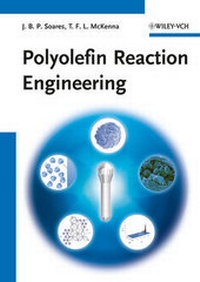
Polyolefin Reaction Engineering
1st Edition
Published on 9. April 2013
XXIV, 328 pages
978-3-527-64697-5 (ISBN)
Description

Monomers composed of carbon and hydrogen atoms are the simple building blocks that make up polyolefins - molecules which are extremely
useful and which have an extraordinary range of properties and applications. How these monomer molecules are connected in the polymer chain defines the molecular architecture of polyolefins.
Written by two world-renowned authors pooling their experience from industry and academia, this book adopts a unique engineering approach
using elegant mathematical modeling techniques to relate polymerization conditions, reactor and catalyst type to polyolefin properties.
Readers thus learn how to design and optimize polymerization conditions to produce polyolefins with a given microstructure, and how different
types of reactors and processes are used to create the different products.
Aimed at polymer chemists, plastics technologists, process engineers,the plastics industry, chemical engineers, materials scientists, and company libraries.
useful and which have an extraordinary range of properties and applications. How these monomer molecules are connected in the polymer chain defines the molecular architecture of polyolefins.
Written by two world-renowned authors pooling their experience from industry and academia, this book adopts a unique engineering approach
using elegant mathematical modeling techniques to relate polymerization conditions, reactor and catalyst type to polyolefin properties.
Readers thus learn how to design and optimize polymerization conditions to produce polyolefins with a given microstructure, and how different
types of reactors and processes are used to create the different products.
Aimed at polymer chemists, plastics technologists, process engineers,the plastics industry, chemical engineers, materials scientists, and company libraries.
More details
Other editions
Additional editions
Joao B. P. Soares | Timothy F. L. McKenna
Polyolefin Reaction Engineering
Software
08/2012
Wiley-VCH
€214.78
No shipping information available
Joao B. P. Soares | Timothy F. L. McKenna
Polyolefin Reaction Engineering
Book
07/2012
1st Edition
Wiley-VCH
€159.00
Shipment within 5-7 days
Persons
João B. P. Soares is Professor in the Department of Chemical Engineering at the University of Waterloo, Canada. He has also worked as a research and development engineer at Pronor, COPENE, and Polibrasil in Brazil. He obtained his PhD from McMaster University working with Professor A. E. Hamielec. He has authored more than 160 articles in refereed journals and 11 book chapters. Professor Soares is a Fellow of the Chemical Institute of Canada and is the recipient of the Premier's Research Excellence Award, the Union Carbide/ Dow Innovation Award, and the Syncrude/ CSChE Canada Innovation Award for contributions to Chemical Engineering under the age of 40. He is also Editor-in-Chief for the Canadian Journal of Chemical Engineering and a member of the Executive Advisory Board of Wiley-VCH Macromolecular Journals. He is a consultant for several polyolefin-manufacturing companies in Canada, USA, Europe Asia, and Brazil.
Timothy F. L. McKenna is a Directeur de Recherche (DR2) at the Laboratoire de Chimie, Catalyse, Polymères et Procédés (C2P2, a CNRS laboratory), in Villeurbanne, France. He obtained his PhD in Chemical Engineering from the University of Massachusetts at Amherst, then moved to France to work with Elf-Aquitaine an Atochem on modeling polyethylene particle growth. After three years with Elf-Atochem, he joined the academic world in 1993 at the Laboratoire de Chimie et Procédés de Polymérisation (LCPP, CNRS). Since then Dr. McKenna has authored or co-authored more than 180 papers and 8 book chapters, and is a consultant at companies in Europe, the middle East and Asia. He is currently an active participant in the Dutch Polymer Institute (DPI), an associate editor of the Canadian Journal of Chemical Engineering, and serves in the International Advisory Board of 2 Macromolecular Journals, and of Chemical Engineering Technology, all from Wiley-VCH.
Prof. Soares and McKenna have given in-house industrial short courses on Polyolefin Reaction Engineering to many polyolefin manufacturing companies worldwide. They also offer an annual short course on the same topic open to industrial and academic participants.
Timothy F. L. McKenna is a Directeur de Recherche (DR2) at the Laboratoire de Chimie, Catalyse, Polymères et Procédés (C2P2, a CNRS laboratory), in Villeurbanne, France. He obtained his PhD in Chemical Engineering from the University of Massachusetts at Amherst, then moved to France to work with Elf-Aquitaine an Atochem on modeling polyethylene particle growth. After three years with Elf-Atochem, he joined the academic world in 1993 at the Laboratoire de Chimie et Procédés de Polymérisation (LCPP, CNRS). Since then Dr. McKenna has authored or co-authored more than 180 papers and 8 book chapters, and is a consultant at companies in Europe, the middle East and Asia. He is currently an active participant in the Dutch Polymer Institute (DPI), an associate editor of the Canadian Journal of Chemical Engineering, and serves in the International Advisory Board of 2 Macromolecular Journals, and of Chemical Engineering Technology, all from Wiley-VCH.
Prof. Soares and McKenna have given in-house industrial short courses on Polyolefin Reaction Engineering to many polyolefin manufacturing companies worldwide. They also offer an annual short course on the same topic open to industrial and academic participants.
Content
PREFACE
INTRODUCTION TO POLYOLEFINS
Introduction
Polyethylene Resins
Polypropylene Resins
POLYOLEFIN MICROSTRUCTURAL CHARACTERIZATION
Introduction
Molecular Weight Distribution
Chemical Composition Distribution
Cross-Fractionation Techniques
Long-Chain Branching
POLYMERIZATION CATALYSIS AND MECHANISM
Introduction
Catalyst Types
Supporting Single-Site Catalysts
Polymerization Mechanism with Coordination Catalysts
POLYOLEFIN REACTORS AND PROCESSES
Introduction
Reactor Configurations and Design
Olefin Polymerization Processes
Conclusion
POLYMERIZATION KINETICS
Introduction
Fundamental Model for Polymerization Kinetics
Nonstandard Polymerization Kinetics Models
Vapor-Liquid-Solid Equilibrium Considerations
POLYOLEFIN MICROSTRUCTURAL MODELING
Introduction
Instantaneous Distributions
Monte Carlo Simulation
PARTICLE GROWTH AND SINGLE PARTICLE MODELING
Introduction
Particle Fragmentation and Growth
Single Particle Models
Limitations of the PFM/MGM Approach: Particle Morphology
DEVELOPING MODELS FOR INDUSTRIAL REACTORS
Introduction
INTRODUCTION TO POLYOLEFINS
Introduction
Polyethylene Resins
Polypropylene Resins
POLYOLEFIN MICROSTRUCTURAL CHARACTERIZATION
Introduction
Molecular Weight Distribution
Chemical Composition Distribution
Cross-Fractionation Techniques
Long-Chain Branching
POLYMERIZATION CATALYSIS AND MECHANISM
Introduction
Catalyst Types
Supporting Single-Site Catalysts
Polymerization Mechanism with Coordination Catalysts
POLYOLEFIN REACTORS AND PROCESSES
Introduction
Reactor Configurations and Design
Olefin Polymerization Processes
Conclusion
POLYMERIZATION KINETICS
Introduction
Fundamental Model for Polymerization Kinetics
Nonstandard Polymerization Kinetics Models
Vapor-Liquid-Solid Equilibrium Considerations
POLYOLEFIN MICROSTRUCTURAL MODELING
Introduction
Instantaneous Distributions
Monte Carlo Simulation
PARTICLE GROWTH AND SINGLE PARTICLE MODELING
Introduction
Particle Fragmentation and Growth
Single Particle Models
Limitations of the PFM/MGM Approach: Particle Morphology
DEVELOPING MODELS FOR INDUSTRIAL REACTORS
Introduction
