

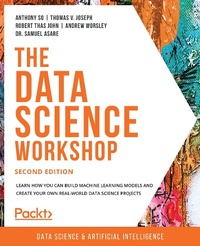
The Data Science Workshop
Learn how you can build machine learning models and create your own real-world data science projects
2nd Edition
Published on 28. August 2020
824 pages
978-1-80056-940-9 (ISBN)
Description

Gain expert guidance on how to successfully develop machine learning models in Python and build your own unique data platforms
Key Features
Gain a full understanding of the model production and deployment process
Build your first machine learning model in just five minutes and get a hands-on machine learning experience
Understand how to deal with common challenges in data science projects
Book DescriptionWhere there's data, there's insight. With so much data being generated, there is immense scope to extract meaningful information that'll boost business productivity and profitability. By learning to convert raw data into game-changing insights, you'll open new career paths and opportunities. The Data Science Workshop begins by introducing different types of projects and showing you how to incorporate machine learning algorithms in them. You'll learn to select a relevant metric and even assess the performance of your model. To tune the hyperparameters of an algorithm and improve its accuracy, you'll get hands-on with approaches such as grid search and random search. Next, you'll learn dimensionality reduction techniques to easily handle many variables at once, before exploring how to use model ensembling techniques and create new features to enhance model performance. In a bid to help you automatically create new features that improve your model, the book demonstrates how to use the automated feature engineering tool. You'll also understand how to use the orchestration and scheduling workflow to deploy machine learning models in batch. By the end of this book, you'll have the skills to start working on data science projects confidently. By the end of this book, you'll have the skills to start working on data science projects confidently.What you will learn
Explore the key differences between supervised learning and unsupervised learning
Manipulate and analyze data using scikit-learn and pandas libraries
Understand key concepts such as regression, classification, and clustering
Discover advanced techniques to improve the accuracy of your model
Understand how to speed up the process of adding new features
Simplify your machine learning workflow for production
Who this book is forThis is one of the most useful data science books for aspiring data analysts, data scientists, database engineers, and business analysts. It is aimed at those who want to kick-start their careers in data science by quickly learning data science techniques without going through all the mathematics behind machine learning algorithms. Basic knowledge of the Python programming language will help you easily grasp the concepts explained in this book.
Key Features
Gain a full understanding of the model production and deployment process
Build your first machine learning model in just five minutes and get a hands-on machine learning experience
Understand how to deal with common challenges in data science projects
Book DescriptionWhere there's data, there's insight. With so much data being generated, there is immense scope to extract meaningful information that'll boost business productivity and profitability. By learning to convert raw data into game-changing insights, you'll open new career paths and opportunities. The Data Science Workshop begins by introducing different types of projects and showing you how to incorporate machine learning algorithms in them. You'll learn to select a relevant metric and even assess the performance of your model. To tune the hyperparameters of an algorithm and improve its accuracy, you'll get hands-on with approaches such as grid search and random search. Next, you'll learn dimensionality reduction techniques to easily handle many variables at once, before exploring how to use model ensembling techniques and create new features to enhance model performance. In a bid to help you automatically create new features that improve your model, the book demonstrates how to use the automated feature engineering tool. You'll also understand how to use the orchestration and scheduling workflow to deploy machine learning models in batch. By the end of this book, you'll have the skills to start working on data science projects confidently. By the end of this book, you'll have the skills to start working on data science projects confidently.What you will learn
Explore the key differences between supervised learning and unsupervised learning
Manipulate and analyze data using scikit-learn and pandas libraries
Understand key concepts such as regression, classification, and clustering
Discover advanced techniques to improve the accuracy of your model
Understand how to speed up the process of adding new features
Simplify your machine learning workflow for production
Who this book is forThis is one of the most useful data science books for aspiring data analysts, data scientists, database engineers, and business analysts. It is aimed at those who want to kick-start their careers in data science by quickly learning data science techniques without going through all the mathematics behind machine learning algorithms. Basic knowledge of the Python programming language will help you easily grasp the concepts explained in this book.
More details
Edition
2nd Revised edition
Language
English
Place of publication
Birmingham
United Kingdom
Target group
Professional and scholarly
US School Grade: College Graduate Student
Edition type
Revised edition
File size
40,90 MB
ISBN-13
978-1-80056-940-9 (9781800569409)
Copyright in bibliographic data and cover images is held by Nielsen Book Services Limited or by the publishers or by their respective licensors: all rights reserved.
Schweitzer Classification
Other editions
Additional editions
Anthony So | Thomas V. Joseph | Robert Thas John
The Data Science Workshop
Learn how you can build machine learning models and create your own real-world data science projects
Book
08/2020
2nd Edition
Packt Publishing
€55.30
Shipment within 3-4 weeks
Previous edition
Anthony So So | Thomas Joseph | Robert Thas John
The Data Science Workshop
A New, Interactive Approach to Learning Data Science
E-Book
01/2020
Packt Publishing
€25.99
Available for download
Persons
Anthony So is a renowned leader in data science. He has extensive experience in solving complex business problems using advanced analytics and AI in different industries including financial services, media, and telecommunications. He is currently the chief data officer of one of the most innovative fintech start-ups. He is also the author of several best-selling books on data science, machine learning, and deep learning. He has won multiple prizes at several hackathon competitions, such as Unearthed, GovHack, and Pepper Money. Anthony holds two master's degrees, one in computer science and the other in data science and innovation. Thomas V. Joseph is a data science practitioner, researcher, trainer, mentor, and writer with more than 19 years of experience. He has extensive experience in solving business problems using machine learning toolsets across multiple industry segments. Robert Thas John is a data engineer with a career that spans two decades. He manages a team of data engineers, analysts, and machine learning engineers - roles that he has held in the past. He leads a number of efforts aimed at increasing the adoption of machine learning on embedded devices through various programs from Google Developers and ARM Ltd, which licenses the chips found in Arduinos and other microcontrollers.
He started his career as a software engineer with work that has spanned various industries. His first experience with embedded systems was in programming payment terminals. Andrew David Worsley is an independent consultant and educator with expertise in the areas of machine learning, statistics, cloud computing, and artificial intelligence. He has practiced data science in several countries across a multitude of industries including retail, financial services, marketing, resources, and healthcare. Dr. Samuel Asare is a professional engineer with enthusiasm for Python programming, research, and writing. He is highly skilled in applying data science methods to the extraction of useful insights from large data sets. He possesses solid skills in project management processes. Samuel has previously held positions, in industry and academia, as a process engineer and a lecturer of materials science and engineering respectively. Presently, he is pursuing his passion for solving industry problems, using data science methods, and writing.
He started his career as a software engineer with work that has spanned various industries. His first experience with embedded systems was in programming payment terminals. Andrew David Worsley is an independent consultant and educator with expertise in the areas of machine learning, statistics, cloud computing, and artificial intelligence. He has practiced data science in several countries across a multitude of industries including retail, financial services, marketing, resources, and healthcare. Dr. Samuel Asare is a professional engineer with enthusiasm for Python programming, research, and writing. He is highly skilled in applying data science methods to the extraction of useful insights from large data sets. He possesses solid skills in project management processes. Samuel has previously held positions, in industry and academia, as a process engineer and a lecturer of materials science and engineering respectively. Presently, he is pursuing his passion for solving industry problems, using data science methods, and writing.
Content
Table of Contents
Introduction to Data Science in Python
Regression
Binary Classification
Multiclass Classification with RandomForest
Performing Your First Cluster Analysis
How to Assess Performance
The Generalization of Machine Learning Models
Hyperparameter Tuning
Interpreting a Machine Learning Model
Analyzing a Dataset
Data Preparation
Feature Engineering
Imbalanced Datasets
Dimensionality Reduction
Ensemble Learning
Introduction to Data Science in Python
Regression
Binary Classification
Multiclass Classification with RandomForest
Performing Your First Cluster Analysis
How to Assess Performance
The Generalization of Machine Learning Models
Hyperparameter Tuning
Interpreting a Machine Learning Model
Analyzing a Dataset
Data Preparation
Feature Engineering
Imbalanced Datasets
Dimensionality Reduction
Ensemble Learning
