

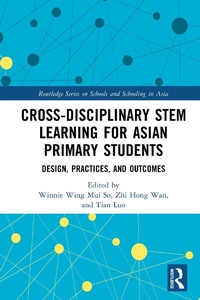
Cross-disciplinary STEM Learning for Asian Primary Students
Design, Practices, and Outcomes
1st Edition
Published on 27. November 2023
276 pages
978-1-000-99229-8 (ISBN)
Description

Given the importance of student learning in the various types and integration of STEM education, this book provides a landscape of cross-disciplinary STEM learning in Asian primary schools, and a systematic overview of design, practices, and outcomes of STEM learning implementation.
Science, Technology, Engineering and Mathematics (STEM) has continued to attract attention worldwide, and there have been calls for the promotion of STEM education in primary schools to nurture students to meet the needs of societies in terms of innovation and technology development. Since STEM is complex in nature and is related to various disciplines, the effort of a single discipline may not be as effective as cross-disciplinary efforts. This edited volume, involving an Asian team of authors, examines how cross-disciplinary STEM learning can be designed for students to achieve viable outcomes, and what opportunities and challenges have been offered to the next generation to equip them with the necessary skills, knowledge, and ways of thinking, as well as attitudes and values for lifelong learning.
A resourceful text for students, researchers, and practitioners interested in the rich development of STEM education and practical methods for a variety of learning approaches from elementary to secondary education has been provided.
Science, Technology, Engineering and Mathematics (STEM) has continued to attract attention worldwide, and there have been calls for the promotion of STEM education in primary schools to nurture students to meet the needs of societies in terms of innovation and technology development. Since STEM is complex in nature and is related to various disciplines, the effort of a single discipline may not be as effective as cross-disciplinary efforts. This edited volume, involving an Asian team of authors, examines how cross-disciplinary STEM learning can be designed for students to achieve viable outcomes, and what opportunities and challenges have been offered to the next generation to equip them with the necessary skills, knowledge, and ways of thinking, as well as attitudes and values for lifelong learning.
A resourceful text for students, researchers, and practitioners interested in the rich development of STEM education and practical methods for a variety of learning approaches from elementary to secondary education has been provided.
More details
Series
Edition
1. Auflage
Language
English
Place of publication
London
United Kingdom
Publishing group
Taylor & Francis Ltd
Target group
College/higher education
Professional and scholarly
Illustrations
47 Tables, black and white; 21 Line drawings, black and white; 26 Halftones, black and white; 47 Illustrations, black and white
ISBN-13
978-1-000-99229-8 (9781000992298)
Copyright in bibliographic data and cover images is held by Nielsen Book Services Limited or by the publishers or by their respective licensors: all rights reserved.
Schweitzer Classification
Other editions
Additional editions
Winnie Wing Mui So | Zhi Hong Wan | Tian Luo
Cross-disciplinary STEM Learning for Asian Primary Students
Design, Practices, and Outcomes
Book
04/2025
1st Edition
Routledge
€65.50
Shipment within 10-20 days
Winnie Wing Mui So | Zhi Hong Wan | Tian Luo
Cross-disciplinary STEM Learning for Asian Primary Students
Design, Practices, and Outcomes
Book
11/2023
1st Edition
Routledge
€206.60
Shipment within 10-20 days
Persons
Winnie Wing Mui So is a Professor in the Department of Science & Environmental Studies at the Education University of Hong Kong.
Zhi Hong Wan is an Associate Professor in the Department of Curriculum and Instruction at the Education University of Hong Kong.
Tian Luo is an Assistant Professor in the College of Teacher Education at Capital Normal University, China.
Zhi Hong Wan is an Associate Professor in the Department of Curriculum and Instruction at the Education University of Hong Kong.
Tian Luo is an Assistant Professor in the College of Teacher Education at Capital Normal University, China.
Content
1. Preface - Cross-disciplinary STEM Learning for Asian Primary Students: Achievements and Challenges
Part I: A Theoretical Perspective on STEM Education in Asian primary schools
2. Policies and Practices of Cross-disciplinary School STEM Education in Asia: An Overview
3. Scaffolds for Educators for Designing STEM Activities: A Review of the Frameworks in STEM Education in Asia
Part II: Inquiry-based STEM Learning
4. The 5E Pedagogical Approach in Integrated STEM Learning
5. Building Miniature Stone Walls in Museum Settings: An Effective Cross-disciplinary STEM Activity in an Informal Learning Environment
Part III: Design-oriented STEM learning
6. Design-Based STEM-BCG Learning for Sustainable Development: Design, Practices, and Outcomes
7. Integrating Epistemic Practices of Engineering into Education
8. Environment-centred STEM Learning for Primary Students: School-STEM Professional Collaboration
Part IV: Technology-enhanced STEM learning
9. Pedagogical Design of STEM Activities for Developing Problem-Solving Skills and Digital Creativity of Primary Students in the Internet of Things Era: Six-Step STEM Pedagogy
10. The Innovative Use of Smartphones for STEM Practical Activities: A Pilot Implementation for a Malaysian Primary School
Part V: Practices in cross-disciplinary STEM learning
11. STEM Education for Primary Schools: A Topic Modelling Study of STEM Applied Learning Programme Websites in Singapore
12. The Impact of Two Teaching Behaviours on Primary School Students' STEM Learning Performance and Flow Experience
13. Perceptions of STEM Education of Teachers from Taiwan: Identifying Factors Influencing Commitment to STEM Teaching
14. Taking the Lead in STEM: A Case Study of a Singapore Primary Science Teacher's Attempt at STEM
Part I: A Theoretical Perspective on STEM Education in Asian primary schools
2. Policies and Practices of Cross-disciplinary School STEM Education in Asia: An Overview
3. Scaffolds for Educators for Designing STEM Activities: A Review of the Frameworks in STEM Education in Asia
Part II: Inquiry-based STEM Learning
4. The 5E Pedagogical Approach in Integrated STEM Learning
5. Building Miniature Stone Walls in Museum Settings: An Effective Cross-disciplinary STEM Activity in an Informal Learning Environment
Part III: Design-oriented STEM learning
6. Design-Based STEM-BCG Learning for Sustainable Development: Design, Practices, and Outcomes
7. Integrating Epistemic Practices of Engineering into Education
8. Environment-centred STEM Learning for Primary Students: School-STEM Professional Collaboration
Part IV: Technology-enhanced STEM learning
9. Pedagogical Design of STEM Activities for Developing Problem-Solving Skills and Digital Creativity of Primary Students in the Internet of Things Era: Six-Step STEM Pedagogy
10. The Innovative Use of Smartphones for STEM Practical Activities: A Pilot Implementation for a Malaysian Primary School
Part V: Practices in cross-disciplinary STEM learning
11. STEM Education for Primary Schools: A Topic Modelling Study of STEM Applied Learning Programme Websites in Singapore
12. The Impact of Two Teaching Behaviours on Primary School Students' STEM Learning Performance and Flow Experience
13. Perceptions of STEM Education of Teachers from Taiwan: Identifying Factors Influencing Commitment to STEM Teaching
14. Taking the Lead in STEM: A Case Study of a Singapore Primary Science Teacher's Attempt at STEM
