

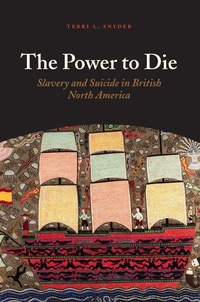
The Power to Die
Slavery and Suicide in British North America
Published on 22. December 2022
255 pages
978-0-226-28073-8 (ISBN)
Description

"[A] well-written exploration of the cultural and legal meanings of slave suicide in British North America... far-reaching, compelling, and relevant." -
Choice
The history of slavery in early America is a history of suicide. On ships crossing the Atlantic, enslaved men and women refused to eat or leaped into the ocean. They strangled or hanged themselves. They tore open their own throats. In America, they jumped into rivers or out of windows, or even ran into burning buildings. Faced with the reality of enslavement, countless Africans chose death instead.
In The Power to Die, Terri L. Snyder excavates the history of slave suicide, returning it to its central place in early American history. How did people-traders, plantation owners, and, most importantly, enslaved men and women themselves-view and understand these deaths, and how did they affect understandings of the institution of slavery then and now?
Snyder draws on an array of sources, including ships' logs, surgeons' journals, judicial and legislative records, newspaper accounts, abolitionist propaganda and slave narratives to detail the ways in which suicide exposed the contradictions of slavery, serving as a powerful indictment that resonated throughout the Anglo-Atlantic world and continues to speak to historians today.
The history of slavery in early America is a history of suicide. On ships crossing the Atlantic, enslaved men and women refused to eat or leaped into the ocean. They strangled or hanged themselves. They tore open their own throats. In America, they jumped into rivers or out of windows, or even ran into burning buildings. Faced with the reality of enslavement, countless Africans chose death instead.
In The Power to Die, Terri L. Snyder excavates the history of slave suicide, returning it to its central place in early American history. How did people-traders, plantation owners, and, most importantly, enslaved men and women themselves-view and understand these deaths, and how did they affect understandings of the institution of slavery then and now?
Snyder draws on an array of sources, including ships' logs, surgeons' journals, judicial and legislative records, newspaper accounts, abolitionist propaganda and slave narratives to detail the ways in which suicide exposed the contradictions of slavery, serving as a powerful indictment that resonated throughout the Anglo-Atlantic world and continues to speak to historians today.
More details
Other editions
Additional editions
Book
08/2015
University of Chicago Press
€48.36
Article not available at the moment
Person
Terri L. Snyder is professor of American studies at California State University, Fullerton, and the author of
Brabbling Women: Disorderly Speech and the Law in Early Virginia. She lives in Pasadena.
Content
- Intro
- Contents
- List of Figures
- Acknowledgments
- Prologue - Anna's Leap
- Introduction - The Problem of Suicide in North American Slavery
- One - Suicide and the Transatlantic Slave Trade
- Two - Suicide and Seasoning in British American Plantations
- Three - Slave Suicide in the Context of Colonial North America
- Four - The Power to Die or the Power of the State? The Legalities of Suicide in Slavery
- Five - The Paradoxes of Suicide and Slavery in Print
- Six - The Meaning of Suicide in Antislavery Politics
- Epilogue - Suicide, Slavery, and Memory in American Culture
- Studying Slave Suicide: An Essay on Sources
- Abbreviations
- Notes
- Select Bibliography of Primary Sources
- Index
