

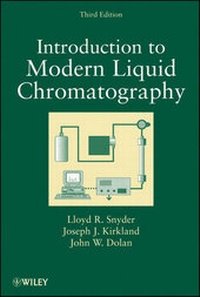
Introduction to Modern Liquid Chromatography
Description

Reviews / Votes
"In summary, I would strongly recommend this book for anyoneworking with LC and LC/MS. It is a finely crafted introduction thatadequately covers nearly every aspect of the science. The emphasison basic principles and practical aspects ensures that it will be auseful reference for many years to come." (J Am Soc Mass Spectrom,2011) "This third edition is highly cross-referenced, so as to allowthe reader to follow up on topics of special interest, or toclarify questions that may arise during reading. The third editionof Introduction to Modern Liquid Chromatography will continue to bethe HPLC reference book for thousands of readers, eitherexperienced workers who may wish to explore topics of his/herchoice, or find an answer to specific problems, or beginners whowould like to understand and know the possibilities offered bythe technique." (Chemistry Journals, 11 April 2011) "This classic text on liquid chromatography has been thoroughlyupdated through the addition of information on moderninstrumentation, columns, and troubleshooting. It is a valuableresource for practicing chromatographers at all levels.." (AnalBioanal Chem, 2011) "In summary, I would strongly recommend this book for anyoneworking with LC and LC/MS. It is a finely crafted introduction thatadequately covers nearly every aspect of the science. The emphasison basic principles and practical aspects ensures that it will be auseful reference for any years to come." (American Society for MassSpectrometry, 21 Januay 2011) "The text is illustrated with many figures and tablesoriginating from authors' own work or taken from the literature . .. both groups of readers will find in this book plenty ofinformation and inspiration." (Journal of Separation Science, 1June 2010) "Following their highly successful second edition (1979), whichappeared more than 30 years ago, Snyder (LC Resources) and Kirkland(Advanced Materials Technology) have teamed with Dolan (LCResources) and additional collaborators to provide an excellentupdate of their earlier work." (CHOICE, July 2010) "It is difficult in these times to ever call a scientific book a"bargain", but this truly is. The wealth of information containedin these almost 1000 pages is invaluable. The book iscomprehensive, eminently readable and approachable, and highlyuseful for both the skilled chromatographer and those new to thetechnique. Everyone using a liquid chromatographic instrument wouldbenefit from owning a copy." (JACS, 2010) "It's current, clearly-indexed, well-referenced, andcomprehensive. The inclusion of John Dolan as author hassignificantly expanded the sections on troubleshooting, andadditional expert contributors have enhanced the coverage of thespecialist chapters." - Bruce Hamilton posted on the ChromatographyForumMore details
Other editions
Additional editions

Persons
Content
Preface xxxi
Glossary of Symbols and Abbreviations xxxv
1 Introduction 1
1.1 Background Information 2
1.2 A Short History of HPLC 6
1.3 Some Alternatives to HPLC 8
1.4 Other Sources of HPLC Information 12
References 15
2 Basic Concepts and the Control of Separation 19
2.1 Introduction 20
2.2 The Chromatographic Process 20
2.3 Retention 24
2.4 Peak Width and the Column Plate Number N 35
2.5 Resolution and Method Development 54
2.6 Sample Size Effects 69
2.7 Related Topics 74
References 83
3 Equipment 87
3.1 Introduction 88
3.2 Reservoirs and Solvent Filtration 89
3.3 Mobile-Phase Degassing 92
3.4 Tubing and Fittings 96
3.5 Pumping Systems 104
3.6 Autosamplers 113
3.7 Column Ovens 125
3.8 Data Systems 127
3.9 Extra-Column Effects 131
3.10 Maintenance 131
References 144
4 Detection 147
4.1 Introduction 148
4.2 Detector Characteristics 149
4.3 Introduction to Individual Detectors 160
4.4 UV-Visible Detectors 160
4.5 Fluorescence Detectors 167
4.6 Electrochemical (Amperometric) Detectors 170
4.7 Radioactivity Detectors 172
4.8 Conductivity Detectors 174
4.9 Chemiluminescent Nitrogen Detector 174
4.10 Chiral Detectors 175
4.11 Refractive Index Detectors 177
4.12 Light-Scattering Detectors 180
4.13 Corona-Discharge Detector (CAD) 184
4.14 Mass Spectral Detectors (MS) 185
4.15 Other Hyphenated Detectors 191
4.16 Sample Derivatization and Reaction Detectors 194
References 196
5 The Column 199
5.1 Introduction 200
5.2 Column Supports 200
5.3 Stationary Phases 217
5.4 Column Selectivity 227
5.5 Column Hardware 238
5.6 Column-Packing Methods 240
5.7 Column Specifications 244
5.8 Column Handling 246
References 250
6 Reversed-phase Chromatography for Neutral Sam- Ples 253
6.1 Introduction 254
6.2 Retention 256
6.3 Selectivity 263
6.4 Method Development and Strategies for Optimizing Selectivity 284
6.5 Nonaqueous Reversed-Phase Chromatography (narp) 295
6.6 Special Problems 297
References 298
7 Ionic Samples: Reversed-phase Ion-pair and Ion- Exchange Chromatography 303
7.1 Introduction 304
7.2 Acid-Base Equilibria and Reversed-Phase Retention 304
7.3 Separation of Ionic Samples by Reversed-Phase Chromatography (RPC) 319
7.4 Ion-Pair Chromatography (IPC) 331
7.5 Ion-Exchange Chromatography (IEC) 349
References 357
8 Normal-phase Chromatography 361
8.1 Introduction 362
8.2 Retention 363
8.3 Selectivity 376
8.4 Method-Development Summary 385
8.5 Problems in the Use of NPC 392
8.6 Hydrophilic Interaction Chromatography (HILIC) 395
References 401
9 Gradient Elution 403
9.1 Introduction 404
9.2 Experimental Conditions and Their Effects on Separation 412
9.3 Method Development 434
9.4 Large-Molecule Separations 464
9.5 Other Separation Modes 465
9.6 Problems 470
References 471
10 Computer-assisted Method Development 475
10.1 Introduction 475
10.2 Computer-Simulation Software 481
10.3 Other Method-Development Software 491
10.4 Computer Simulation and Method Development 492
References 497
11 Qualitative and Quantitative Analysis 499
11.1 Introduction 499
11.2 Signal Measurement 500
11.3 Qualitative Analysis 516
11.4 Quantitative Analysis 520
11.5 Summary 529
References 529
12 Method Validation 531 with Michael Swartz
12.1 Introduction 532
12.2 Terms and Definitions 534
12.3 System Suitability 542
12.4 Documentation 543
12.5 Validation for Different Pharmaceutical-Method Types 546
12.6 Bioanalytical Methods 548
12.7 Analytical Method Transfer (AMT) 554
12.8 Method Adjustment or Method Modification 561
12.9 Quality Control and Quality Assurance 564
12.10 Summary 565
References 566
13 Biochemical and Synthetic Polymer Separations 569 with Timothy Wehr, Carl Scandella, and Peter Schoenmakers
13.1 Biomacromolecules 570
13.2 Molecular Structure and Conformation 571
13.3 Special Considerations for Biomolecule HPLC 579
13.4 Separation of Peptides and Proteins 584
13.5 Separation of Nucleic Acids 618
13.6 Separation of Carbohydrates 625
13.7 Separation of Viruses 630
13.8 Size-Exclusion Chromatography (SEC) 631
13.9 Large-Scale Purification of Large Biomolecules 641
13.10 Synthetic Polymers 648
References 658
14 Enantiomer Separations 665 with Michael Lämmerhofer, Norbert M. Maier and Wolfgang Lindner
14.1 Introduction 666
14.2 Background and Definitions 666
14.3 Indirect Method 670
14.4 Direct Method 675
14.5 Peak Dispersion and Tailing 681
14.6 Chiral Stationary Phases and Their Characteristics 681
14.7 Thermodynamic Considerations 715
References 718
15 Preparative Separations 725 with Geoff Cox
15.1 Introduction 726
15.2 Equipment for Prep-LC Separation 730
15.3 Isocratic Elution 736
15.4 Severely Overloaded Separation 748
15.5 Gradient Elution 751
15.6 Production-Scale Separation 754
References 755
16 Sample Preparation 757 with Ronald Majors 757
16.1 Introduction 758
16.2 Types of Samples 759
16.3 Preliminary Processing of Solid and Semi-Solid Samples 760
16.4 Sample Preparation for Liquid Samples 764
16.5 Liquid-Liquid Extraction 764
16.6 Solid-Phase Extraction (SPE) 771
16.7 Membrane Techniques in Sample Preparation 790
16.8 Sample Preparation Methods for Solid Samples 791
16.9 Column-Switching 796
16.10 Sample Preparation for Biochromatography 797
16.11 Sample Preparation for LC-MS 800
16.12 Derivatization in HPLC 802
References 805
17 Troubleshooting 809
Quick Fix 809
17.1 Introduction 810
17.2 Prevention of Problems 811
17.3 Problem-Isolation Strategies 819
17.4 Common Symptoms of HPLC Problems 821
17.5 Troubleshooting Tables 865
References 876
Appendix I. Properties of HPLC Solvents 879
I.1 Solvent-Detector Compatibility 879
I. 2 Solvent Polarity and Selectivity 882
I. 3 Solvent Safety 885
References 886
Appendix II. Preparing Buffered Mobile Phases 887
II.1 Sequence of Operations 887
II.2 Recipes for Some Commonly Used Buffers 888
Reference 890
Index 891
