

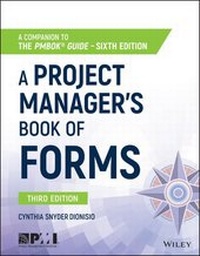
A Project Manager's Book of Forms
Description

More details
Other editions
Additional editions
Previous edition
Person
Content
2
Planning Forms
2.0 PLANNING PROCESS GROUP
The purpose of the Planning Process Group is to elaborate the information from the project charter to create a comprehensive set of plans that will enable the project team to deliver the project objectives. There are 24 processes in the Planning Process Group.
- Develop project management plan
- Plan scope management
- Collect requirements
- Define scope
- Create work breakdown structure (WBS)
- Plan schedule management
- Define activities
- Sequence activities
- Estimate activity durations
- Develop schedule
- Plan cost management
- Estimate costs
- Determine budget
- Plan quality management
- Plan resource management
- Estimate activity resources
- Plan communications management
- Plan risk management
- Identify risks
- Perform qualitative analysis
- Perform quantitative analysis
- Plan risk responses
- Plan procurement management
- Plan stakeholder management
The intent of the Planning Process Group is to at least:
- Elaborate and clarify the project scope
- Develop a realistic schedule
- Develop a realistic budget
- Identify project and product quality processes
- Identify and plan for the needed project resources
- Determine and plan for the communication needs
- Establish risk management practices
- Identify the procurement needs of the project
- Determine how to effectively engage stakeholders
- Combine all the planning information into a project management plan and a set of project documents that are cohesive and integrated
Planning is not a one-time event. It occurs throughout the project. Initial plans will become more detailed as additional information about the project becomes available. Additionally, as changes are approved for the project or product, many of the planning processes will need to be revisited and the documents revised and updated.
Many of the forms in this section provide information needed for other forms. The form description indicates from where information is received and to where it goes.
The forms used to document planning information include:
- Project management plan
- Change management plan
- Project roadmap
- Scope management plan
- Requirements management plan
- Requirements documentation
- Requirements traceability matrix
- Project scope statement
- Assumption log
- Work breakdown structure (WBS)
- Work breakdown structure dictionary
- Schedule management plan
- Activity list
- Activity attributes
- Milestone list
- Network diagram
- Duration estimates
- Duration estimating worksheet
- Project schedule
- Cost management plan
- Cost estimates
- Cost estimating worksheet
- Bottom-up cost estimating worksheet
- Cost baseline
- Quality management plan
- Quality metrics
- Responsibility assignment matrix
- Roles and responsibilities
- Resource management plan
- Team charter
- Resource requirements
- Resource breakdown structure
- Communications management plan
- Risk management plan
- Risk register
- Risk report
- Probability and impact assessment
- Probability and impact matrix
- Risk data sheet
- Procurement management plan
- Procurement strategy
- Source selection criteria
- Procurement strategy
- Stakeholder engagement plan
Some forms in this section are not explicitly described in the PMBOK® Guide - Sixth Edition, but they are useful in planning and managing a project. Use the forms here as a starting point for your project. You should tailor the forms to meet the needs of your project by editing, combining, or revising them.
2.1 PROJECT MANAGEMENT PLAN
The project management plan describes how the team will execute, monitor, control, and close the project. While it has some unique information, it is primarily comprised of all the subsidiary management plans and the baselines. The project management plan combines all this information into a cohesive and integrated approach to managing the project. Typical information includes:
- Selected project life cycle
- Development approach for key deliverables
- Variance thresholds
- Baseline management
- Timing and types of reviews
The project management plan contains plans for managing all the Knowledge Areas as well as specific aspects of the project that require special focus. These take the form of subsidiary management plans and can include:
- Change management plan
- Scope management plan
- Schedule management plan
- Requirements management plan
- Cost management plan
- Quality management plan
- Resource management plan
- Communications management plan
- Risk management plan
- Procurement management plan
- Stakeholder engagement plan
The project management plan also contains baselines. Common baselines include:
- Scope baseline
- Schedule baseline
- Cost baseline
- Performance measurement baseline (an integrated baseline that includes scope, schedule, and cost)
In addition, any other relevant, project-specific information that will be used to manage the project is recorded in the project management plan.
The project management plan can receive information from all the subsidiary management plans and baselines. Because it is the foundational document for managing the project it also provides information to all subsidiary plans. In addition, the project management plan provides information to all other integration processes.
The project management plan is an output from the process 4.2 Develop Project Management Plan in the PMBOK® Guide - Sixth Edition. This document is developed as the initial project planning is conducted, and then it is not usually changed unless there is a significant change in the charter, environment, or scope of the project.
Tailoring Tips
Consider the following tips to help tailor the project management plan to meet your needs:
- For large and complex projects, each subsidiary management plan will likely be a separate standalone plan. In this case you may present your project management plan as a shell with just information on the life cycle, development approach, and key reviews, and then provide a link or reference to the more detailed subsidiary management plans.
- For smaller projects, a project roadmap that summarizes the project phases, major deliverables, milestones, and key reviews may be sufficient.
- You will likely have additional subsidiary management plans that are relevant to the nature of your project, such as a technology management plan, a logistics management plan, a safety management plan, and so forth.
Alignment
The project management plan should be aligned and consistent with the following documents:
- All subsidiary management plans
- Project roadmap
- Milestone list
Description
You can use the element descriptions in Table 2.1 to assist you in developing a project management plan.
TABLE 2.1 Elements of a Project Management Plan
Document Element Description Project life cycle Describe the life cycle that will be used to accomplish the project. This may include the following:- Name of each phase
- Key activities for the phase
- Key deliverables for the phase
- Entry criteria for the phase
- Exit criteria for the phase
- Key reviews for the phase
