

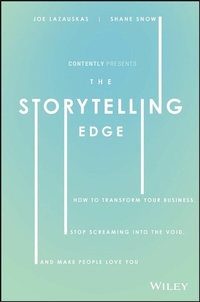
The Storytelling Edge
Description

More details
Other editions
Additional editions
Content
About the Authors xv
Introduction xvii
Stories Matter xviii
Businesses Need to Tell Good Stories xix
Workers and Leaders Need to Tell Good Stories xx
Who Are We? xx
Why This Book? xxii
1 The Power of Story 1
Jacques and the Beggar 4
And Now for Shane's Favorite Ryan Gosling Story 5
Our Brains Are Built for Story 8
Stories Help Us Remember 10
Stories Generate Empathy--at the Chemical Level 12
Stories Bring Us Together 14
With Great Power . . . 19
2 The Elements of Great Storytelling 23
Element 1: Relatability 25
Element 2: Novelty 29
What Movie Popularity Data Tell Us about Novelty 31
Element 3: Tension 35
Element 4: Fluency 38
3 Honing Your Storytelling Chops 41
Universal Storytelling Frameworks 43
The Ben Franklin Method for Improving Story Skills 48
The Sludge Report 52
4 Transforming Business with Storytelling 57
How Stories Make Products and Services Better 62
Stories Make Advertising Better 68
Stories Make Your Sales Conversions Better 71
Stories Make Your Hiring Process Better 73
Stories Build Your Brand 74
How We Built the Most Influential Content Strategy Blog on Earth 79
#1: Committing to a Mission 79
#2: Getting Smart about Audience 81
#3: Establishing a Strategic Methodology 83
5 The Killer Formula for Building an Audience 85
The CCO Pattern: Create, Connect, Optimize 87
Connect: The Storytelling Bull's-Eye 94
Create: The Story Funnel-Matrix 100
Optimize: Cranking the Efficiency 104
6 The Brand Newsroom 113
The Talent Race 116
The Virtual Newsroom 118
What Type of Newsroom Do You Prefer? 119
7 The Future of Brand Storytelling 121
#1: Breakthrough Quality Storytelling 125
#2: Rigorously Strategic 128
#3: Tech-Enabled and Data-Optimized 132
The Content Decision Engine 135
The Content Operating Wheel 136
Strategy 138
Plan 142
Create 145
Activate 148
Optimize 150
8 The Storytelling Habit 157
Selling Storytelling Inside Your Organization 160
A Culture of Storytelling 164
May the Story Force Be with You 165
Notes 167
Index 169
1
The Power of Story
Pretend that the world decided to elect a queen. The candidates have been whittled down to two well-known British women: Queen Elizabeth and J. K. Rowling, author of the Harry Potter series.
You have been asked to vote in this election based on who you trust more. Who would you vote for, and why?
A couple of years ago we were curious about this, so we took the geeky route and asked 3,000 Americans this question.
The results of our election might surprise you.
Rowling, the children's book author, beat Elizabeth, the monarch, by what pollsters call a landslide.
But why?
Why would we be more likely to trust the author over the queen? Why would we choose the storyteller over the woman with a lifetime of leadership experience? And what does this have to do with the business world?
In this book, we're going to answer those questions. First, we'll dig into the science of story and what stories do to our brains. Then we'll get into how we can become powerful storytellers ourselves and how to use storytelling as a strategy to persuade and present more effectively at work, grow our businesses, and make a difference in the world.
And, as you might have guessed, we're going to start with a couple of stories.
Jacques and the Beggar
Many years ago, a French poet named Jacques Prévert was walking down the street. He passed a beggar asking for money. For whatever reason, Jacques decided to stop and talk to the man.
"How's it going?" Jacques asked.
As the beggar turned, Jacques noticed that he was blind. In fact, he had a sign that said so.
The beggar replied, "It's not going very well. People walk by and they don't leave any money in my hat. Would you give me some money?"
"I'm a poor writer," Jacques said. "I have no money. But perhaps I could rewrite your sign for you?"
"By all means," said the beggar. He had nothing to lose.
So Jacques took the sign, flipped it over, and wrote a new message. And then he went about his day.
A few days later, Jacques was walking along the same path, came across the same beggar, and decided to ask the same question.
"How's it going?"
This time the beggar's tune had changed.
"People have been so generous lately," he said. "My hat fills up three times a day. Thank you, thank you for what you wrote on my sign."
Here's what Jacques had written:
"Spring is coming, but I won't see it."
With one sentence, Jacques transformed a statement into a story. In a single line, he changed a man's life.
Now-keep that story in the back of your mind while we tell you one of Shane's favorite stories in the world:
And Now for Shane's Favorite Ryan Gosling Story
Ryan Gosling is an actor. He's pretty.
For a long time, Shane didn't care about him at all.
Sure, he seemed like a good actor. But Shane never saw The Notebook, which the whole world adored. He knew there was a bizarre amount of Internet meme activity around Gosling. But, you know, whatever. He was okay.
Then one day, Shane was sitting in the audience of a business conference. Some guy was giving a terribly dull presentation-one of those talks where there are about 250 words of tiny text crammed onto every single slide. Shane ran out of emails to answer, so he began browsing Wikipedia. We don't quite know how, but at some point, he ended up on the entry for Ryan Gosling. And for whatever reason, he decided to go ahead and read it.
Don't judge. As we said, the presentation was really boring.
Here's the gist of Ryan's story, according to the editors at Wikipedia:
Gosling had a bit of a sad childhood. He grew up in Canada. (That was not the sad part!) His dad was a traveling salesman, so his family moved a lot. When he was young, his parents split up. He ended up living with his mom, who worked full time. All the moving and family trouble affected him. He had a hard time making friends. He didn't learn to read until far later than most kids-nearly into his teens. He was diagnosed with ADHD.
Watching television became Gosling's favorite hobby. He loved movies and accents. He loved The Mickey Mouse Club. He loved Marlon Brando.
But he was bullied at school. Moving around and watching a lot of TV probably didn't help him make friends.
Things came to a head one day at school when he brought knives to primary school and threw them at the kids who bullied him. He'd decided to take matters into his own hands like his action film hero Rambo.
Around age 12, Gosling begged his mom to let him go to an audition for The Mickey Mouse Club in Montreal. He was a cute, talented kid, and he got the part.
Now here's the crazy part of the story: Because his mother couldn't move to Orlando with him, Gosling got adopted by none other than Justin Timberlake's mom. (Or rather, she became his legal guardian.)
He learned how to perform on The Mickey Mouse Club. He learned to read well. He learned to focus. He grew up.
.and he became Ryan Gosling.
And then something strange happened.
After reading this Wikipedia entry, Shane suddenly wanted to watch some Ryan Gosling movies. So he went and watched The Notebook. (Turns out it's fantastic!) The next time a Gosling movie was in the theater, Shane watched it. He started telling people about how cool Ryan Gosling was. How human he was. It wasn't long before people started introducing him as, "This is Shane-he founded Contently, and he's a HUGE Ryan Gosling fan."
And it was true! Ten minutes on Wikipedia had turned him from apathetic to advocate. He's on Team Gosling, and he's on it simply because he learned his story.
As weird as it sounds, Shane feels like he has a relationship with Ryan.
We learn a couple of things from these two stories. First: Stories are powerful. Both Jacques's experience with the blind man and Shane's with Ryan Gosling show this. They illustrate what great stories fundamentally do: They build relationships, and they make people care.
People didn't care much about the blind man when he asked for money. But when he helped people understand what it was like to be in his shoes-when he shared his story-they were moved to help him.
Shane didn't care about Ryan Gosling. Now he refers to him by his first name. If they ever meet, he's going to give Ryan a hug. But we bet Ryan's used to that sort of thing by now.
This power of stories to change our minds, to build relationships and make people care, is more than just neat. It's scientific.
A few years ago, a group of researchers from University of Pennsylvania gave $5 to random people and asked them to read different letters from charities asking for money. When the plea for donations relied on statistics and talked about widespread problems, people donated less. When the request involved a story of an individual in pain, people donated more.
Versions of this experiment have been repeated dozens of times using television commercials, brochures, and in-person persuasion. The result is always the same. A plea for help will get some donations. But a story always gets more.
That's because.
Our Brains Are Built for Story
In the classic tale In the Heart of the Sea: The Tragedy of the Whaleship Essex by Nathaniel Philbrick, a group of sailors were "zagging" off the coast of South America in 1821 when they came across something ghastly. They were in a whaling ship named the Dauphin, under the command of a captain named Zimri Coffin. One day on the horizon a small boat popped into view in the middle of the ocean. Here's an account of what the Dauphin crew saw:
Under Coffin's watchful eye, the helmsman brought the ship as close as possible to the derelict craft. Even though their momentum quickly swept them past it, the brief seconds during which the ship loomed over the open boat presented a sight that would stay with the crew the rest of their lives.
First they saw bone-human bones-littering the thwarts and floorboards, as if the whaleboat were the seagoing lair of a ferocious man-eating beast.
Then they saw the two men.
They were curled up in opposite ends of the boat, their skin covered with sores, their eyes bulging from the hollows of their skulls, their beards caked with salt and blood. They were sucking the marrow from the bones of their dead shipmates.1
Quick! Think about where you were when you just read that. Do you recall how the seat you were sitting in felt as you pictured the salt-caked beards of the cannibal shipmates? Did someone in the room with you happen to cough while you read this? Do you recall any background noises outside? Any trucks or sirens?
By the time you finished reading that passage, chances are your brain had pulled you into the story. Your imagination filled in the scene, and your present circumstances faded into the background of your consciousness. This is what Jonathan Gottschall, who shares this anecdote in his...
