

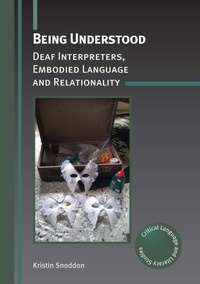
Being Understood
Deaf Interpreters, Embodied Language and Relationality
Published on 11. November 2025
172 pages
978-1-78892-119-0 (ISBN)
Description

Experiences of not understanding and not being understood during interactions are a pervasive aspect of life for many deaf people, so ensuring understanding becomes a moral imperative in deaf worlds and part of deaf ontologies. Through a series of linked applied linguistics studies regarding the primacy of text, signing songs, the mediation practices of deaf interpreters and Caribbean deaf epistemologies of language and understanding, this book outlines theoretical and methodological approaches to analyzing deaf people's experiences of understanding and being understood. These are grounded in a Continental philosophy of language and qualitative methods including autoethnography, interpretative interviews and phenomenology. The book explores issues surrounding linguistic and semiotic repertoires; access and affordances; orientation, sociality and power; and mediated communication. Ultimately, it reveals both the workings of epistemic injustice related to deaf signers and ways of understanding and being understood that extend beyond named languages.
Reviews / Votes
What does it mean to be understood as a deaf person? Kristin Snoddon asks from the borderlands of lived experience: deaf, deafblind and hard of hearing people as writers, song signers, interpreters, dancers, musicians. By illuminating deaf worlds of (not) understanding and (not) being understood, layers of alienation and shame are reshaped into sites of linguistic flourishing. * Gabrielle Hodge, University of Edinburgh, UK * This powerfully written book offers intimate portraits and generative analyses of less-attended-to deaf practices such as writing, music, and translation in Canada and Trinidad and Tobago. Grounded in disabled feminist methodologies, Snoddon opens up critical and consequential conversations between linguistics, deaf studies, and philosophy. * E. Mara Green, Barnard College, Columbia University, USA * A masterfully rich meditation on the diversity of the linguistic human experience and expression, which skillfully explores the ethics, politics and policy of language and linguistic alterity in a grounded and deeply humane manner. By closely interrogating the link between knowledge work and self-knowledge, this important book makes a unique and distinct contribution to a trans- and interdisciplinary understanding of the social philosophy of language, and its fundamental challenges, ambiguities and hopes. * Yael Peled, Max Planck Institute for the Study of Religious and Ethnic Diversity, Germany *More details
Series
Language
English
Place of publication
Bristol
United Kingdom
Target group
College/higher education
Product notice
Reflowable
File size
2,71 MB
ISBN-13
978-1-78892-119-0 (9781788921190)
Copyright in bibliographic data and cover images is held by Nielsen Book Services Limited or by the publishers or by their respective licensors: all rights reserved.
Schweitzer Classification
Other editions
Additional editions
Book
11/2025
Multilingual Matters
€131.80
Shipment within 3-4 weeks
Person
Kristin Snoddon is a Professor in the School of Early Childhood Studies, Toronto Metropolitan University, Canada. She is co-editor of Critical Perspectives on Plurilingualism in Deaf Education (with Joanne C. Weber, Multilingual Matters, 2021) and Sign Language Ideologies in Practice (with Annelies Kusters, Mara Green and Erin Moriarty, Mouton De Gruyter, 2020).
Content
Acknowledgments
Foreword
Series Editors' Preface
Introduction: Understanding, Difference and Relationality in Methodology
Part 1: Linguistic Flourishing
Chapter 1. Being a Deaf Scholar: Writing as Being
Chapter 2. Signing Songs and the Openings of Semiotic Repertoires
Part 2: Deaf Interpreters and Understanding
Chapter 3. Sign Language Ideologies and the Ethics of Relationality
Chapter 4. Brokering Understanding: Deaf Interpreters' Role and Practice
Part 3: Caribbean Deaf Epistemologies of Language and Understanding
Chapter 5. A Phenomenology of Deaf People's Experiences of Understanding and Music at Trinidad Carnival
Chapter 6. Toward a Caribbean Deaf Queer Phenomenology
Conclusion
References
Index
Foreword
Series Editors' Preface
Introduction: Understanding, Difference and Relationality in Methodology
Part 1: Linguistic Flourishing
Chapter 1. Being a Deaf Scholar: Writing as Being
Chapter 2. Signing Songs and the Openings of Semiotic Repertoires
Part 2: Deaf Interpreters and Understanding
Chapter 3. Sign Language Ideologies and the Ethics of Relationality
Chapter 4. Brokering Understanding: Deaf Interpreters' Role and Practice
Part 3: Caribbean Deaf Epistemologies of Language and Understanding
Chapter 5. A Phenomenology of Deaf People's Experiences of Understanding and Music at Trinidad Carnival
Chapter 6. Toward a Caribbean Deaf Queer Phenomenology
Conclusion
References
Index
