

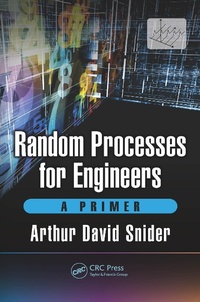
Random Processes for Engineers
A Primer
1st Edition
Published on 27. January 2017
207 pages
978-1-4987-9904-1 (ISBN)
Description

This book offers an intuitive approach to random processes and educates the reader on how to interpret and predict their behavior. Premised on the idea that new techniques are best introduced by specific, low-dimensional examples, the mathematical exposition is easier to comprehend and more enjoyable, and it motivates the subsequent generalizations. It distinguishes between the science of extracting statistical information from raw data--e.g., a time series about which nothing is known a priori--and that of analyzing specific statistical models, such as Bernoulli trials, Poisson queues, ARMA, and Markov processes. The former motivates the concepts of statistical spectral analysis (such as the Wiener-Khintchine theory), and the latter applies and interprets them in specific physical contexts. The formidable Kalman filter is introduced in a simple scalar context, where its basic strategy is transparent, and gradually extended to the full-blown iterative matrix form.
Reviews / Votes
"This is great and timely book! It takes difficult concepts and distills them to the reader in a way that is simple and easy to understand. It connects students with hard to understand theories and concepts though the use of good examples and graphical illustrations."- George Edwards, University of Denver, USA
"This book offers an intuitive approach to random processes and discusses how to interpret and predict their behavior. Based on the idea that new techniques are best introduced by specific, low-dimensional examples, the mathematical exposition is made easier to comprehend and serves to motivate the subsequent generalizations. It distinguishes between the science of extracting statistical information from raw data such as a time series about which nothing is known a priori and that of analyzing specific statistical models, such as Bernoulli trials, Poisson queues, ARMA, and Markov processes. The former motivates the concepts of statistical spectral analysis (such as the Wiener-Khintchine theory), and the latter applies and interprets them in specific physical contexts. The Kalman filter is introduced in a simple scalar context, where its basic strategy is transparent and gradually extended to the full-blown iterative matrix form."
-IEEE Control Systems Magazine, December 2017 Issue "This is great and timely book! It takes difficult concepts and distills them to the reader in a way that is simple and easy to understand. It connects students with hard to understand theories and concepts though the use of good examples and graphical illustrations."
- George Edwards, University of Denver, USA
"This book offers an intuitive approach to random processes and discusses how to interpret and predict their behavior. Based on the idea that new techniques are best introduced by specific, low-dimensional examples, the mathematical exposition is made easier to comprehend and serves to motivate the subsequent generalizations. It distinguishes between the science of extracting statistical information from raw data such as a time series about which nothing is known a priori and that of analyzing specific statistical models, such as Bernoulli trials, Poisson queues, ARMA, and Markov processes. The former motivates the concepts of statistical spectral analysis (such as the Wiener-Khintchine theory), and the latter applies and interprets them in specific physical contexts. The Kalman filter is introduced in a simple scalar context, where its basic strategy is transparent and gradually extended to the full-blown iterative matrix form."
-IEEE Control Systems Magazine, December 2017 Issue
More details
Edition
1. Auflage
Language
English
Place of publication
London
United Kingdom
Publishing group
Taylor & Francis Ltd
Target group
College/higher education
Professional and scholarly
Illustrations
55 Illustrations, color; 28 Illustrations, black and white
ISBN-13
978-1-4987-9904-1 (9781498799041)
Copyright in bibliographic data and cover images is held by Nielsen Book Services Limited or by the publishers or by their respective licensors: all rights reserved.
Schweitzer Classification
Other editions
Additional editions
Book
09/2020
1st Edition
CRC Press
€100.40
Shipment within 15-20 days
Book
01/2017
1st Edition
CRC Press
€163.42
Article not available at the moment
Person
Dr. Arthur David Snider has over fifty years of experience in modeling physical systems in the areas of heat transfer, electromagnetics, microwave circuits, and orbital mechanics, as well as the mathematical areas of numerical analysis, signal processing, differential equations, and optimization. He holds degrees in both mathematics (BS, MIT, PhD, NYU) and physics (MA, Boston U), and he is a registered professional engineer. He served for forty-five years on the faculties of mathematics, physics, and electrical engineering at the University of South Florida after working for five years as a systems analyst at MIT's Draper Instrumentation Lab. He consults in many industries in Florida and has published five other textbooks in applied mathematics.
Content
Probability Basics. Random Processes. Analysis of Raw Data. Models for Random Processes. Least Mean-Square Error Predictors. The Kalman Filter.
