

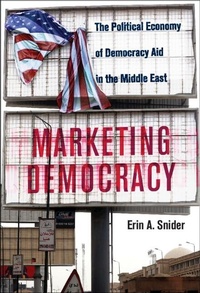
Marketing Democracy
The Political Economy of Democracy Aid in the Middle East
Published on 23. March 2022
250 pages
978-1-108-95269-9 (ISBN)
Description

For nearly two decades, the United States devoted more than $2 billion towards democracy promotion in the Middle East with seemingly little impact. To understand the limited impact of this aid and the decision of authoritarian regimes to allow democracy programs whose ultimate aim is to challenge the power of such regimes, Marketing Democracy examines the construction and practice of democracy aid in Washington DC and in Egypt and Morocco, two of the highest recipients of US democracy aid in the region. Drawing on extensive fieldwork, novel new data on the professional histories of democracy promoters, archival research and recently declassified government documents, Erin A. Snider focuses on the voices and practices of those engaged in democracy work over the last three decades to offer a new framework for understanding the political economy of democracy aid. Her research shows how democracy aid can work to strengthen rather than challenge authoritarian regimes. Marketing Democracy fundamentally challenges scholars to rethink how we study democracy aid and how the ideas of democracy that underlie democracy programs come to reflect the views of donors and recipient regimes rather than indigenous demand.
Reviews / Votes
'Marketing Democracy provides a crucial angle to the robust body of research on authoritarian durability in the Middle East by showing how democracy promotion actually works on the ground. Snider meticulously traces how program officers in Western aid agencies, regime officials, and local civil society activists negotiate with each other to construct and reconstruct the actual content and implementation of these aid programs. Even though funders are well aware of its ineffectiveness, democracy promotion continues and does little to challenge entrenched power structures.' Melani Cammett, Harvard University 'By opening the black box of democracy aid, Erin Snider provides a pathbreaking contribution to our understanding of U.S. democracy promotion. Her attention to the voices of a variety of actors who participate in the aid process - including USAID bureaucrats, government officials of recipient states, and local activists - allows Snider to challenge prevailing notions of what democracy means and uncover how democracy assistance is constructed, negotiated, and executed.' Catherine Herrold, Syracuse University 'Across decades, the United States has spent billions of dollars to promote democracy, particularly in the Middle East. Yet, these efforts have borne little fruit. Snider brilliantly combines the lenses of political economy analysis with a decade of extraordinary fieldwork to explain why. In key cases, she powerfully elucidates how meaningful political reform is routinely subordinated in favour of 'negotiated deals' serving the agendas of the pivotal actors in both donor and recipient states.' James Morrison, London School of Economics and Political Science '... a strong addition to the literature on foreign aid and democracy promotion. ... Recommended.' H. Shambayati, Choice 'Through a meticulous analysis of USAID policies and archival research, including Freedom of Information Act access, complemented by an impressive qualitative-interview pool of diplomats, democracy-aid bureaucrats, technocrats, activists, and development practitioners, Snider's book is an exemplary case of interpretative methodology and its potential for elucidating processes of change and stagnation across time and space. Importantly, the book's rich empirical contribution and extensive interview data with US policymakers and civil society stake- holders from the MENA is unmatched in breadth and scope. This makes Marketing Democracy essential reading for academics, students, and policy- makers who are interested in understanding why democracy aid failed to induce and sustain democratic outcomes at the local level for citizens and civil society stakeholders in recipient states.' Shamiran Mako, Political Science Quarterly 'Drawing on two years of fieldwork, extensive archival research, and novel statistical data, Marketing Democracy is a timely and fascinating book, rich in both its empirical and theoretical contributions... Snider should be congratulated for this excellent book. Its timeliness and richness of empirical detail will attract not only scholars but also policymakers in the US democracy promotion community...I recommend Marketing Democracy for any student, scholar, or policymaker interested in learning more about the perverse, unintended consequences of US programs aimed at encouraging democratization. Marketing Democracy is an exemplar in showing how the United States can do more for the Arab world by doing less. Matt Buehler, Perspectives on PoliticsMore details
Series
Language
English
Place of publication
Cambridge
United Kingdom
Target group
Professional and scholarly
Illustrations
Worked examples or Exercises
File size
6,27 MB
ISBN-13
978-1-108-95269-9 (9781108952699)
Copyright in bibliographic data and cover images is held by Nielsen Book Services Limited or by the publishers or by their respective licensors: all rights reserved.
Schweitzer Classification
Other editions
Additional editions
Book
03/2022
Cambridge University Press
€119.60
Shipment within 15-20 days
Person
Content
Part I. Introduction and Argument: 1. Introduction; 2. A political economy of democracy aid; Part II. Marketing Democracy: 3. Ideas and the institutional architecture of democracy Aid; 4. Neoliberalism on the Nile: US democracy aid in Egypt; 5. Reforming the kingdom: US democracy aid in Morocco; Part III. Securing Democracy: 6. The politics of democracy aid after the Arab uprisings.
