

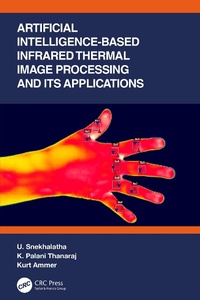
Artificial Intelligence-based Infrared Thermal Image Processing and its Applications
1st Edition
Published on 28. September 2022
246 pages
978-1-000-68845-0 (ISBN)
Description

Infrared thermography is a fast and non-invasive technology that provides a map of the temperature distribution on the body's surface. This book provides a description of designing and developing a computer-assisted diagnosis (CAD) system based on thermography for diagnosing such common ailments as rheumatoid arthritis (RA), diabetes complications, and fever. It also introduces applications of machine-learning and deep-learning methods in the development of CAD systems.
Key Features:
Covers applications of various image processing techniques in thermal imaging applications for the diagnosis of different medical conditions
Describes the development of a computer diagnostics system (CAD) based on thermographic data
Discusses deep-learning models for accurate diagnosis of various diseases
Includes new aspects in rheumatoid arthritis and diabetes research using advanced analytical tools
Reviews application of feature fusion algorithms and feature reduction algorithms for accurate classification of images
This book is aimed at researchers and graduate students in biomedical engineering, medicine, image processing, and CAD.
Key Features:
Covers applications of various image processing techniques in thermal imaging applications for the diagnosis of different medical conditions
Describes the development of a computer diagnostics system (CAD) based on thermographic data
Discusses deep-learning models for accurate diagnosis of various diseases
Includes new aspects in rheumatoid arthritis and diabetes research using advanced analytical tools
Reviews application of feature fusion algorithms and feature reduction algorithms for accurate classification of images
This book is aimed at researchers and graduate students in biomedical engineering, medicine, image processing, and CAD.
More details
Edition
1. Auflage
Language
English
Place of publication
London
United Kingdom
Publishing group
Taylor & Francis Ltd
Target group
Professional and scholarly
Product notice
Reflowable
Illustrations
18 Tables, black and white; 62 Line drawings, black and white; 1 Halftones, black and white; 63 Illustrations, black and white
ISBN-13
978-1-000-68845-0 (9781000688450)
Copyright in bibliographic data and cover images is held by Nielsen Book Services Limited or by the publishers or by their respective licensors: all rights reserved.
Schweitzer Classification
Other editions
Additional editions
U. Snekhalatha | K. Palani Thanaraj | Kurt Ammer
Artificial Intelligence-based Infrared Thermal Image Processing and its Applications
Book
03/2025
1st Edition
CRC Press
€71.40
Shipment within 10-20 days
U. Snekhalatha | K. Palani Thanaraj | Kurt Ammer
Artificial Intelligence-based Infrared Thermal Image Processing and its Applications
Book
09/2022
1st Edition
CRC Press
€186.20
Shipment within 10-20 days
Persons
Dr. U. Snekhalatha is currently working as an Professor in the Department of Biomedical Engineering, SRM Institute of Science and Technology (SRMIST), Kattankulathur, India. She pursued her Doctorate in Biomedical Engineering at SRMIST (2015). Her areas of interest include biomedical signal processing, medical image processing, biomedical instrumentation, and machine learning and deep learning techniques. She has published 88 research articles in reputed peer-reviewed international journals and international conferences. She has filed four Indian patents of which, all are in published stage. She obtained the Best Researcher Award for her publications in Nature indexed journal during the Research Day function held on March 1, 2021 at SRMIST. She received Gandhian Young Technological Innovation Award for paper titled "Design of Acetone Breath Gas Analyzer in the Evaluation of Diabetes Mellitus," Appreciation 2020, Society for Research and Initiatives for Sustainable Technologies and Institutions, November 5, 2020. She has obtained best paper award and gold medals for some research paper publications. She is a life member of various professional societies such as the Biomedical Society of India, IEI, IEANG, IRED, ISTE, and ISCA. She is currently serving as a reviewer and guest editor for various reputed peer-reviewed international journals.
Dr. K. Palani Thanaraj is currently working as an Assistant Professor in the Department of Electronics & Instrumentation Engineering, St. Joseph's College of Engineering, Chennai. He has completed his PhD in 2018 in the Faculty of Information and Communication Engineering from Anna University, Chennai. His research areas include image processing, advanced signal processing, image segmentation, machine learning, and deep learning. He has developed deep learning algorithms for performing image classification of medical images for disease diagnosis. He has published his works in many reputed and refereed journals indexed in Web of Science and Scopus.
Prof Dr. med. Kurt Ammer was certified as a general medical practitioner in 1978, a consultant for physical medicine and rehabilitation in 1989, and a consultant for physical medicine and rehabilitation (rheumatology) in 1994. He was senior researcher at the Ludwig Boltzmann Research Unit for Physical Diagnostics, Austria, between 1988 and 2004. From 1985 until his retirement in early 2013, he was Vice Director of the Institute of Physical Medicine and Rehabilitation at the Hanusch Hospital in Vienna, Austria. He got involved in medical thermography in 1988, and was appointed as secretary and treasurer of the European Association of Thermology (EAT) in 1990, and currently serves as the EAT treasurer. Since 2002, he has been appointed as external professor at the Medical Imaging Research Unit, University of South Wales, Pontypridd, UK. His research interests focus on rehabilitation medicine and the application and standardization of thermal imaging in medicine.
Dr. K. Palani Thanaraj is currently working as an Assistant Professor in the Department of Electronics & Instrumentation Engineering, St. Joseph's College of Engineering, Chennai. He has completed his PhD in 2018 in the Faculty of Information and Communication Engineering from Anna University, Chennai. His research areas include image processing, advanced signal processing, image segmentation, machine learning, and deep learning. He has developed deep learning algorithms for performing image classification of medical images for disease diagnosis. He has published his works in many reputed and refereed journals indexed in Web of Science and Scopus.
Prof Dr. med. Kurt Ammer was certified as a general medical practitioner in 1978, a consultant for physical medicine and rehabilitation in 1989, and a consultant for physical medicine and rehabilitation (rheumatology) in 1994. He was senior researcher at the Ludwig Boltzmann Research Unit for Physical Diagnostics, Austria, between 1988 and 2004. From 1985 until his retirement in early 2013, he was Vice Director of the Institute of Physical Medicine and Rehabilitation at the Hanusch Hospital in Vienna, Austria. He got involved in medical thermography in 1988, and was appointed as secretary and treasurer of the European Association of Thermology (EAT) in 1990, and currently serves as the EAT treasurer. Since 2002, he has been appointed as external professor at the Medical Imaging Research Unit, University of South Wales, Pontypridd, UK. His research interests focus on rehabilitation medicine and the application and standardization of thermal imaging in medicine.
Content
Chapter 1 Fundamentals of Infrared Thermal Imaging
Chapter 2 Protocol for Standardized Data Collection in Humans
Chapter 3 Basic Approaches of Artificial Intelligence and Machine Learning in Thermal Image Processing
Chapter 4 Thermal Imaging for Arthritis Evaluation in a Small Animal Model
Chapter 5 Thermal Imaging for Inflammatory Arthritis Evaluation
Chapter 6 Potential of Thermal Imaging to Detect Complications in Diabetes: Rationale for Diabetes Screening with Thermal Imaging
Chapter 7 Thermal Imaging in Detection of Fever for Infectious Diseases
Chapter 8 Ethical Aspects in Thermal Imaging Research
Chapter 2 Protocol for Standardized Data Collection in Humans
Chapter 3 Basic Approaches of Artificial Intelligence and Machine Learning in Thermal Image Processing
Chapter 4 Thermal Imaging for Arthritis Evaluation in a Small Animal Model
Chapter 5 Thermal Imaging for Inflammatory Arthritis Evaluation
Chapter 6 Potential of Thermal Imaging to Detect Complications in Diabetes: Rationale for Diabetes Screening with Thermal Imaging
Chapter 7 Thermal Imaging in Detection of Fever for Infectious Diseases
Chapter 8 Ethical Aspects in Thermal Imaging Research
