

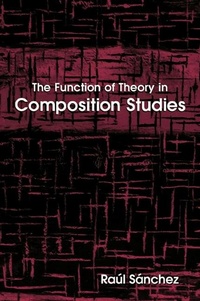
The Function of Theory in Composition Studies
Published on 1. February 2012
133 pages
978-0-7914-8315-2 (ISBN)
Description

Offers an extended critique of key assumptions in composition theory and a new paradigm for thinking about writing in an increasingly globalized and textualized world.
How can theory improve our knowledge of writing? Raúl Sánchez answers this question by examining dominant theoretical trends in composition studies over the last fifteen years, citing their common origins in a narrow, representational metatheory of writing. He argues that this adherence actually leads the field away from its objects of study: writing and the writing subject. Through this extended critique, he elaborates an alternative metatheory, one that restores writing to the conceptual center of composition studies by emphasizing its generative-rather than its representational-characteristics, particularly in increasingly networked and textualized cultures.
Raúl Sánchez is Associate Professor of English at the University of Florida.
How can theory improve our knowledge of writing? Raúl Sánchez answers this question by examining dominant theoretical trends in composition studies over the last fifteen years, citing their common origins in a narrow, representational metatheory of writing. He argues that this adherence actually leads the field away from its objects of study: writing and the writing subject. Through this extended critique, he elaborates an alternative metatheory, one that restores writing to the conceptual center of composition studies by emphasizing its generative-rather than its representational-characteristics, particularly in increasingly networked and textualized cultures.
Raúl Sánchez is Associate Professor of English at the University of Florida.
More details
Other editions
Additional editions
Raul Sanchez
The Function of Theory in Composition Studies
Book
06/2006
State University of New York Press
€31.00
Shipment within 10-20 days
Raul Sanchez
The Function of Theory in Composition Studies
Book
07/2005
State University of New York Press
€96.00
Shipment within 10-20 days
Person
Raúl Sánchez is Associate Professor of English at the University of Florida.
Content
1. The Current State of Composition Theory
2. The Discourse of Knowledge in Composition Theory
3. Composition's Ideology Apparatus
4 Theories of Culture in Composition Theory
5. Writing Without Subjects
Notes
Works Cited
Index
