

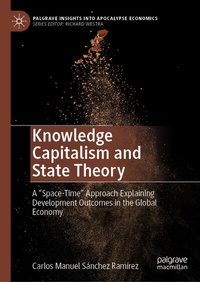
Knowledge Capitalism and State Theory
Description

The book builds on an important emergent body of discussion which questions, both empirically and theoretically, the conventional neoclassical doctrine that economies are more efficient if the state withdraws from it. It develops a "space-time" approach to state theory as a way of explaining development outcomes in the global economy as the latter increasingly shifts to what is referred to as "knowledge capitalism". It examines two global cases - Finland and China - as expressions of two broad models of successful development punctuated most recently by successful responses to the Covid-19 pandemic. It also contrasts both cases with the unsuccessful development of Brazil and Argentina toward "knowledge capitalism" and the ramifications of that for their efforts to combat Covid-19. This book will be of interest to academics in economics, politics and international relations.
More details
Other editions
Additional editions
Person
Carlos M. Sánchez Ramírez is Professor of International Economics, World Economic Structure and Economic Integration at the National University of Mexico. He is the author of Mexico in Knowledge Economy: Conditions and Challenges of its 32 States in the New Capitalism Phase of Development. In 2014, he was awarded the National Research Award by National University of Mexico, PricewaterhouseCoopers Mexico, and Interacciones Financial Group.
Content
Chapter 1. Introduction: Revisiting State theory in Knowledge Capitalism after markets failure and pandemic crisis through a space - time approach.- Chapter 2. The socio - space - time relativity of the State.- Chapter 3. Long - term cyclicality of capitalism as State time dimension.- Chapter 4. Finland, the Innovate State.- Chapter 5. China, the visible hand of the State.- Chapter 6. Brazil and Argentina: Hegemonic crisis, neo - developmental State and wasted decade.- Chapter 7. Post - pandemic COVID - 19 World Order: decline of neoliberalism and strike back of the State? A reading from Gramsci.- Chapter 8. Conclusion: New Cold War as post - pandemic COVID - 19 World Order?
