

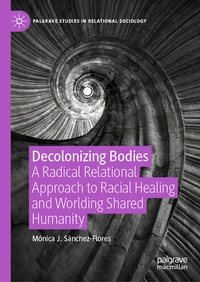
Decolonizing Bodies
Description

Decolonizing Bodies explores processes of racialization through decolonial and radical relational lenses. It weaves together theory and the author's personal stories to examine how human bodies and whole nations are racialized by late capitalism's colonial legacies. It begins by introducing Radical Relational Individuality, a decolonial and relational perspective on embodied humans. It then discusses mixed-race myths in Mexico and Canada that reveal the persistence of systemic racism as global white ignorance and structural gaslighting. It engages with the trauma of racism embedded in human bodies, how institutions perpetuate white supremacy, and the need for racial healing for everybody. Decolonizing Bodies includes an interview with educator and leadership coach Tovi C. Scruggs on her transformational teachings and concludes by discussing decolonial cosmopolitan localism based on pluriversality, a shared world, shared humanity, and an expansive form of radical relational freedom that centers an ethic of love and our deep interconnections and dependencies on everybody and everything. This book will be of interest to scholars of sociology, race and racism, and decolonial approaches.
Reviews / Votes
" Decolonizing Bodies takes readers on a journey from the (pseudo-)disembodied classrooms of the colonial university, to the fantastical post-racial mythologies of mestizaje in Mexico and métissage in Canada, to the author's own experiences of racial oppression and whitexican privilege, and her path to heal her own racial trauma. Sánchez-Flores proposes the concept of the radical relational individual (RRI). Unlike the disembodied ego cogito of Enlightenment philosophy (who is also, inextricably, a colonizing ego conquiro and ego extermino ), the radical relational individual understands their vulnerable interdependence on human and more-than-human others, finds joy in the onto-epistemic multiplicity of the pluriverse, and pursues their own racial healing as crucial to a loving struggle against oppression. From the wreckage of colonial trauma, Decolonizing Bodies issues an invitation to embodiment, calling us to dismantle the empires within our own flesh and to world a shared humanity." (Christopher Powell, Toronto Metropolitan University, ON, Canada)
More details
Other editions
Additional editions
Person
Mónica J. Sánchez-Flores is Associate Professor of Sociology in the Department of Environment, Culture and Society in Thompson Rivers University ne Secwepemcúl'ecw (Kamloops, BC, Canada). She is the author of Political Philosophy for the Global Age (2005) and Cosmopolitan Liberalism: Expanding the Boundaries of the Individual (2010).
Content
1. Introduction: A Decolonial and Radical Relational Approach to Processes of Racialization.- 2. Reframing Human Individuality as Radically Relational.- 3. Racializing Nation(s).- 4. Racializing Bodies.- 5. Racial Healing is for Every-Body.- 6. Conclusion: Worlding Shared Humanity in a Shared World.
