

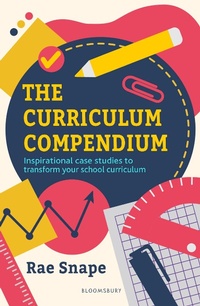
The Curriculum Compendium
Inspirational Case Studies to Transform Your School Curriculum
1st Edition
Published on 18. July 2024
320 pages
978-1-80199-093-6 (ISBN)
Description

From influential primary headteacher Rae Snape, author of The Headteacher's Handbook, comes The Curriculum Compendium, the ultimate guide to curriculum design.
Drawing on a wide range of primary school examples and linked to the four areas of the Oftsed framework, The Curriculum Compendium examines situations in which schools have successfully designed curricula to meet the needs of their pupils. Full of inspiring real-life case studies, this book encourages teachers and school leaders to rethink, transform, improve and enhance their curriculum.
Written by members of staff at leading schools, each case study provides the reader with a range of suggested approaches to try. They explore the context of the school, the intent, implementation and impact behind the curriculum vision, how the school turned the vision into reality, along with key takeaways for other schools.
Drawing on a wide range of primary school examples and linked to the four areas of the Oftsed framework, The Curriculum Compendium examines situations in which schools have successfully designed curricula to meet the needs of their pupils. Full of inspiring real-life case studies, this book encourages teachers and school leaders to rethink, transform, improve and enhance their curriculum.
Written by members of staff at leading schools, each case study provides the reader with a range of suggested approaches to try. They explore the context of the school, the intent, implementation and impact behind the curriculum vision, how the school turned the vision into reality, along with key takeaways for other schools.
Reviews / Votes
There are no quick fixes to creating a great curriculum. The settings that are doing the most thoughtful work start with thinking about what their pupils and the community really need. We see terrific examples of this from Milton Road Primary School and the Fulbridge Academy. A great curriculum takes the national curriculum as a starting point and includes opportunities for truly memorable learning. If we're looking for inspiration to take our own curriculum thinking to the next level, then the best way we can do this is to eavesdrop the conversations of colleagues doing interesting stuff. When we are presented with case studies, it's as though we are part of the conversation. The Curriculum Compendium is a magnificent body of work with stunning contributions from colleagues across the sector. It makes a significant contribution to the curriculum conversations across the country and deserves to be in every school. * Mary Myatt, education writer and speaker * This book is packed full of useful and insightful information for educators, leaning on lived experience and theory. It's a must-read if you are looking to create effective schools that are inclusive. * Bennie Kara, Former Deputy Headteacher, Writer and Trainer * Rae Snape has put together a fantastic Compendium for Curriculum action. It is comprehensive, inspiring and above all grounded in case examples. It gives us content, context, quality, leadership and personal and collective templates for engaging in curriculum transformation on the ground. Be inspired and be busy implementing the deep agenda you will find in this Handbook to be treasured. * Michael Fullan, Professor Emeritus, former Dean OISE/University of Toronto. * This is a vibrant book that talks with teachers. It is full of rich case studies that takes all those words we see on school logos and strap lines and shows how they can become a living reality for the children we teach. * Mick Waters, Professor of Education * The Curriculum Compendium does what it says on the tin. Just this - a book filled with case studies, tried and tested methods, real schools keeping it real, making it purposeful, meaningful and of value. A book to share with all staff at different levels. * Rachel Orr, leadership coach, education consultant and retired headteacher *More details
Edition
1. Auflage
Language
English
Place of publication
London
United Kingdom
Publishing group
Bloomsbury Publishing PLC (Digital)
Target group
Professional and scholarly
ISBN-13
978-1-80199-093-6 (9781801990936)
Copyright in bibliographic data and cover images is held by Nielsen Book Services Limited or by the publishers or by their respective licensors: all rights reserved.
Schweitzer Classification
Other editions
Additional editions
Book
07/2024
Bloomsbury Education
€31.50
Shipment within 3-4 weeks
Person
Rae Snape is an experienced headteacher in Cambridge and is a National Leader of Education. She is passionate about the positive and transformative power of arts, culture, creativity and connection in young people's lives and, along with other key cultural leaders, was one of the initiators of My Cambridge, a cultural educational partnership for the city. Rae is Chair of Cambridgeshire School Improvement Board and Festival Designer of Cambridgeshire Festival of Education. She is also Vice Chair of the DfE's Primary Headteachers' Reference Group, Fellow of the Royal Society of the Arts, Founding Fellow of the Chartered College of Teaching, and Ambassador for HundrED.org. Follow Rae on Twitter: @RaeSnape
Content
- Cover
- Half Title
- Series
- Title
- Copyright
- Dedication
- Contents
- Foreword
- Introduction
- How to use this book
- A unique compelling narrative
- Part 1 Leadership and management - vision and ethos
- 1 The world beneath our feet (David Aston Headteacher - Wilburton C of E Primary School,Dr Jen McGaley Pla
- 2 Making learning memorable (Ben Erskine)
- 3 Releasing the imagination and celebrating the art of the possible (Dr James Biddulph)
- 4 A curriculum matched to context (Kyrstie Stubbs)
- 5 Da Vinci life-skills curriculum and assessment (Rosina Dorelli and Zachary Reznichek co-founders of Biophilic Ed
- Editor's reflection on Part 1: Leadership and management - vision and ethos
- Part 2 Leadership and management - operational excellence
- 6 A curriculum of PRIDE (Christopher Harrison)
- 7 A curriculum that sparkles (Craig Chaplin and Philippa Rollins)
- 8 Intentional inclusion = conscious curricula (Nicole Ponsford)
- 9 Shaking up the curriculum (Sarah Wordlaw)
- 10 Change at pace (Tom Turnham)
- Editor's reflection on Part 2: Leadership and management - operational excellence
- Part 3 Quality of education
- 11 Curriculum continuity from KS1-5 - history as a case study (Alex Fairlamb)
- 12 From digital consumers to content creators (Allen Tsui)
- 13 Opening doors to ambitious English (Bob Cox)
- 14 Curriculum planning in PE - what children need vs what teachers want (Ian Roberts and Heather Macneil)
- 15 Arts-rich ambition (Nancy Wayman)
- Editor's reflection on Part 3: Quality of education
- Part 4 Behaviour and attitudes to learning
- 16 Outdoor learning (Christian Kitley)
- 17 Going beyond the National Curriculum with an explorer curriculum (Joe Hallgarten and Jo Franklin)
- 18 Learning adventure curriculum (Jonathan Le Fevre)
- 19 Battling the powers that be to champion Ed Tech (Matt Jessop)
- 20 Finding natural wonder (Ruthie Collins founder of Natural Wonder)
- Editor's reflection on Part 4: Behaviour and attitudes to learning
- Part 5 Behaviour and respect
- 21 Mental health and wellbeing in the curriculum (Andrew Cowley)
- 22 Curriculum K - putting health at the heart of education (Ben Levinson and Kayleigh Cowx)
- 23 Teaching mental resilience (Lucy Bailey)
- 24 Who says children must sit to learn? Can we move and learn? (Paula Manser)
- 25 A learning framework to put wellbeing at the heart of school (Rachel Musson)
- Editor's reflection on Part 5: Behaviour and respect
- Part 6 Personal development
- 26 The metacognitive curriculum (Anoara Mughal)
- 27 I am a problem solver. How about you? (Dr Anita Devi)
- 28 The joy of not knowing - a curriculum for lifelong learners (Dr Marcelo Staricoff)
- 29 Big picture learning - the student is the curriculum (PROFESSOR Scott Boldt)
- 30 Evolving education (Lucy Stephens)
- Editor's reflection on Part 6: Personal development
- Final thoughts
- Contributor biographies
- Editor biography
- References
- Index
