

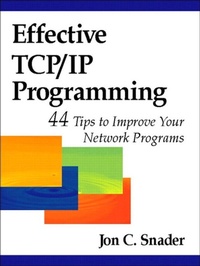
Effective TCP/IP Programming
44 Tips to Improve Your Network Programs
1st Edition
Published on 4. May 2000
320 pages
978-0-321-63839-7 (ISBN)
Description

Programming in TCP/IP can seem deceptively simple. Nonetheless, many network programmers recognize that their applications could be much more robust. Effective TCP/IP Programming is designed to boost programmers to a higher level of competence by focusing on the protocol suite's more subtle features and techniques. It gives you the know-how you need to produce highly effective TCP/IP programs.
In forty-four concise, self-contained lessons, this book offers experience-based tips, practices, and rules of thumb for learning high-performance TCP/IP programming techniques. Moreover, it shows you how to avoid many of TCP/IP's most common trouble spots. Effective TCP/IP Programming offers valuable advice on such topics as:
Exploring IP addressing, subnets, and CIDR
Preferring the sockets interface over XTI/TLI
Using two TCP connections
Making your applications event-driven
Using one large write instead of multiple small writes
Avoiding data copying
Understanding what TCP reliability really means
Recognizing the effects of buffer sizes
Using tcpdump, traceroute, netstat, and ping effectively
Numerous examples demonstrate essential ideas and concepts. Skeleton code and a library of common functions allow you to write applications without having to worry about routine chores.
Through individual tips and explanations, you will acquire an overall understanding of TCP/IP's inner workings and the practical knowledge needed to put it to work. Using Effective TCP/IP Programming, you'll speed through the learning process and quickly achieve the programming capabilities of a seasoned pro.
In forty-four concise, self-contained lessons, this book offers experience-based tips, practices, and rules of thumb for learning high-performance TCP/IP programming techniques. Moreover, it shows you how to avoid many of TCP/IP's most common trouble spots. Effective TCP/IP Programming offers valuable advice on such topics as:
Exploring IP addressing, subnets, and CIDR
Preferring the sockets interface over XTI/TLI
Using two TCP connections
Making your applications event-driven
Using one large write instead of multiple small writes
Avoiding data copying
Understanding what TCP reliability really means
Recognizing the effects of buffer sizes
Using tcpdump, traceroute, netstat, and ping effectively
Numerous examples demonstrate essential ideas and concepts. Skeleton code and a library of common functions allow you to write applications without having to worry about routine chores.
Through individual tips and explanations, you will acquire an overall understanding of TCP/IP's inner workings and the practical knowledge needed to put it to work. Using Effective TCP/IP Programming, you'll speed through the learning process and quickly achieve the programming capabilities of a seasoned pro.
More details
Edition
1. Auflage
Language
English
Place of publication
United States
Publishing group
Pearson Education (US)
Target group
College/higher education
File size
7,38 MB
ISBN-13
978-0-321-63839-7 (9780321638397)
Copyright in bibliographic data and cover images is held by Nielsen Book Services Limited or by the publishers or by their respective licensors: all rights reserved.
Schweitzer Classification
Other editions
Additional editions
Jon C. Snader
Effective TCP/IP Programming
44 Tips to Improve Your Network Programs: 44 Tips to Improve Your Network Programs
Book
05/2000
Addison Wesley
€59.51
Article exhausted; check different version
Person
Jon C. Snader is a TCP/IP and VPN expert whose background includes work in communications, networking, compiler development, operating systems, and radio network controllers.
Content
Preface.
1. Introduction.
A Few Conventions.
Road Map to the Rest of the Book.
Client-Server Architecture.
Basic Sockets API Review.
Summary.
2. Basics.
Tip 1: Understand the Difference between Connected and Connectionless Protocols.
Tip 2: Understand Subnets and CIDR.
Tip 3: Understand Private Addresses and NAT.
Tip 4: Develop and Use Application "Skeletons."
Tip 5: Prefer the Sockets Interface to XTI/TLI.
Tip 6: Remember That TCP Is a Stream Protocol.
Tip 7: Don't Underestimate the Performance of TCP.
Tip 8: Avoid Reinventing TCP.
Tip 9: Realize That TCP Is a Reliable Protocol, Not an Infallible Protocol.
Tip 10: Remember That TCP/IP Is Not Polled.
Tip 11: Be Prepared for Rude Behavior from a Peer.
Tip 12: Don't Assume That a Successful LAN Strategy Will Scale to a WAN.
Tip 13: Learn How the Protocols Work.
Tip 14: Don't Take the OSI Seven-Layer Reference Model Too Seriously.
3. Building Effective and Robust Network Programs.
Tip 15: Understand the TCP Write Operation.
Tip 16: Understand the TCP Orderly Release Operation.
Tip 17: Consider Letting inetd Launch Your Application.
Tip 18: Consider Letting tcpmux "Assign" Your Server's Well-Known Port.
Tip 19: Consider Using Two TCP Connections.
Tip 20: Consider Making Your Applications Event Driven (1).
Tip 21: Consider Making Your Applications Event Driven (2).
Tip 22: Don't Use TIME-WAIT Assassination to Close a Connection.
Tip 23: Servers Should Set the SO_REUSEADDR Option.
Tip 24: When Possible, Use One Large Write Instead of Multiple Small Writes.
Tip 25: Understand How to Time Out a Connect Call.
Tip 26: Avoid Data Copying.
Tip 27: Zero the sockaddr_in Structure Before Use.
Tip 28: Don't Forget about Byte Sex.
Tip 29: Don't Hardcode IP Addresses or Port Numbers in Your Application.
Tip 30: Understand Connected UDP Sockets.
Tip 31: Remember That All the World's Not C.
Tip 32: Understand the Effects of Buffer Sizes.
4. Tools and Resources.
Tip 33: Become Familiar with the ping Utility.
Tip 34: Learn to Use tcpdump or a Similar Tool.
Tip 35: Learn to Use traceroute.
Tip 36: Learn to Use ttcp.
Tip 37: Learn to Use lsof.
Tip 38: Learn to Use netstat.
Tip 39: Learn to Use Your System's Call Trace Facility.
Tip 40: Build and Use a Tool to Capture ICMP Messages.
Tip 41: Read Stevens.
Tip 42: Read Code.
Tip 43: Visit the RFC Editor's Page.
Tip 44: Frequent the News Groups.
Appendix A: Miscellaneous UNIX Code.
etcp.h Header.
The daemon Function.
The signal Function.
Appendix B: Miscellaneous Windows Code.
The skel.h Header.
Windows Compatibility Routines.
Bibliography.
Index
1. Introduction.
A Few Conventions.
Road Map to the Rest of the Book.
Client-Server Architecture.
Basic Sockets API Review.
Summary.
2. Basics.
Tip 1: Understand the Difference between Connected and Connectionless Protocols.
Tip 2: Understand Subnets and CIDR.
Tip 3: Understand Private Addresses and NAT.
Tip 4: Develop and Use Application "Skeletons."
Tip 5: Prefer the Sockets Interface to XTI/TLI.
Tip 6: Remember That TCP Is a Stream Protocol.
Tip 7: Don't Underestimate the Performance of TCP.
Tip 8: Avoid Reinventing TCP.
Tip 9: Realize That TCP Is a Reliable Protocol, Not an Infallible Protocol.
Tip 10: Remember That TCP/IP Is Not Polled.
Tip 11: Be Prepared for Rude Behavior from a Peer.
Tip 12: Don't Assume That a Successful LAN Strategy Will Scale to a WAN.
Tip 13: Learn How the Protocols Work.
Tip 14: Don't Take the OSI Seven-Layer Reference Model Too Seriously.
3. Building Effective and Robust Network Programs.
Tip 15: Understand the TCP Write Operation.
Tip 16: Understand the TCP Orderly Release Operation.
Tip 17: Consider Letting inetd Launch Your Application.
Tip 18: Consider Letting tcpmux "Assign" Your Server's Well-Known Port.
Tip 19: Consider Using Two TCP Connections.
Tip 20: Consider Making Your Applications Event Driven (1).
Tip 21: Consider Making Your Applications Event Driven (2).
Tip 22: Don't Use TIME-WAIT Assassination to Close a Connection.
Tip 23: Servers Should Set the SO_REUSEADDR Option.
Tip 24: When Possible, Use One Large Write Instead of Multiple Small Writes.
Tip 25: Understand How to Time Out a Connect Call.
Tip 26: Avoid Data Copying.
Tip 27: Zero the sockaddr_in Structure Before Use.
Tip 28: Don't Forget about Byte Sex.
Tip 29: Don't Hardcode IP Addresses or Port Numbers in Your Application.
Tip 30: Understand Connected UDP Sockets.
Tip 31: Remember That All the World's Not C.
Tip 32: Understand the Effects of Buffer Sizes.
4. Tools and Resources.
Tip 33: Become Familiar with the ping Utility.
Tip 34: Learn to Use tcpdump or a Similar Tool.
Tip 35: Learn to Use traceroute.
Tip 36: Learn to Use ttcp.
Tip 37: Learn to Use lsof.
Tip 38: Learn to Use netstat.
Tip 39: Learn to Use Your System's Call Trace Facility.
Tip 40: Build and Use a Tool to Capture ICMP Messages.
Tip 41: Read Stevens.
Tip 42: Read Code.
Tip 43: Visit the RFC Editor's Page.
Tip 44: Frequent the News Groups.
Appendix A: Miscellaneous UNIX Code.
etcp.h Header.
The daemon Function.
The signal Function.
Appendix B: Miscellaneous Windows Code.
The skel.h Header.
Windows Compatibility Routines.
Bibliography.
Index
