

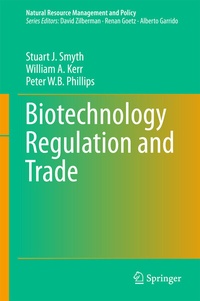
Biotechnology Regulation and Trade
Description

This book discusses the regulatory and trade challenges facing the global adoption of biotechnological products and offers strategies for overcoming these obstacles and moving towards greater global food security. The first section of the book establishes the context of the conflict, discussing the challenges of global governance, international trade, and the history of regulation of genetically modified (GM) crops. In this section, the authors emphasize the shift from exclusively science-based regulation to the more socio-economically focused framework established by the Cartagena Protocol on Biosafety, which was adopted in 2000. The second section of the book provides a snapshot of the current state of international GM crop adoption and regulation, highlighting the US, Canada, and the EU. The final section of the book identifies options for breaking the gridlock of regulation and trade that presently exist. This book adds to the current literature by providing new information about innovative agricultural technologies and encouraging debate by providing an alternative to the narratives espoused by environmental non-governmental organizations. This book will appeal to students of economics, political science, and policy analysis, as well as members of regulatory agencies and agricultural industry firms.
More details
Other editions
Additional editions
Content
Section I: The Changing Dynamics of Institutional Architecture.- 1. International Governance in the 21 st Century.- 2. Governance Challenges from Transformative Technologies.- 3. Barriers to Trade and Investment Impacts.- 4. Managing Trade in Products of Biotechnology.- 5. International Treaty Precedence.- Section II: Present Pulse of the International Market.- 6. Benefits of Genetically Modified Crops.- 7. The Regulation of Genetically Modified Crops in Canada.- 8. Canadian Canola: A Case Study in Profitable Genetic Innovation.- 9. Coexistence and International Commodity Trade.- 10. Global Trade Impacts from Low Level Presence.- 11. The World Trade Organization and Low Level Presence.- 12. Food Security and the Evaluation of Risk.- 13. Innovation and Utility: The Challenges of Winners and Losers.- Section III: Breaking the Gridlock.- 14. Accelerating Genetically Modified Crop.- 15. Governance Constraints on Improving Food Security.- 16. The Cost of Socio-Economic Biosafety Assessments.- 17. Institutions, Trade and Food Security.- 18. The Future of Food Security.
