

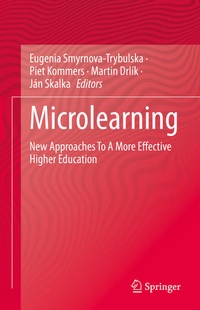
Microlearning
Description

This book is about the most significant developments in the field of microlearning in the teaching of programming. In particular, the book covers the creation of content and the use of microlearning activities for automatically evaluating programming assignments. These critical component of microlearning represent a significant contribution both in fulfilling individual project objectives and in improving computer programming education in general.
The book is interdisciplinary, examining both computer science and education. Specific topics explored include: development of distance courses, creating microcourses, fostering interdisciplinary knowledge, IT, management, and theoretical, methodological and practical aspects of the implementation of microlearning. Additionally, comprehensive analysis of the scientific literature (monographs, articles, proceedings) on the subject of the project and conducted research is provided.
More details
Other editions
Additional editions
Persons
Eugenia Smyrnova-Trybulska is Associate Professor Head of Department of Humanistic Education and Auxiliary Sciences of Pedagogy, University of Silesia in Katowice (US), Poland. Coordinator of distance learning platform of the Faculty of the Ethnology and Sciences of Education . Author of more than 180 publications, authors, co-authors, editors of more than 20 books and monographs. Author and methodology consultant of the elaboration of more than 150 e-learning courses. Main research projects and organizational activities: 2009-2010 - Coordinator of the international educational project No.10920089 E-learning - as a Road to Communicating in a Multicultural Environment , co-financed by the International Visehrad Fund (Partners: University of Ostrava, Czech Republic, Matej Bel University in Banska Bystrica, Slovakia). 2007-2008 - Participation in the project funded by the Ministry of Education Post-graduate studies for teachers in ICT, foreign languages and other subjects , co-financed by the European Social Fund. 2012 - Participation in the ESF Project Strengthening of competitive advantages in research and development of information technology In Moravian-Silesian Region , CZ1.07/2.3.00/09.0197, Methodology consultant for the elaboration of e-learning courses in the Project UPGOW ("University - Partner of the Knowledge-Based Economy"). The project under the Operational Programme Human Capital, sub. 4.1.1 with support from the European Social Fund (ESF), task 46. Coordinator of the Theoretical and Practical Aspects of Distance Learning Conference, other.
Piet Kommers is , Associate Professor in the Faculty of Behavioral Sciences, Department of Media. His actual interest is media, learning and visual communication. From 1990 he is increasingly involved as partner and coordinator in European research projects based and continuous learning. His role in initiating higher education in Eastern Europe led to his UNESCO chair, followed by the award of honorary doctor by Capital Normal University in Beijing in 2000. Main recent functions: Committee Member for the Academy of Sciences; Communication and Organization, UT; Scientific Board Member for New Learning Projects. Ministry of Education, Singapore; Lector at Fontys University of Applied Sciences for the Integration of ICT in Education; Regular Visiting Professor for Human Factors in Multimodal Communication for the European PhD Academy IMPDET at Joensuu University, Finland; Visiting Professor at the Institute of Educational Multimedia and Telematics; University of Hokkaido, Sapporo, Japan; Member of the UNESCO Board Creative Media Interaction for a Better Future: Trends, Challenges and Priorities .
Martin Drlík received the M.S. degree in biophysics from the Faculty of Mathematics, Physics and Computer Science, Comenius University, Bratislava, Slovakia, in 2001, and the Ph.D. degree intheory of computer science education from Constantine the Philosopher University, Nitra, Slovakia, in 2009. Since 2002, he has been an Assistant Professor with the Department of Informatics, Constantine the Philosopher University. His research interests include the learning analytics, educational data mining, software engineering, and database systems. Dr. Drlík has been a member of ACM since 2007. He was a recipient of the Green Group Award (best paper) of the International Conference on Computational Science 2013 and the Workshop on Computational Finance and Business Intelligence (Barcelona, 2013).
Jan Skalka received the M.S. degree in mathematics and computer science education from the Faculty Naturals Science, Constantine the Philosopher University, Nitra, Slovakia, in 1996, and the Ph.D. degree in education technology, in 2004. Since 2000, he has been an Assistant Professor with the Department of Informatics, Constantine the Philosopher University. His researchinterests include the programming education, software engineering, and database systems. Dr. Skalka leads many educational and developing projects and now he is a main developer of microlearning educational system PRISCILLA.
Content
