

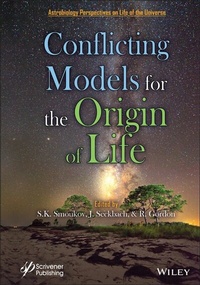
Conflicting Models for the Origin of Life
Description

Conflicting Models for the Origin of Life provides a forum to compare and contrast the many hypotheses that have been put forward to explain the origin of life.
There is a revolution brewing in the field of Origin of Life: in the process of trying to figure out how Life started, many researchers believe there is an impending second creation of life, not necessarily biological. Up-to-date understanding is needed to prepare us for the technological, and societal changes it would bring. Schrodinger's 1944 "What is life?" included the insight of an information carrier, which inspired the discovery of the structure of DNA. In "Conflicting Models of the Origin of Life" a selection of the world's experts are brought together to cover different aspects of the research: from progress towards synthetic life - artificial cells and sub-cellular components, to new definitions of life and the unexpected places life could (have) emerge(d). Chapters also cover fundamental questions of how memory could emerge from memoryless processes, and how we can tell if a molecule may have emerged from life. Similarly, cutting-edge research discusses plausible reactions for the emergence of life both on Earth and on exoplanets. Additional perspectives from geologists, philosophers and even roboticists thinking about the origin of life round out this volume. The text is a state-of-the-art snapshot of the latest developments on the emergence of life, to be used both in graduate classes and by citizen scientists.
Audience
Researchers in any area of astrobiology, as well as others interested in the origins of life, will find a modern and current review of the field and the current debates and obstacles. This book will clearly illustrate the current state-of-the-art and engage the imagination and creativity of experts across many disciplines.
More details
Other editions
Additional editions
Persons
Stoyan Smoukov, PhD, is a Professor at Queen Mary University of London, leading the Active & Intelligent Materials (AIM) Lab (previously from 2012-2017 at the University of Cambridge). He has led pioneering research in multi-functional materials with the support of the prestigious European Research Council individual ERC grant. His focus on bottom-up design for inanimate materials has yielded novel artificial muscles, supercapacitors, multifunctional materials which can replace whole devices, the discovery of artificial morphogenesis, and combinatorial approaches to multi-functionality. Prof. Smoukov has published more than 95 journal papers, cited over 4000 times, with an H-index of 35.
Joseph Seckbach, PhD, is a retired senior academician at The Hebrew University of Jerusalem, Israel. He earned his PhD from the University of Chicago and did a post-doctorate in the Division of Biology at Caltech, in Pasadena, CA. He served at Louisiana State University (LSU), Baton Rouge, LA, USA, as the first selected Chair for the Louisiana Sea Grant and Technology transfer. Professor Joseph Seckbach has edited over 40 scientific books and authored about 140 scientific articles.
Richard Gordon, PhD, is a theoretical biologist who retired from the Department of Radiology, University of Manitoba in 2011. Presently he is at Gulf Specimen Marine Lab & Aquarium, Panacea, Florida. His interest in exobiology (now astrobiology) dates from 1960s undergraduate work on organic matter in the Orgueil meteorite with Edward Anders. He has published critical reviews of panspermia and the history of discoveries of life in meteorites, and with Stoyan Smoukov, worked on shaped droplets supporting the Archaea First Hypothesis.
Content
Foreword, "Are There Men on the Moon?" by Winston S. Churchill xiii
Preface xix
Appendix to Preface by Richard Gordon and George Mikhailovsky xxv
Part I: Introduction to the Origin of Life Puzzle 1
1 Origin of Life: Conflicting Models for the Origin of Life 3
Sohan Jheeta and Elias Chatzitheodoridis
1.1 Introduction 3
1.2 Top-Down Approach-The Phylogenetic Tree of Life 6
1.3 Bottom-Up Approach-The Hypotheses 11
1.4 The Emergence of Chemolithoautotrophs and Photolithoautotrophs? 19
1.5 Viruses: The Fourth Domain of Life? 22
1.6 Where are We with the Origin of Life on Earth? 25
References 25
2 Characterizing Life: Four Dimensions and their Relevance to Origin of Life Research 33
Emily C. Parke
2.1 Introduction 33
2.2 The Debate About (Defining) Life 35
2.2.1 The Debate and the Meta-Debate 35
2.2.2 Defining Life is Only One Way to Address the Question "What is Life?" 37
2.3 Does Origin of Life Research Need a Characterization of Life? 39
2.4 Dimensions of Characterizing Life 41
2.4.1 Dimension 1: Dichotomy or Matter of Degree? 41
2.4.2 Dimension 2: Material or Functional? 43
2.4.3 Dimension 3: Individual or Collective? 44
2.4.4 Dimension 4: Minimal or Inclusive 46
2.4.5 Summary Discussion of the Dimensions 47
2.5 Conclusion 48
Acknowledgments 48
References 48
3 Emergence, Construction, or Unlikely? Navigating the Space of Questions Regarding Life's Origins 53
Stuart Bartlett and Michael L. Wong
3.1 How Can We Approach the Origins Quest(ion)? 53
3.2 Avian Circularities 54
3.3 Assuming That 56
3.4 Unlikely 56
3.5 Construction 58
3.6 Emergence 60
References 63
Part II: Chemistry Approaches 65
4 The Origin of Metabolism and GADV Hypothesis on the Origin of Life 67
Kenji Ikehara
4.1 Introduction 68
4.2 [GADV]-Amino Acids and Protein 0th-Order Structure 70
4.3 Exploration of the Initial Metabolism: The Origin of Metabolism 71
4.3.1 From What Kind of Enzymatic Reactions Did the Metabolic System Originate? 71
4.3.2 What Kind of Organic Compounds Accumulated on the Primitive Earth 72
4.3.3 What Organic Compounds were Required for the First Life to Emerge? 74
4.4 From Reactions Using What Kind of Organic Compounds Did the Metabolism Originate? 75
4.4.1 Catalytic Reactions with What Kind of Organic Compounds Were Incorporated Into the Initial Metabolism? 76
4.4.2 Search for Metabolic Reactions Incorporated Into the Initial Metabolism 76
4.4.3 Syntheses of [GADV]-Amino Acids Leading to Produce [GADV]-Proteins/Peptides Were One of the Most Important Matters for the First Life 76
4.4.4 Nucleotide Synthetic Pathways were Integrated at the Second Phase in the Initial Metabolism 78
4.5 Discussion 80
4.5.1 Protein 0 th -Order Structure Was the Key for Solving the Origin of Metabolism 80
4.5.2 Validity of GPG-Three Compounds Hypothesis on the Origin of Metabolism 82
4.5.3 Establishment of the Metabolic System and the Emergence of Life 83
4.5.4 The Emergence of Life Viewed from the Origin of Metabolism 84
Acknowledgments 85
References 86
5 Chemical Automata at the Origins of Life 89
André Brack
5.1 Introduction 89
5.2 Theoretical Models 90
5.2.1 The Chemoton Model 90
5.2.2 Autopoiesis 90
5.2.3 Biotic Abstract Dual Automata 91
5.2.4 Automata and Diffusion-Controlled Reactions 91
5.2.5 Quasi-Species and Hypercycle 91
5.2.6 Computer Modeling 91
5.2.7 Two-Dimensional Automata 92
5.3 Experimental Approach 92
5.3.1 The Ingredients for Life 92
5.3.2 Capabilities Required for the Chemical Automata 93
5.3.2.1 Autonomy 93
5.3.2.2 Self-Ordering and Self-Organization 93
5.3.2.3 About Discriminating Aggregation 94
5.3.2.4 Autocatalysis and Competition 95
5.4 Conclusion 95
References 96
6 A Universal Chemical Constructor to Explore the Nature and Origin of Life 101
Geoffrey J. T. Cooper, Sara I. Walker and Leroy Cronin
6.1 Introduction 102
6.2 Digitization of Chemistry 109
6.3 Environmental Programming, Recursive Cycles, and Protocells 117
6.4 Measuring Complexity and Chemical Selection Engines 122
6.5 Constructing a Chemical Selection Engine 125
Acknowledgements 126
References 126
7 How to Make a Transmembrane Domain at the Origin of Life: A Possible Origin of Proteins 131
Richard Gordon and Natalie K. Gordon
7.1 Introduction 131
7.2 The Initial "Core" Amino Acids 132
7.3 The Thickness of Membranes of the First Vesicles 142
7.4 Carbon-Carbon Distances Perpendicular to a Membrane 144
7.5 The Thickness of Modern Membranes 144
7.6 A Prebiotic Model for the Coordinated Growth of Membrane Thickness and Transmembrane Peptides 145
7.7 A Model for the Coordinated Growth of Membrane Thickness and Transmembrane Peptides 148
7.8 RNA World with the Protein World 150
7.9 Conclusion 153
Acknowledgements 154
References 155
Part III: Physics Approaches 175
8 Patterns that Persist: Heritable Information in Stochastic Dynamics 177
Peter M. Tzelios and Kyle J. M. Bishop
8.1 Introduction 178
8.2 Markov Processes 181
8.2.1 Simple Examples of Markov Processes 181
8.2.2 Stochastic Dynamics 183
8.2.3 Master Equation 185
8.2.4 Dynamic Persistence 186
8.2.5 Coarse Graining 187
8.2.6 Entropy Production 188
8.3 Results 189
8.3.1 The Persistence Filter 189
8.4 Mechanisms of Persistence 190
8.5 Effects of Size N and Disequilibrium ¿ 192
8.6 Probability of Persistence 194
8.6.1 Continuity Constraint 195
8.6.2 Locality Constraint 196
8.6.3 New Strategies for Persistence 197
8.7 Measuring Persistence in Practice 198
8.7.1 Computable Information Density (CID) 198
8.7.2 Quantifying Persistence in Dynamic Assemblies of Colloidal Rollers 200
8.8 Conclusions 203
8.9 Methods 205
8.9.1 Coarse-Graining 205
8.10 Monte Carlo Optimization 206
8.11 Experiments on Ferromagnetic Rollers 206
8.12 A Persistence in Equilibrium Systems 207
Acknowledgements 209
References 209
9 When We Were Triangles: Shape in the Origin of Life via Abiotic, Shaped Droplets to Living, Polygonal Archaea During the Abiocene 213
Richard Gordon
9.1 Introduction 213
9.1.1 What Correlates with Archaea Shape? Nothing! 214
9.1.2 Archaea's Place in the Tree of Life 219
9.1.3 The Discovery and Exploration of Shaped Droplets 222
9.1.4 Shaped Droplets as Protocells 223
9.1.5 Comparison of Shaped Droplets with Archaea 223
9.1.6 The S-Layer 224
9.1.7 The S-Layer as a Two-Dimensional Liquid with Fault Lines 224
9.1.8 The Analogy of the S-Layer to Bubble Rafts 229
9.1.9 Energy Minimization Model for the S-Layer in Polygonal Archaea 229
9.2 Discussion 236
9.3 Conclusion 240
Acknowledgements 240
References 240
10 Challenges and Perspectives of Robot Inventors that Autonomously Design, Build, and Test Physical Robots 263
Fumiya Iida, Toby Howison, Simon Hauser and Josie Hughes
10.1 Introduction 263
10.2 Physical Evolutionary-Developmental Robotics 264
10.2.1 Robotic Invention 265
10.2.2 Physical Morphology Adaptation 266
10.3 Falling Paper Design Experiments 269
10.3.1 Design-Behavior Mapping 270
10.3.2 More Variations of Paper Falling Patterns 272
10.3.3 Characterizing Falling Paper Behaviors 274
10.4 Evolutionary Dynamics of Collective Bernoulli Balloons 274
10.5 Discussions and Conclusions 276
Acknowledgments 277
References 277
Part IV: The Approach of Creating Life 279
11 Synthetic Cells: A Route Toward Assembling Life 281
Antoni Llopis-Lorente, N. Amy Yewdall, Alexander F. Mason, Loai K. E. A. Abdelmohsen and Jan C. M. van Hest
11.1 Compartmentalization: Putting Life in a Box 282
11.2 The Making of Cell-Sized Giant Liposomes 283
11.3 Coacervate-Based Synthetic Cells 285
11.4 Adaptivity and Functionality in Synthetic Cells 288
11.5 Synthetic Cell Information Processing and Communication 291
11.6 Intracellular Information Processing: Making Decisions with All the Noise 292
11.7 Extracellular Communication: the Art of Talking and Selective Listening 294
11.8 Conclusions 296
Acknowledgments 296
References 297
12 Origin of Life from a Maker's Perspective-Focus on Protocellular Compartments in Bottom-Up Synthetic Biology 303
Ivan Ivanov, Stoyan K. Smoukov, Ehsan Nourafkan, Katharina Landfester and Petra Schwille
12.1 Introduction 303
12.2 Unifying the Plausible Protocells in Line with the Crowded Cell 309
12.3 Self-Sustained Cycles of Growth and Division 311
12.4 Transport and Energy Generation at the Interface 314
12.4.1 Energy and Complexity 315
12.4.2 Energy Compartmentation 316
12.5 Synergistic Effects Towards the Origin of Life 319
References 320
Part V: When and Where Did Life Start? 327
13 A Nuclear Geyser Origin of Life: Life Assembly Plant - Three-Step Model for the Emergence of the First Life on Earth and Cell Dynamics for the Coevolution of Life's Functions 329
Shigenori Maruyama and Toshikazu Ebisuzaki
13.1 Introduction 330
13.2 Natural Nuclear Reactor 331
13.2.1 Principle of a Natural Nuclear Reactor 331
13.2.2 Natural Nuclear Reactor in Gabon 332
13.2.3 Radiation Chemistry to Produce Organics 333
13.2.4 Hadean Natural Nuclear Reactor 334
13.3 Nuclear Geyser Model as a Birthplace of Life on the Hadean Earth 336
13.4 Nine Requirements for the Birthplace of Life 338
13.5 Three-Step Model for the Emergence of the First Life on Hadean Earth 340
13.5.1 The Emergence of the First Proto-Life 341
13.5.1.1 Domain I: Inorganics 342
13.5.1.2 Domain II: From Inorganic to Organic 342
13.5.1.3 Domain III: Production of More Advanced BBL 343
13.5.1.4 Domain IV: Passage Connecting Geyser Main Room with the Surface and Fountain Flow 343
13.5.1.5 Domain V: Production of BBL in an Oxidizing Wet-Dry Surface Environment 345
13.5.1.6 Domain VI: Birthplace of the First Proto-Life 346
13.5.1.7 Utilization of Metallic Proteins 347
13.5.2 The Emergence of the Second Proto-Life 348
13.5.2.1 Drastic Environmental Change from Step 1 to Step 2 348
13.5.2.2 Biological Response from Step 1 to Step 2 349
13.5.3 The Emergence of the Third Proto-Life, Prokaryote 350
13.5.3.1 Drastic Environmental Changes from Step 2 to Step 3 350
13.5.3.2 Biological Response from Step 2 to Step 3 351
13.6 Concept of the Cell Dynamics: Life Assembly Plant 353
Acknowledgments 356
References 356
14 Comments on the Nuclear Geyser Origin of Life Proposal of the Authors S. Maruyama and T. Ebisuzaki and Interstellar Medium as a Possible Birthplace of Life 361
Jaroslav Jirík
References 366
15 Nucleotide Photochemistry on the Early Earth 369
Whitaker, D. E., Colville, B.W.F. and Powner, M. W.
15.1 Introduction 369
15.2 Pyrimidine Photochemistry 372
15.2.1 Photohydrates 372
15.2.2 Photodimers 374
15.2.3 Glycosidic Bond Cleavage 376
15.2.4 Addition of Nucleophiles to C 2 378
15.3 Purine Photochemistry 380
15.4 Photochemistry of Noncanonical Nucleosides 382
15.4.1 Photochemical Anomerization of Cytidine Nucleosides 383
15.4.2 Thiobase Irradiation Products 387
15.4.3 Photochemical Decarboxylation of Orotidine 390
15.4.4 Photochemical Synthesis of AICN, a Possible Synthetic Precursor to the Purines 391
15.5 Considering More Complex Photochemical Systems 392
15.6 Concluding Remarks 395
References 395
16 Origins of Life on Exoplanets 407
Paul B. Rimmer
16.1 Introduction 407
16.2 How to Test Origins Hypotheses 408
16.3 Exoplanets as Laboratories 410
16.4 The Scenario 412
16.5 Initial Conditions 414
16.5.1 Chemical Initial Conditions 414
16.5.1.1 Hydrogen Cyanide 414
16.5.1.2 Sulfite and Sulfide 415
16.5.2 Physical Initial Conditions 415
16.6 Chances of Success 417
16.7 Relevance of the Outcome 420
16.8 Conclusions 420
Acknowledgements 421
References 421
17 The Fish Ladder Toy Model for a Thermodynamically at Equilibrium Origin of Life in a Lipid World in an Endoreic Lake 425
Richard Gordon, Shruti Raj Vansh Singh, Krishna Katyal and Natalie K. Gordon
17.1 The Fish Ladder Model for the Origin of Life 426
17.2 Could the Late Heavy Bombardment have Supplied Enough Amphiphiles? 435
17.3 How Many Uphill Steps to LUCA? 438
17.4 How Long Would the Origin of Life Take After the CVC is Achieved? 440
17.5 Conclusion 440
Acknowledgements 443
Appendix (Discussion with David Deamer) 443
References 447
Index 459
Foreword
https://winstonchurchill.hillsdale.edu/men-moon-churchill-alien-life-1942/
"Are There Men on the Moon?" by Winston S. Churchill
Text from Michael Wolff, ed., The Collected Essays of Sir Winston Churchill, vol. 4, Churchill at Large (London: Library of Imperial History, 1975), IV 493-98. Reproduced courtesy of the Estate of Winston S. Churchill by permission of Curtis Brown Group Ltd.
Does life exist elsewhere in the Universe? Indeed a fascinating question. All living things of the type we know require water, not only because some of them want it to drink or, in the case of marine animals, to live and swim in, but because every living unit, animal or vegetable, consists to a very considerable extent of this fluid.
Now one cannot altogether rule out the possibility of a totally different world with oceans of some other liquid, such as petrol or, as some might perhaps prefer, alcohol, in which a weird and complex organic synthesis has brought into being units which one might call "living creatures." But nothing in our present knowledge entitles us to make such an assumption. Of one thing, however, we can be certain, and that is that any entities formed in such surroundings would be totally unlike anything we know under the guise of living creatures or plants.
Now, if we confine ourselves to the sorts of things we know and admit that water is a necessary ingredient of their life and being, we are restricted within comparatively narrow limits in the conditions in which such entities can exist. As we all know, if it is too hot, water boils. Even the most meagre acquaintance with hygiene tells us that the best way to sterilize anything is to dip it in boiling water. On the other hand, if the surroundings are too cold, water freezes, and it is difficult to imagine that life could ever be formed in a world of ice and snow, even though creatures, developed from types which were produced in kinder surroundings, have managed to survive in arctic regions.
Briefly, then, if life in the form we know it is to exist anywhere, it can only be in regions of comparatively moderate temperature, say between a few degrees of frost and the boiling point of water. Obviously, the stars are completely ruled out for this reason. For these consist of gigantic masses of incandescent gas in which every chemical compound is split up in its simplest components and in which the mere idea of life is an absurdity.
But the sun, which is a comparatively insignificant star in the Milky Way-which is the name we give to our galaxy-is surrounded, as we know, by planets of which our world is one. On our earth life has developed. It has been able to do this because the temperature is neither too high nor too low. It is very easy to see what fixes the temperature of our earth. It is the temperature at which the heat falling upon it from the sun is equal to the heat which it radiates away into outer space. If it gained more than it lost it would get hotter, until the export of heat equaled the import, and vice versa. Mathematicians have an exact way of calculating this. But even without mathematics, it is clear that if the earth were further away from the sun it would receive less heat and therefore that its temperature would be lower.
From these considerations alone it is safe to rule out what are known as the outer planets-Jupiter, Saturn, Uranus, Neptune, and the recently discovered Pluto-as possible abodes of life. There remain Mars, Venus, and Mercury. The mean temperature of Mars is well below the freezing point of water. It is a cold, arid planet with a climate somewhat like the top of Mount Everest would be if the sun were partly obscured, but with much less ice owing to a shortage of water. Life may exist there; indeed, the changes of color in its spring and winter seem to indicate that some form of vegetation-be it only lichen-enlivens the faintly sunlit landscape. But the circumstances are harsh and forbidding, the atmosphere is thin and dry and short of oxygen, and there is little reason to suppose that any very highly organized forms are likely to have arisen.
Venus, on the other hand, being nearer to the sun, is considerably warmer than we are. Apparently, there is moisture in plenty, indeed, from our point of view, too much. For it is covered with a perpetual layer of cloud which prevents us seeing what the surface may be like. Though there does not seem to be much evidence of oxygen, it may be that in this hothouse atmosphere an elaborate flora and fauna exist, perhaps even intelligent beings. But unless they have developed some form of aeroplane which enables them to rise above the clouds, it is quite possible that if such intellectual creatures live there, they are quite unaware of the existence of an immense and complex universe of stars and nebulae outside their own world, and that they are living in the egocentric belief that they are the one and only habitation fit for reasoning beings.
On Mercury, the innermost planet, it seems unlikely that life has arisen. Water would boil on the sunny side, while the face remote from the sun is so cold that most of the planet's surface would be intolerable for any living entity we know.
But what, it may be asked, of the moon? Our own satellite approximately the same distance from the sun as we are, and whose temperature therefore must be about the same as our own. This brings us to another condition which must be fulfilled if water and any sort of atmosphere are to persist. Any form of gas or vapor, as we know, consists of a lot of small particles, so-called molecules, flying about at high speeds, bumping into one another and against any solid or liquid with which they are in contact. The hotter the gas, the faster they move; indeed, when we say that it is a hot day, what we really mean is that the molecules in the air are moving faster than usual. Now, it may seem strange that these molecules flying about in the outmost layers of the atmosphere do not simply shoot away into space; for, after all, there is no lid on the top of the atmosphere to stop them. The reason they do not is simply what we call the force of gravity. If you throw a stone into the air, the reason it falls down and does not go straight on is because it is pulled back by the earth. In the same way, a molecule at the top of the atmosphere does not fly away because the earth attracts it, and it falls back again.
Now, the moon is very much smaller than the earth, and the force with which it attracts anything is therefore less. A man who could throw a cricket ball a hundred yards on the earth could throw it six hundred on the moon. The molecules in the atmosphere, which find it impossible to escape from the earth, would readily fly away from the moon's surface; indeed, such atmosphere as it may have had in the beginning has almost completely vanished. Thus the moon is an arid desert, almost entirely bereft of air or water, on which only the lowest forms of life can possibly exist.
This argument applies, of course, even more strictly to the small fragmentary planets called the asteroids, a group of hundreds of little units ranging from about four hundred miles in diameter downwards which circle round the sun in orbits between that of the earth and Mars. Even the largest, with an area of some hundreds of millions of acres-which might at first sight appear to be an agreeable refuge in these unpleasant times, if only one could get there-is completely ruled out for any normal form of life by the smallness of the gravitational force which exists on its surface. On the smaller ones it would be possible to drive a golf ball right away into space; indeed, a man would run some risk if he jumped over an obstacle of flying away from his world altogether and himself becoming a planetoid circling round the sun.
But, of course, nobody could live on such a tiny world, as no air or water could possibly remain on its surface, where the pull of gravity is so minute. In our own solar system, therefore, we can say fairly definitely that life of any complexity can exist outside our own earth only on Venus or Mars.
But what about planets surrounding the other stars? The sun is merely one star in our galaxy, which contains several thousand millions of others. At first sight it might appear obvious that these others may be presumed to possess planets, which, if they happen to be at an appropriate distance and of the proper size, may be surrounded by atmospheres and be watered by rain as we are. This is probably true of a large number, though doubt has been cast upon it for a rather interesting reason. Astronomers for over a hundred years have been trying to account for the fact that there are all these planets surrounding the sun. They are all of them moving in much the same plane and in the same direction. Surely this should provide a clue.
Now one of the explanations which has found great favor is that they were formed by the close approach to our sun of some vagrant star. This would attract gas on the surface and form a huge tidal wave which, if the star were sufficiently large and sufficiently close, might be dragged out of the sun and form a splutter of gas which would condense ultimately into a series of planets. Now, if this was the origin of the planets, it is possible to work out how near the vagrant star must have come, and it is found that the approach must have been very close indeed.
But we know how many stars there are, how far they are apart, and how fast they move. One can work out, therefore, what the chances are of a close approach of this nature. Roughly speaking, if we made a model in which our world...
