

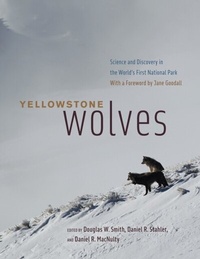
Yellowstone Wolves
Science and Discovery in the World's First National Park
Published on 22. December 2022
344 pages
978-0-226-72848-3 (ISBN)
Description

This beautifully illustrated volume on the Yellowstone Wolf Project includes an introduction by Jane Goodall and an exclusive online documentary.
The reintroduction of wolves to Yellowstone National Park was one of the greatest wildlife conservation achievements of the twentieth century. Eradicated after the park was first established, these iconic carnivores returned in 1995 when the US government reversed its century-old policy of extermination. In the intervening decades, scientists have built a one-of-a-kind field study of these wolves, their behaviors, and their influence on the entire ecosystem.
Yellowstone Wolves tells the incredible story of the Yellowstone Wolf Project, as told by the people behind it. This wide-ranging volume highlights what has been learned in the decades since reintroduction, as well as the unique blend of research techniques used to gain this knowledge. We learn about individual wolves, population dynamics, wolf-prey relationships, genetics, disease, management and policy, and the rippling ecosystem effects wolves have had on Yellowstone's wild and rare landscape.
Featuring a foreword by Jane Goodall, beautiful images, a companion online documentary by celebrated filmmaker Bob Landis, and contributions from more than seventy wolf and wildlife conservation luminaries from Yellowstone and around the world, Yellowstone Wolves is an informative and beautifully realized celebration of the extraordinary Yellowstone Wolf Project.
The reintroduction of wolves to Yellowstone National Park was one of the greatest wildlife conservation achievements of the twentieth century. Eradicated after the park was first established, these iconic carnivores returned in 1995 when the US government reversed its century-old policy of extermination. In the intervening decades, scientists have built a one-of-a-kind field study of these wolves, their behaviors, and their influence on the entire ecosystem.
Yellowstone Wolves tells the incredible story of the Yellowstone Wolf Project, as told by the people behind it. This wide-ranging volume highlights what has been learned in the decades since reintroduction, as well as the unique blend of research techniques used to gain this knowledge. We learn about individual wolves, population dynamics, wolf-prey relationships, genetics, disease, management and policy, and the rippling ecosystem effects wolves have had on Yellowstone's wild and rare landscape.
Featuring a foreword by Jane Goodall, beautiful images, a companion online documentary by celebrated filmmaker Bob Landis, and contributions from more than seventy wolf and wildlife conservation luminaries from Yellowstone and around the world, Yellowstone Wolves is an informative and beautifully realized celebration of the extraordinary Yellowstone Wolf Project.
More details
Other editions
Additional editions
Douglas W. Smith | Daniel Stahler | Daniel R. MacNulty
Yellowstone Wolves
Science and Discovery in the World's First National Park
Book
12/2020
University of Chicago Press
€40.00
Shipment within 10-20 days
Content
- Intro
- Contents
- Study Area Map
- A Note on Accompanying Video | Robert K. Landis
- Foreword | Jane Goodall
- Preface | Douglas W. Smith, Daniel R. Stahler, and Daniel R. MacNulty
- Part 1: History and Reintroduction
- 1. Historical and Ecological Context for Wolf Recovery | Douglas W. Smith, Daniel R. Stahler, Daniel R. MacNulty, and Lee H. Whittlesey
- BOX 1.1. Wolf History and Surveys in Yellowstone National Park | John Weaver
- 2. How Wolves Returned to Yellowstone | Steven H. Fritts, Rebecca J. Watters, Edward E. Bangs, Douglas W. Smith, and Michael K. Phillips
- BOX 2.1. To Reintroduce or Not to Reintroduce, That Is the Question | Diane Boyd
- Guest Essay: Why Are Yellowstone Wolves Important? | L. David Mech
- Part 2: Behavioral and Population Ecology
- 3. Essential Biology of the Wolf: Foundations and Advances | Daniel R. MacNulty, Daniel R. Stahler, Tim Coulson, and Douglas W. Smith
- 4. Ecology of Family Dynamics in Yellowstone Wolf Packs | Daniel R. Stahler, Douglas W. Smith, Kira A. Cassidy, Erin E. Stahler, Matthew C. Metz, Rick McIntyre, and Daniel R. MacNulty
- BOX 4.1. Naming Wolf Packs | Daniel R. Stahler
- 5. Territoriality and Competition between Wolf Packs | Kira A. Cassidy, Douglas W. Smith, Daniel R. Stahler, Daniel R. MacNulty, Erin E. Stahler, and Matthew C. Metz
- BOX 5.1. Auditory Profile: The Howl of the Wolf | John B. Theberge and Mary T. Theberge
- 6. Population Dynamics and Demography | Douglas W. Smith, Kira A. Cassidy, Daniel R. Stahler, Daniel R. MacNulty, Quinn Harrison, Ben Balmford, Erin E. Stahler, Ellen E. Brandell, and Tim Coulson
- Guest Essay: Yellowstone Wolves Are Important Because They Changed Science | Rolf O. Peterson and Trevor S. Peterson
- Part 3: Genetics and Disease
- 7. Yellowstone Wolves at the Frontiers of Genetic Research | Daniel R. Stahler, Bridgett M. vonHoldt, Elizabeth Heppenheimer, and Robert K. Wayne
- 8. The K Locus: Rise of the Black Wolf | Rena M. Schweizer, Daniel R. Stahler, Daniel R. MacNulty, Tim Coulson, Phil Hedrick, Rachel Johnston, Kira A. Cassidy, Bridgett M. vonHoldt, and Robert K. Wayne
- 9. Infectious Diseases in Yellowstone's Wolves | Ellen E. Brandell, Emily S. Almberg, Paul C. Cross, Andrew P. Dobson, Douglas W. Smith, and Peter J. Hudson
- Guest Essay: Why Are Yellowstone Wolves Important? A European Perspective | Olof Liberg
- Part 4: Wolf-Prey Relationships
- 10. How We Study Wolf-Prey Relationships | Douglas W. Smith, Matthew C. Metz, Daniel R. Stahler, and Daniel R. MacNulty
- BOX 10.1. Nine-Three-Alpha | Douglas W. Smith
- BOX 10.2. The Bone Collectors | Ky Koitzsch and Lisa Koitzsch
- 11. Limits to Wolf Predatory Performance | Daniel R. MacNulty, Daniel R. Stahler, and Douglas W. Smith
- BOX 11.1. Tougher Times for Yellowstone Wolves Reflected in Tooth Wear and Fracture | Blaire Van Valkenburgh
- 12. What Wolves Eat and Why | Matthew C. Metz, Mark Hebblewhite, Douglas W. Smith, Daniel R. Stahler, Daniel R. MacNulty, Aimee Tallian, and John A. Vucetich
- BOX 12.1. Bison in Wood Buffalo National Park | L. N. Carbyn
- 13. Wolf Predation on Elk in a Multi-Prey Environment | Matthew C. Metz, Douglas W. Smith, Daniel R. Stahler, Daniel R. MacNulty, and Mark Hebblewhite
- BOX 13.1. Generalizing Wolf-Prey Dynamics across Systems: Yellowstone, Banff, and Isle Royale | Mark Hebblewhite
- BOX 13.2. The Predator's Perspective: Biomass of Prey | Matthew C. Metz
- BOX 13.3. Lessons from Denali National Park: Stability in Predator-Prey Dynamics Is a Pause on the Way to Somewhere Else | Layne Adams
- 14. Population Dynamics of Northern Yellowstone Elk after Wolf Reintroduction | Daniel R. MacNulty, Daniel R. Stahler, Travis Wyman, Joel Ruprecht, Lacy M. Smith, Michel T. Kohl, and Douglas W. Smith
- BOX 14.1. Wolves and Elk in the Madison Headwaters | Robert A. Garrott, P. J. White, Claire Gower, Matthew S. Becker, Shana Drimal, Ken L. Hamlin, and Fred G. R. Watson
- BOX 14.2. Ecology of Fear | Daniel R. Stahler and Daniel R. MacNulty
- Guest Essay: The Value of Yellowstone's Wolves? The Power of Choice | Michael K. Phillips
- Part 5: Ecosystem Effects and Species Interactions
- 15. Indirect Effects of Carnivore Restoration on Vegetation | Rolf O. Peterson, Robert L. Beschta, David J. Cooper, N. Thompson Hobbs, Danielle Bilyeu Johnston, Eric J. Larsen, Kristin N. Marshall, Luke E. Painter, William J. Ripple, Joshua R. Rose, Douglas W. Smith, and Evan C. Wolf
- BOX 15.1. Long-Term Trends in Beaver, Moose, and Willow Status in the Southern Portion of the Absaroka-Beartooth Wilderness | Daniel B. Tyers
- 16. Competition and Coexistence among Yellowstone's Meat Eaters | Daniel R. Stahler, Christopher C. Wilmers, Aimee Tallian, Colby B. Anton, Matthew C. Metz, Toni K. Ruth, Douglas W. Smith, Kerry A. Gunther, and Daniel R. MacNulty
- Guest Essay: Old Dogs Taught Old Lessons | Paul C. Paquet
- Part 6: Conservation, Management, and the Human Experience
- 17. Wolves and Humans in Yellowstone | Douglas W. Smith, Daniel R. Stahler, Rick McIntyre, Erin E. Stahler, and Kira A. Cassidy
- 18. The Wolf Watchers | Nathan Varley, Rick McIntyre, and James Halfpenny
- BOX 18.1. Bob Landis's Yellowstone Wolves Documentaries
- BOX 18.2. Seeing Wolves | Robert Hayes
- 19. Conservation and Management: A Way Forward | Douglas W. Smith, P. J. White, Daniel R. Stahler, Rebecca J. Watters, Kira A. Cassidy, Adrian Wydeven, Jim Hammill, and David E. Hallac
- Guest Essay: Making Better Sense of Wolves | Susan G. Clark
- Afterword | Rebecca J. Watters, Douglas W. Smith, Daniel R. Stahler, and Daniel R. MacNulty
- Acknowledgments
- Appendix: Species Names Used in the Text
- Literature Cited
- List of Contributors
- Name Index
- Subject Index
