

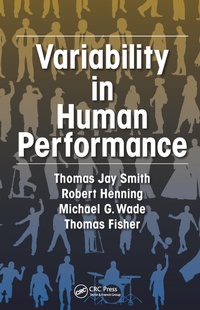
Variability in Human Performance
1st Edition
Published on 26. August 2014
389 pages
978-1-4665-7972-9 (ISBN)
Description

Understanding the conditions under which variability in performance may arise, and the processes related to its emergence, gives us insight into the development of techniques for improving the quality of performance.This book introduces a comprehensive framework for understanding human performance variability in terms of how human control of behavior is closely tied to design factors in the performance environment. Empirical evidence, as well as practical examples and application areas, introduced in support of this framework. The book provides suggestions on how individuals, groups, and organizations can significantly reduce variability in human performance that often leads to systems failures.
Reviews / Votes
"Throughout, the book focuses on the sources of variability in human performance, including the design of work systems. The book will therefore be of interest to a wide range of HFE specialists."-RS Bridger, Institute of Naval Medicine"This is a truly excellent book that increases awareness of the study of variability in movement performance. ... Importantly, this book provides exciting discussions on theoretical problems on movement variability such as what are the sources of this variability."
-DR. Nick Stergiou, University of Nebraska Omaha and University of Nebraska Medical Center
More details
Series
Language
English
Place of publication
Baton Rouge
United States
Publishing group
Taylor & Francis Inc
Target group
College/higher education
Professional and scholarly
Illustrations
61 s/w Abbildungen, 17 s/w Tabellen
61 b/w images, 17 tables and 5 equations
File size
6,72 MB
ISBN-13
978-1-4665-7972-9 (9781466579729)
Copyright in bibliographic data and cover images is held by Nielsen Book Services Limited or by the publishers or by their respective licensors: all rights reserved.
Schweitzer Classification
Other editions
Additional editions
Thomas J. Smith | Robert A. Henning | Michael G. Wade
Variability in Human Performance
Book
03/2017
1st Edition
CRC Press
€97.30
Shipment within 10-20 days
Thomas J. Smith | Robert A. Henning | Michael G. Wade
Variability in Human Performance
Book
08/2014
1st Edition
CRC Press
€237.70
Shipment within 15-20 days
Persons
Thomas J. Smith has research and teaching experience and funding support encompassing many areas of human factors/ergonomics, including human performance variability, educational ergonomics, human error and hazard management, occupational ergonomics, occupational health and safety, surface transportation, occupancy quality, patient safety, work physiology, kinesiology, and ergonomics certification systems. He is a research associate with the School of Kinesiology, University of Minnesota. He is a Certified Human Factors Professional with over 100 publications.
His honors include serving as senior editor for a recent special issue of Ergonomics in Design dealing with the topic of globalization of ergonomics, serving as chair of the Professional Standards and Education Standing Committee for the International Ergonomics Association (IEA), originator and committee member for the IEA K.U. Smith Student Award, editorial board member for the journal Theoretical Issues in Ergonomics Science, director and past president of the Human Factors and Ergonomics Society (HFES) Upper Midwest Chapter, general chair for the 2001 HFES Annual Meeting, member of the 2002 State of Minnesota Ergonomics Task Force, and member of the Dakota County (Minnesota) University of Minnesota Extension Committee.
Robert A. Henning is an associate professor of industrial/organizational psychology at the University of Connecticut. He holds degrees from the University of Wisconsin-Madison in psychology (BS), biomedical engineering (MS), and industrial engineering (PhD). He also received three years of postdoctoral training at the National Institute for Occupational Safety and Health (NIOSH) in a fellowship program administered by the National Research Council. He is a board-certified professional ergonomist. Since 2006, he has been an active researcher in the Center for the Promotion of Health in the New England Workplace where he conducts research on programs
His honors include serving as senior editor for a recent special issue of Ergonomics in Design dealing with the topic of globalization of ergonomics, serving as chair of the Professional Standards and Education Standing Committee for the International Ergonomics Association (IEA), originator and committee member for the IEA K.U. Smith Student Award, editorial board member for the journal Theoretical Issues in Ergonomics Science, director and past president of the Human Factors and Ergonomics Society (HFES) Upper Midwest Chapter, general chair for the 2001 HFES Annual Meeting, member of the 2002 State of Minnesota Ergonomics Task Force, and member of the Dakota County (Minnesota) University of Minnesota Extension Committee.
Robert A. Henning is an associate professor of industrial/organizational psychology at the University of Connecticut. He holds degrees from the University of Wisconsin-Madison in psychology (BS), biomedical engineering (MS), and industrial engineering (PhD). He also received three years of postdoctoral training at the National Institute for Occupational Safety and Health (NIOSH) in a fellowship program administered by the National Research Council. He is a board-certified professional ergonomist. Since 2006, he has been an active researcher in the Center for the Promotion of Health in the New England Workplace where he conducts research on programs
Content
Introduction. Variability in Human Motor and Sport Performance. Variability in Cognitive and Psychomotor Performance. Educational Ergonomics - Context Specificity in Student Learning. Variability in Human Performance under Displaced Sensory Feedback. Human Error and Performance Variability. Variability in Affective Performance. Social Cybernetics of Team Performance Variability. Variability in Human Work Performance - Interaction with Complex Sociotechnical SystemsVariability in Human Performance Variability - An Evolutionary PerspectiveSummary and Conclusions. Summary. Conclusions - The Purpose of Human Performance Variability.
