

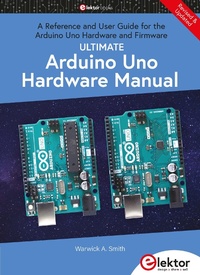
Ultimate Arduino Uno Hardware Manual
A Reference and User Guide for the Arduino Uno Hardware and Firmware
1st Edition
Published on 26. April 2021
195 pages
978-3-89576-435-6 (ISBN)
Description

A manual providing up-to-date hardware information for the popular Arduino Uno, the easy to use open-source electronics platform used by hobbyists, makers, hackers, experimenters, educators and professionals.
Get all the information that you need on the hardware and firmware found on Arduino Uno boards in this handy reference and user guide.
- ldeal for the workbench or desktop
- Contains all of the Arduino Uno hardware information in one place
- Covers Arduino / Genuino Uno revision 3 and earlier boards
- Easily find hardware technical specifications with explanations
- Pin reference chapter with interfacing examples
- Diagrams and illustrations for easy reference to alternate pin functions and hardware connections
- Learn to back up and restore firmware on the board, or load new firmware
- Basic fault finding and repair procedures for Arduino Uno boards
- Power supply circuits simplified and explained
- Mechanical dimensions split into five easy to reference diagrams
- Contains circuit diagrams, parts list and board layout reference to easily locate components
Get all the information that you need on the hardware and firmware found on Arduino Uno boards in this handy reference and user guide.
- ldeal for the workbench or desktop
- Contains all of the Arduino Uno hardware information in one place
- Covers Arduino / Genuino Uno revision 3 and earlier boards
- Easily find hardware technical specifications with explanations
- Pin reference chapter with interfacing examples
- Diagrams and illustrations for easy reference to alternate pin functions and hardware connections
- Learn to back up and restore firmware on the board, or load new firmware
- Basic fault finding and repair procedures for Arduino Uno boards
- Power supply circuits simplified and explained
- Mechanical dimensions split into five easy to reference diagrams
- Contains circuit diagrams, parts list and board layout reference to easily locate components
All prices
More details
Other editions
Additional editions
Warwick A. Smith
Ultimate Arduino Uno Hardware Manual
A Reference and User Guide for the Arduino Uno Hardware and Firmware
Book
04/2021
1st Edition
Elektor
€34.95
Article exhausted; check different version
Person
Warwick A. Smith is an electronics engineer and embedded programmer from South Africa with experience in industrial, commercial, and aerospace-related industries.
Warwick has a wide interest in various fields of technology, including embedded systems hardware, software, and information technology. His writing style has been described as "clear and concise" as well as "conversational and friendly".
Warwick has a wide interest in various fields of technology, including embedded systems hardware, software, and information technology. His writing style has been described as "clear and concise" as well as "conversational and friendly".
Content
- ULTIMATE Arduino Uno Hardware Manual
- All rights reserved
- Table of Contents
- Introduction
- Index
- 1 Arduino Uno Overview
- 1.1 Arduino Uno Description and Functionality
- 1.2 Arduino Uno Firmware
- 1.3 Precautions During Handling and Usage
- 1.4 Arduino Uno History and Revisions
- 1.5 First Time Use and Basic Testing
- 1.6 Arduino Uno References and Help
- 2 Hardware Technical Information
- 2.1 Microcontroller
- 2.2 Atmel, Microchip and AVR
- 2.3 Memory
- 2.4 Power and USB
- 2.5 Operating Frequency
- 2.6 LED Indicators and Reset Button
- 2.7 User Pin Headers
- 2.8 Programming Headers
- 2.9 Shared Pins
- 3 Pin Reference and Interfacing
- 3.1 Pin Default and Alternate Functions
- 3.2 ATmega328P to Arduino Uno Pin Mapping
- 3.3 Pin Types and Interfacing
- 3.4 ICSP Header on Main Microcontroller
- 3.5 ICSP Header on USB Microcontroller
- 3.6 JP2 Header on USB Microcontroller
- 3.7 Finding the Datasheets
- 4 Power Reference
- 4.1 Power Supply Specification
- 4.2 Power Circuit
- 4.3 Power Supply Protection
- 5 Arduino Uno Firmware and Bootloader
- 5.1 Updating the USB to Serial Bridge Firmware using DFU
- 5.2 Microchip Studio
- 5.3 USB Microcontroller Firmware
- 5.4 Main Microcontroller Bootloader
- 5.5 The RESET-EN Solder Jumper
- 5.6 Alternative Firmware Programming Methods
- 6 Circuit Diagram and Components
- 6.1 Circuit Diagram
- 6.2 Component List
- 6.3 Component Positions on the Board
- 6.4 Getting an Electronic Copy of the Circuit Diagram
- 7 Fault Finding and Measurement
- 7.1 Basic Fault Finding and Repair
- 7.2 Replacing the Main Arduino Uno Microcontroller
- 7.3 Voltage Measurements
- 7.4 Waveform Patterns and Measurement
- 8 Mechanical Dimensions and Templates
- 8.1 Measurements, Tolerance and Scale
- 8.2 Length, Width and Mass
- 8.3 Mounting Hole Spacing and Size
- 8.4 Shape Dimensions
- 8.5 Header Positions
- 8.6 Shield Reverse Connection Protection
- 8.7 Using Strip-board as a Shield
- 8.8 Drill Template and KiCad Template
- Appendix Specifications Quick Reference
