

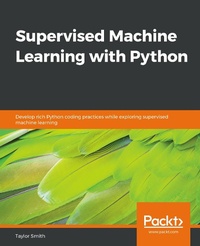
Supervised Machine Learning with Python
Develop rich Python coding practices while exploring supervised machine learning
Published on 23. September 2024
162 pages
978-1-83882-306-1 (ISBN)
Description

Teach your machine to think for itself!
Key Features
Delve into supervised learning and grasp how a machine learns from data
Implement popular machine learning algorithms from scratch
Explore some of the most popular scientific and mathematical libraries in the Python language
Book DescriptionSupervised machine learning is used in a wide range of sectors, such as finance, online advertising, and analytics, to train systems to make pricing predictions, campaign adjustments, customer recommendations, and much more by learning from the data that is used to train it and making decisions on its own. This makes it crucial to know how a machine 'learns' under the hood. This book will guide you through the implementation and nuances of many popular supervised machine learning algorithms, and help you understand how they work. You'll embark on this journey with a quick overview of supervised learning and see how it differs from unsupervised learning. You'll then explore parametric models, such as linear and logistic regression, non-parametric methods, such as decision trees, and a variety of clustering techniques that facilitate decision-making and predictions. As you advance, you'll work hands-on with recommender systems, which are widely used by online companies to increase user interaction and enrich shopping potential. Finally, you'll wrap up with a brief foray into neural networks and transfer learning. By the end of this book, you'll be equipped with hands-on techniques and will have gained the practical know-how you need to quickly and effectively apply algorithms to solve new problems.What you will learn
Crack how a machine learns a concept and generalizes its understanding of new data
Uncover the fundamental differences between parametric and non-parametric models
Implement and grok several well-known supervised learning algorithms from scratch
Work with models in domains such as ecommerce and marketing
Get to grips with algorithms such as regression, decision trees, and clustering
Build your own models capable of making predictions
Delve into the most popular approaches in deep learning such as transfer learning and neural networks
Who this book is forThis book is for anyone who wants to get started with supervised learning. Intermediate knowledge of Python programming along with fundamental knowledge of supervised learning is expected.
Key Features
Delve into supervised learning and grasp how a machine learns from data
Implement popular machine learning algorithms from scratch
Explore some of the most popular scientific and mathematical libraries in the Python language
Book DescriptionSupervised machine learning is used in a wide range of sectors, such as finance, online advertising, and analytics, to train systems to make pricing predictions, campaign adjustments, customer recommendations, and much more by learning from the data that is used to train it and making decisions on its own. This makes it crucial to know how a machine 'learns' under the hood. This book will guide you through the implementation and nuances of many popular supervised machine learning algorithms, and help you understand how they work. You'll embark on this journey with a quick overview of supervised learning and see how it differs from unsupervised learning. You'll then explore parametric models, such as linear and logistic regression, non-parametric methods, such as decision trees, and a variety of clustering techniques that facilitate decision-making and predictions. As you advance, you'll work hands-on with recommender systems, which are widely used by online companies to increase user interaction and enrich shopping potential. Finally, you'll wrap up with a brief foray into neural networks and transfer learning. By the end of this book, you'll be equipped with hands-on techniques and will have gained the practical know-how you need to quickly and effectively apply algorithms to solve new problems.What you will learn
Crack how a machine learns a concept and generalizes its understanding of new data
Uncover the fundamental differences between parametric and non-parametric models
Implement and grok several well-known supervised learning algorithms from scratch
Work with models in domains such as ecommerce and marketing
Get to grips with algorithms such as regression, decision trees, and clustering
Build your own models capable of making predictions
Delve into the most popular approaches in deep learning such as transfer learning and neural networks
Who this book is forThis book is for anyone who wants to get started with supervised learning. Intermediate knowledge of Python programming along with fundamental knowledge of supervised learning is expected.
More details
Edition
Digital original
Language
English
Place of publication
Birmingham
United Kingdom
Target group
Professional and scholarly
US School Grade: College Graduate Student
Edition type
Digital original
File size
10,24 MB
ISBN-13
978-1-83882-306-1 (9781838823061)
Copyright in bibliographic data and cover images is held by Nielsen Book Services Limited or by the publishers or by their respective licensors: all rights reserved.
Schweitzer Classification
Other editions
Additional editions
Taylor Smith
Supervised Machine Learning with Python
Develop rich Python coding practices while exploring supervised machine learning
Book
05/2019
Packt Publishing
€32.10
Shipment within 3-4 weeks
Person
Smith Taylor :
Taylor Smith is a machine learning enthusiast with over five years of experience who loves to apply interesting computational solutions to challenging business problems. Currently working as a principal data scientist, Taylor is also an active open source contributor and staunch Pythonista.
Taylor Smith is a machine learning enthusiast with over five years of experience who loves to apply interesting computational solutions to challenging business problems. Currently working as a principal data scientist, Taylor is also an active open source contributor and staunch Pythonista.
Content
Table of Contents
First step towards supervised learning
Implementing parametric models
Working with non-parametric models
Advanced topics in supervised machine learning
First step towards supervised learning
Implementing parametric models
Working with non-parametric models
Advanced topics in supervised machine learning
