

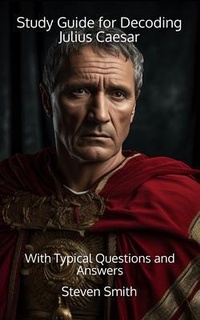
Study Guide for Decoding Julius Caesar
With Typical Questions and Answers
1st Edition
Published on 21. March 2024
117 pages
978-1-964189-18-5 (ISBN)
Description

"Decoding Julius Caesar" takes the reader into the Shakespearean play with the intention of revealing all its key aspects. Understand the intricate historical backdrop of the Roman Republic's final days, dominated by key figures like Julius Caesar, Brutus, Cassius, Mark Antony, and Octavius Caesar. Follow their character development, revealing personal dilemmas, political machinations, and pivotal transformations. The guide dissects central themes such as ambition, power, manipulation, fate, friendship, honor, public versus private life, and legacy, offering critical interpretations. It spotlights Shakespeare's masterful use of rhetorical devices, enhancing understanding of the language and vocabulary skills. Unearth the powerful relationships within the play, the significance of conflict, and the climactic turning points leading to its resolution. Furthermore, it provides insights into Caesar's influence, moral lessons, and enduring impact. This guide is an invaluable companion for students, educators, and Shakespeare enthusiasts, combining detailed analysis with historical context, comparative literature, and creative exploration. Let this guide illuminate your journey through one of Shakespeare's most significant tragedies.
More details
Content
- Intro
- 1. How to use this guide
- 2. Historical background to William Shakespeare
- 3. Historical background to Julius Caesar
- 4. Why do students study Julius Caesar
- 5. New language and vocabulary skills
- 6. Describe the character development
- 7. Examples of understanding of rhetorical devices
- 8. Examples of cultural literacy
- 9. Examples of empathy and human understanding
- 10. Examples of political philosophy and ethical dilemmas
- 11. Examples of public speaking and performance skills
- 12. Examples of understanding of dramatic devices
- 13. Examples of cultural and historical context
- 14. Examples of comparative literature
- 15. Examples of creativity
- 16. Summary to each act
- 17. Summary Act 1
- 18. Summary Act 2
- 19. Summary Act 3
- 20. Summary Act 4
- 21. Summary Act 5
- 22. Main characters
- 23. Julius Caesar
- 24. Caesar's positive characteristics
- 25. Caesar's negative charcteristics
- 26. What led to Caesar's downfall
- 27. Caesar's influence after his death
- 28. Marcus Brutus
- 29. Cassius
- 30. Mark Antony
- 31. Octavius Caesar
- 32. Portia
- 33. Calpurnia
- 34. Casca
- 35. Minor charcters
- 36. What are the important relationships
- 37. Details about Caesar and Brutus' relationship
- 38. Details about Brutus and Cassius'relationship
- 39. Details about Brutus and Portia's relationship
- 40. Details about Julius Caesar and Calpurnia's relationship
- 41. Details about Mark Antony and Caesar's relationship
- 42. Details about Mark Antony and Octavius' relationship
- 43. What are the themes
- 44. Describe ambition and power theme
- 45. Describe manipulation and rhetoric theme
- 46. Describe fate vs. free will theme
- 47. Describe friendship and betrayal theme
- 48. Describe honor and duty theme
- 49. Describe public vs. private life theme
- 50. Describe mortality and legacy theme
- 51. Conflicts
- 52. Describe the political conflict
- 53. Describe internal conflict within Brutus
- 54. Describe rhetorical conflict
- 55. Describe the climax of the play
- 56. Describe the resolution of the play
- 57. What is the moral of the story
