

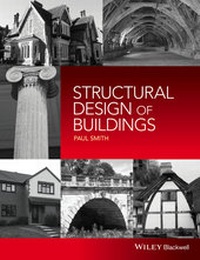
Structural Design of Buildings
Description

More details
Other editions
Additional editions
Person
Content
Acknowledgements xvii
About the Author xv
Introduction xvii
Chapter 1 The History of Buildings 1
The development of building knowledge 1
Styles of architecture and building construction 2
Chapter 2 Loadings and Aspects of Structural Theory Relating to Buildings 19
Weight and mass 19
Permanent actions or dead loads 19
Variable actions or imposed loads 20
Wind load 20
Accidental actions 26
Seismic action 26
BS EN 1991: Actions on structures EC1 26
Combinations of load and factors of safety 26
Stress 27
Strain 27
Young's modulus or modulus of elasticity 27
Plastic deformation 27
Buckling 29
Local buckling 29
Second moment of area 29
Centre of gravity 30
Lateral torsional buckling 30
Neutral axis 30
Bending force 30
Shear force and bending moment 31
Deflection 31
Static equilibrium 31
Internal forces 32
Derivation of shear force 35
Derivation of bending moment 35
Derivation of deflection 36
Basic theory of bending 37
Moment of resistance 39
Combined bending and direct stress 40
External and internal statically determinate structures 40
Connections and restraints 41
Stiffness 44
Buildings and load paths 45
Chapter 3 The Construction of Buildings 49
Breathable and non-breathable construction 49
Timber frame 51
Stone 64
Modern timber frame construction 81
Solid brick construction 81
Cavity construction 82
Steel construction 84
Commercial steel portal frames 87
Precast concrete construction 88
Chapter 4 Steel 93
Steel properties 93
Lateral torsional buckling 93
The effect of end restraints on a beam 93
Bending failure 101
Local buckling 101
Shear failure 102
Web bearing and buckling 102
Deflection 102
Fire and corrosion 102
Chapter 5 Concrete 105
The history of cement and concrete 105
Cement 105
Water and workability - now known as consistence 106
Failure of concrete 107
Strength of concrete 109
Concrete mix designs 109
Creep 111
Environment 111
Air-entrained concrete 111
Accelerators and retarders 112
Plasticizers 112
Fly ash, silica flume and ground granulated blast furnace slag 112
Anti-corrosion 112
Chapter 6 Timber 113
Grading of timber 113
Moisture 113
Air-dried timber 119
Kiln-dried timber 119
Dimensions of timber 120
Shear 120
Bending 120
Deflection 121
Chapter 7 Foundations 123
Purpose of foundations 123
The history of foundations 123
Building Regulation requirements 124
Stepped foundation 125
Types of foundation 126
Piles 132
Bearing pressure 134
Bearing capacity 134
Eccentric loading on foundations 137
Climatic and moisture changes 138
Physical damage by trees 139
Underpinning 139
Chapter 8 Walls 141
The strength of walls 141
Masonry unit 141
Frost resistance and soluble salts 142
Concrete blocks 143
Mortar 143
Lime putty (non-hydraulic lime) 144
Hydraulic lime 144
Important rules in the use of lime mortars 144
Cement 145
Characteristic strength of masonry 145
Slenderness ratio 146
Flexural stiffness and the second moment of area 147
Euler load 148
Leaning walls and stability 153
Movement joints 153
Changes due to temperature changes 154
Changes due to moisture changes 154
Traditional design of walls 155
Middle-third rule 156
Timber frame walls and raking 157
Chapter 9 Floors 161
The history of floors 161
Modern solid floors 162
Suspended floors and engineered floor joists 163
Holes and notches in floor joists 163
Limecrete 168
The use of plaster and lime ash floors 168
Beam and block suspended floors and hollow core floors 171
Damp 171
Salts 172
Sulphate attack 172
Ceilings 173
Chapter 10 Roofs 175
Trussed and cut roofs 175
Modern truss roofs 175
Cut roofs 177
Roof components 179
Wind bracing 188
Roof spread 189
Overloading of roof members 191
Alterations to roof structures 192
Traditional timber frame building trusses 192
Modern rafter design 193
Flat roof construction 195
Chapter 11 Arches and Columns 197
The history of arches 197
Inversion theory 197
Line of thrust 199
Formation of hinges 201
Visible line of thrust 201
Height and thickness of an arch 203
Gothic arch 203
Domes 203
Columns 204
Chapter 12 Geology 209
The importance of understanding geology 209
Sinkholes 209
Landslips 213
Mining 216
Loess 220
Quick sand 220
Seismic activity 220
Drainage and the water table 220
Chapter 13 Site Investigation 223
Site investigation 223
Boreholes 223
Trenches 223
Geophysics 223
Gravity surveys 223
Magnetic surveys 224
Electromagnetic surveys 224
Electrical surveys 224
Ground-penetrating radar 224
Seismic reflection surveys 224
Seismic refraction 224
Made-up ground or fill 225
Walkover 225
Japanese knotweed 227
Buddleia 227
Desk study 227
Radon 228
Chapter 14 Stability of Buildings 229
Disproportionate collapse 229
Class 1 230
Class 2A 230
Class 2B 230
Class 3 231
Chapter 15 Dimensions of Buildings 233
Building Regulations Part A 233
Slenderness ratio 234
Buttresses and end restraints 245
Lateral restraint of walls and roofs 245
Chapter 16 Basements and Retaining Structures 247
Structural considerations 247
Safety factors 248
Theory behind the design 248
Loading 248
Angle of shearing resistance 250
Effects of water 251
Proportions of walls 251
Design example 252
Specialist advice 260
Types of wall 278
Basements 281
Chapter 17 Structural Alterations 283
Preliminary considerations 283
Removal of walls 283
Alterations to timbers and trusses 285
Alterations to roof structures for dormers 287
Loft conversions 288
Flitch beams 289
Lintels and openings 293
Chapter 18 Structural Defects in Buildings 295
Structural defects 295
Compression 295
Tension 295
Shear 295
Random cracking 295
Location of cracking 296
Roof spread 296
Settlement 296
Shrinkage due to thermal and moisture movements 297
Movement of brickwork along the damp-proof course 298
Subsidence 298
Chemical reactions 301
High alumina cement (HAC) 302
Wall tie failure 302
Damp 303
Overloading 303
Professional advice 305
Chapter 19 The Ancient Use of Sign and Geometry in the Setting Out of Buildings 307
Daisy wheel 307
The golden number or golden mean 307
Pythagoras 309
Masonic markings 309
Ordnance datum bench marks 310
References 313
Index 315
Chapter 1
The History of Buildings
The development of building knowledge
In order to understand the construction of buildings it is necessary to determine the age of the building and the technologies likely to be included in the construction and design of that period. For this reason, this first chapter briefly explains the construction and features of buildings over the years and this is further developed in chapter three where the construction is discussed in more detail.
Since the beginning of time man has been engaged in building structures and it is remarkable that many of the early structures still exist. The Neolithic period as early as 6500-10 200 BC saw the first structures being made which may have been simple huts and bridges but nevertheless commenced mankind's quest to construct buildings. Buildings continued to develop through the Mesopotamian, Ancient Greek and Ancient Egyptian periods, which ranged from 6000 BC until 146 BC, and some of these structures - such as the pyramids - are a lasting legacy to the ingenuity and understanding of building construction principles. Following this, the period of the Ancient Romans from around 753 BC until 476 AD saw large-scale buildings become more commonplace. As techniques and materials became better understood, more adventurous structures were constructed.
The Medieval period of the 12th century until the 18th century saw timber frame houses being constructed and some of the early timber frame houses of this era still exist, such as the Medieval Merchants House in Southampton, Hampshire. The development of these structures is intrinsically linked to the understanding of materials and the behaviour of structures which carpenters gained over these centuries.
Masons involved in the construction of churches would travel across the east and west, refining techniques and applying them to new and larger structures. One such example is the development of the arch from a circular arch to a gothic pointed arch, which improved its ability to carry loads, thus resulting in larger-scale and more impressive structures. This is evident in the late 16th century when large glass windows became fashionable in churches to provide light, which also had a significant theological meaning.
The understanding of flying buttresses to resist large lateral and horizontal loads meant that vaulted ceilings could be constructed which accommodated large spans. The first example in England was in Durham Cathedral, which was commenced in 1093. Other early examples include the apse of the Basilica of Saint-Remi in Reims dating from 1170.
Although some of the structural principals were understood, many were based on trial and error and then carried through as tried and tested means of developing structures.
Such scholars as Marcus Vitruvius Pollio wrote some of the earliest books on architecture, and his work De architectura (known as Ten Books of Architecture) is the only surviving book from the classical period. This provided dimensions for columns based on the number and type of column used and the style of temple required. The height of the column was expressed as a multiple of the diameter. This work was not discovered until 1414 in a library in Switzerland, and interestingly there had been no other printed works prior to this time.
During the Renaissance period, in 1450, Leon Battista Alberti published De re aedificatoria, which translates as The Art of Building. This was one of the first printed books on architecture. Later, Sebastiano Serlio (1475-1554) published Regole generali d'architettura, which translates as General Rules of Architecture. Then, in 1570, Adrea Palladio published I quattro libra dell'architettura, which translates as Four Books of Architecture. This final publication carried many of the Renaissance ideas into Europe.
Prior to these publications there were very few books for architects and masons to reference how structures were constructed. Following the Renaissance period (15th-17th centuries), more information became available.
During the years 1100-1200, fire was the major concern and a hazard in built-up cities. The construction of houses during this time was predominantly in timber, and densely populated areas resulted in accommodation being provided by extending existing properties and adding additional storeys.
In 1666 the Great Fire of London transformed building control and regulation in the UK. The following year the London Building Act banned the use of timber and insisted on the use of brick and stone in the construction of houses. In 1694, following another major fire in Warwick, more major cities were prompted to introduce Building Acts based upon that introduced in London. By the 18th century, most cities had a Building Control Authority and had adopted a Building Act.
The Building Act of 1858 meant that plans had to be deposited with the authorities for new buildings and alterations. This makes it easier - after this period - to ascertain the history and construction of properties throughout the UK.
Styles of architecture and building construction
It is remarkable that today we still dwell in houses constructed as far back as Medieval times, and it is at this point that we begin our analysis of the structures of buildings based on the techniques used in the past.
Medieval
The majority of the remaining residential dwellings of this period are of timber frame. Predominantly these were of cruck construction or box frame, where the roof is a separate structure to the walls. Medieval buildings tended to have thick timber members which were irregular in shape, and the timber posts were placed directly onto or inserted into the ground. The floor joists were generally large and laid flat rather than upright, typically these would be 200 mm × 150 mm timbers. Figure 1.1 shows a photograph of a typical cruck frame construction used in a house in Herefordshire.
Figure 1.1: Photograph of typical cruck construction in Herefordshire.
In their simplest form, Medieval buildings were four-bay cruck frame structures with a large hall occupying at least two of the bays. The open-plan design centred around a large fire, which was the only means of heating. Access was gained through two large doors normally located on opposite sides, which formed cross passages. Of the remaining bays, one would form a parlour which would create some privacy for its occupants and the other would be split as a pantry and buttery for storing food and drink. Over 4000 cruck frame buildings remain in the UK today.
Other forms of construction existed at this time, and stone cottages have been constructed from materials close to hand from a very early period in history. Cob construction is another form of construction with the main component being mud, earth or clay. This form of construction can be traced back to the 14th century and was particularly evident in the south-west and central-southern England.
Tudor (1485-1560)
With the exception of churches, most buildings in the Tudor period were also of timber frame construction with box frame construction being dominant. Houses tended to be one-room deep with a limited span, as the walls did not have sufficient load-bearing capacity to support the heavy roof structure. Some masonry brick construction was used to fill the timber panels and some stone construction for windows and quoins.
Bricks were a luxury product and found only in the homes of the wealthy, and generally in the east and south parts of the country. This was predominantly because the people who knew how to make and use bricks were Flemish immigrants who settled on the east coast.
Most large houses were constructed around a central hall, with wings containing private chambers at one end and kitchens and service rooms at the other. As today, space within the towns and cities was valuable and the timber frame houses were generally owned by rich merchants. Plots in the cities tended to be long and narrow, and houses often had a rectangular form with the gable end facing onto the street. The ground floor was used for commercial enterprise, with the living accommodation being above. To gain additional space, jetties were introduced to extend over ground floors and create additional storeys.
The jetties extended the higher storeys forward of the building line into the street, reducing the distance between the facing properties. Consequently, this resulted in an increased fire risk, as fire could travel easily from one building to another. Figure 1.2 is a photograph showing the close proximity of timber frame properties in Leominster, increasing the risk of fire. This was a prominent reason for the spread of the Great Fire of London in 1666.
Figure 1.2: Photograph showing the close proximity of timber frame housing in Leominster, increasing the risk of fire.
Initially little consideration was given to external appearance, but towards the end of the Tudor period the finest timber frame houses featured close timber studding, decorative panels and brick panels with diagonal patterns.
Glazing was not generally used in properties at this time, and only the finest properties enjoyed this privilege. Timber frame houses at this time had shutters and mullions rather than glass.
Floorboards above the floor...
