

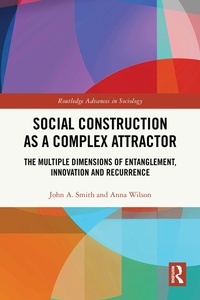
Social Construction as a Complex Attractor
The Multiple Dimensions of Entanglement, Innovation and Recurrence
Will be published approx. on 12. June 2026
240 pages
978-1-040-56242-0 (ISBN)
Description

This book examines the dominance of social construction within sociology while shedding light on what social construction looks like in practice beyond the realm of sociological thought.
The idea that reality is socially constructed has dominated sociological thinking since Berger and Luckmann's seminal work in the 1960s, but it has also been widely accepted across society and the media as the explanation of a wide range of phenomena, including conceptions of beauty, the value of money, moral standards, religion, nationality and race. By analysing a selection of key 20th- and 21st-century movements, Smith and Wilson show that the space of possible outcomes is always materially as well as socially constrained and identify path-dependent patterns of conservation and innovation.
Exploring questions of power, stratification, solidarity and freedom, it is an essential read for those who want to go beyond description and critique, and instead actively seek to understand why these are recurring patterns in human society, what kinds of alternatives might be possible, and what futures are open to us. As such, it will appeal to scholars and students interested in complex approaches across a wide range of fields, in particular to those working within sociology, social theory, philosophy, anthropology and geography.
The idea that reality is socially constructed has dominated sociological thinking since Berger and Luckmann's seminal work in the 1960s, but it has also been widely accepted across society and the media as the explanation of a wide range of phenomena, including conceptions of beauty, the value of money, moral standards, religion, nationality and race. By analysing a selection of key 20th- and 21st-century movements, Smith and Wilson show that the space of possible outcomes is always materially as well as socially constrained and identify path-dependent patterns of conservation and innovation.
Exploring questions of power, stratification, solidarity and freedom, it is an essential read for those who want to go beyond description and critique, and instead actively seek to understand why these are recurring patterns in human society, what kinds of alternatives might be possible, and what futures are open to us. As such, it will appeal to scholars and students interested in complex approaches across a wide range of fields, in particular to those working within sociology, social theory, philosophy, anthropology and geography.
More details
Series
Language
English
Place of publication
London
United Kingdom
Publishing group
Taylor & Francis Ltd
Target group
College/higher education
Professional and scholarly
File size
1,76 MB
ISBN-13
978-1-040-56242-0 (9781040562420)
Copyright in bibliographic data and cover images is held by Nielsen Book Services Limited or by the publishers or by their respective licensors: all rights reserved.
Schweitzer Classification
Other editions
Additional editions
John A. Smith | Anna Wilson
Social Construction as a Complex Attractor
The Multiple Dimensions of Entanglement, Innovation and Recurrence
Book
approx. 06/2026
1st Edition
Routledge
€191.50
Not yet published
Persons
John A. Smith has taught at Goldsmiths College, University of London; Lancaster University; and Greenwich University. He is a sociologist and a painter trained at the Royal College of Art. He is interested in sociological theory, philosophy and visual culture, and has published in all of these areas. His most recent work was Radical Ecology in the Face of the Anthropocene Extinction (2024), also with Anna Wilson.
Anna Wilson is a transdisciplinary academic who has researched and taught in physics and education in universities in the UK and Australia. She is currently based in the School of Education at the University of Glasgow, where her research explores learning in the context of complex predicaments including technologization, climate change and (un)sustainability.
Anna Wilson is a transdisciplinary academic who has researched and taught in physics and education in universities in the UK and Australia. She is currently based in the School of Education at the University of Glasgow, where her research explores learning in the context of complex predicaments including technologization, climate change and (un)sustainability.
Content
Introduction; 1. Social Construction in Sociology: the 19th and 20th Century Legacy; 2. Economic and Psychological Perspectives on Social Construction: America, the Soviet Union and Europe after World War I; 3. Post World War II: Containing Communism and Fascism; Promoting Liberty Democracy and the Free Market; 4. Ecological-Topographical and Emotional-Cognitive Perspectives; 5. 21st Century Developments; 6. Conclusions
