

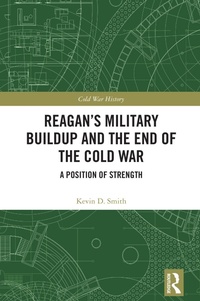
Reagan's Military Buildup and the End of the Cold War
A Position of Strength
1st Edition
Will be published approx. on 30. June 2026
298 pages
978-1-040-59531-2 (ISBN)
Description

This book offers an analysis of the United States' conventional military buildup during the final decade of the Cold War.
Departing from a historiography largely focused on strategic arms and summit diplomacy, the work examines how the modernization of non-nuclear forces formed an integral part of Ronald Reagan's broader Cold War strategy. It shows that the revitalization of conventional forces was not ancillary to diplomacy but a central pillar of a policy that sought to negotiate from strength while enhancing deterrence. Spanning the late 1970s and 1980s, the book explores how the armed forces were rebuilt after the post-Vietnam downturn. It highlights well-known and illustrative case studies - including the M1 Abrams tank, advanced tactical aircraft, naval expansion, precision-guided munitions, and new command-and-control systems - to demonstrate how doctrine, technology, and personnel reforms were closely linked. Methodologically grounded in defense budgets, congressional debates, official reports, and service doctrines, the study argues that the conventional buildup played a significant yet underappreciated role in shaping the Cold War's final phase. By strengthening deterrence, reassuring allies, and intensifying economic and technological competition, these reforms contributed to pressures that influenced Soviet policy choices and reforms, leaving an enduring imprint on the Cold War's outcome and the post-Cold War world.
This book will be of much interest to students of US political history, Cold War studies, strategic studies, and international relations.
Departing from a historiography largely focused on strategic arms and summit diplomacy, the work examines how the modernization of non-nuclear forces formed an integral part of Ronald Reagan's broader Cold War strategy. It shows that the revitalization of conventional forces was not ancillary to diplomacy but a central pillar of a policy that sought to negotiate from strength while enhancing deterrence. Spanning the late 1970s and 1980s, the book explores how the armed forces were rebuilt after the post-Vietnam downturn. It highlights well-known and illustrative case studies - including the M1 Abrams tank, advanced tactical aircraft, naval expansion, precision-guided munitions, and new command-and-control systems - to demonstrate how doctrine, technology, and personnel reforms were closely linked. Methodologically grounded in defense budgets, congressional debates, official reports, and service doctrines, the study argues that the conventional buildup played a significant yet underappreciated role in shaping the Cold War's final phase. By strengthening deterrence, reassuring allies, and intensifying economic and technological competition, these reforms contributed to pressures that influenced Soviet policy choices and reforms, leaving an enduring imprint on the Cold War's outcome and the post-Cold War world.
This book will be of much interest to students of US political history, Cold War studies, strategic studies, and international relations.
More details
Series
Edition
1. Auflage
Language
English
Place of publication
London
United Kingdom
Publishing group
Taylor & Francis Ltd
Target group
College/higher education
Professional and scholarly
Illustrations
45 Tables, black and white; 29 Line drawings, black and white; 29 Illustrations, black and white
File size
10,79 MB
ISBN-13
978-1-040-59531-2 (9781040595312)
Copyright in bibliographic data and cover images is held by Nielsen Book Services Limited or by the publishers or by their respective licensors: all rights reserved.
Schweitzer Classification
Other editions
Additional editions
Book
approx. 06/2026
1st Edition
Routledge
€192.50
Not yet published
Person
Kevin D. Smith is the Executive Director of the National Institute for Cold War Studies and has a PhD in History from Liberty University.
Content
Introduction 1 Defense Budgets 2 Carter's Buildup 3 The Challenges of 1981 4 Doctrines of Defense 5 Procurement 6 Research, Development, Test, and Evaluation 7 Personnel 8 Operations 9 Dividends 10 Beyond the Buildup
