

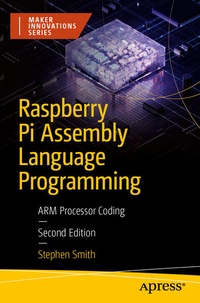
Raspberry Pi Assembly Language Programming
Description

Gain all the skills required to dive into the fundamentals of the Raspberry Pi hardware architecture and how data is stored in the Pi's memory. This book provides you with working starting points for your own projects while you develop a working knowledge of Assembly Language programming on the Raspberry Pi.
You'll learn how to interface to the Pi's hardware including accessing the GPIO ports. The book covers the basics of code optimization as well as how to inter-operate with C and Python code, so you'll develop enough background to use the official ARM reference documentation for further projects.
With Raspberry Pi Assembly Language Programming as your guide, you'll study how to read and reverse engineer machine code and then apply those new skills to study code examples and take control of your Pi's hardware and software both.
For this New Edition
Since the original edition, the Raspberry Pi OS has moved to 64-bits. The operating system has been revamped along with several new versions of the Raspberry Pi hardware. The new edition is 64-bit, based on the latest Raspberry Pi OS and hardware, and incorporates reader feedback from the first edition.
What You'll Learn
- Program basic ARM 64-Bit Assembly Language
- Interface with the various hardware devices on the Raspberry Pi
- Comprehend code containing Assembly Language
- Use the official ARM reference documentation
Who This Book Is For
Coders who have already learned to program in a higher-level language like Python, Java, C#, or C and now wish to learn Assembly Language programming.
More details
Other editions
Additional editions
Previous edition
Person
Stephen Smith is a retired Software Architect, located in Gibsons, BC, Canada. He's been developing software since high-school, or way too many years to record. Since retiring he has pursued Artificial Intelligence programming, earned his Advanced HAM Radio License and enjoys mountain biking, hiking, and nature photography. He continues to write his popular technology blog at smist08.wordpress.com.
Content
Chapter 1: Getting Started.- Chapter 2: Loading and Adding.- Chapter 3: Tooling Up.- Chapter 4: Controlling Program Flow.- Chapter 5: Thanks for the Memories.- Chapter 6: Functions and the Stack.- Chapter 7: Linux Operating System Services.- Chapter 8: Programming GPIO Pins.- Chapter 9: Interacting with C and Python.- Chapter 10: Multiply, Divide and Accumulate.- Chapter 11: Floating Point Operations.- Chapter 12: Neon Coprocessor.- Chapter 13: Optimizing Code.- Chapter 14: Reading and Understanding Code.- Chapter 15: Hacking Code.- Appendix A: The ARM Instruction Set.- Appendix B: Linux System Calls.- Appendix C: Binary Formats.- Appendix D: Assembler Directives.- Appendix E: ASCII Character Set.
