

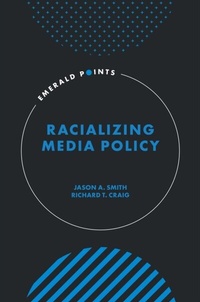
Racializing Media Policy
1st Edition
Published on 22. February 2023
120 pages
978-1-80455-738-9 (ISBN)
Description

Scholars in the Sociology of Race have extensively researched public policy sectors such as housing, taxation, and immigration. However, media policy research has often failed to effectively engage with the critical concept of racialization, driven instead by political and economic perspectives. Racializing Media Policy fills this gap in the sociological, communications, and media studies literatures with its focus on the racialized processes that construct media policy work in the United States.
With research that merges subfields of racialization and media policy, explores the US broadcasting policy, and examines racialization without integration and mediating structural challenges, the authors delve into multiple scenarios of racialization in policy. The chapters offer theoretical frameworks and case studies to consider the ways that media policy spaces are embedded with ideologies and praxes surrounding race.
Racializing Media Policy contributes to a wider understanding of the role of policy work in the media systems, particularly by examining the ways that race is embedded within those structures. This unique perspective makes the volume an important read for scholars across the Sociology and Media Studies fields, in addition to providing critical context for policymakers.
With research that merges subfields of racialization and media policy, explores the US broadcasting policy, and examines racialization without integration and mediating structural challenges, the authors delve into multiple scenarios of racialization in policy. The chapters offer theoretical frameworks and case studies to consider the ways that media policy spaces are embedded with ideologies and praxes surrounding race.
Racializing Media Policy contributes to a wider understanding of the role of policy work in the media systems, particularly by examining the ways that race is embedded within those structures. This unique perspective makes the volume an important read for scholars across the Sociology and Media Studies fields, in addition to providing critical context for policymakers.
Reviews / Votes
Racializing Media Policy [...] is a robust and deeply reported historical account of race in media policy [...] its accessible writing and thorough case studies make it valuable for journalists, policymakers, and media professionals striving to understand the systemic barriers that shape racial representation in broadcast media. For researchers interested in media policy, this book provides a strong historical and theoretical framework to examine broadcast regulation as a racialized system. -- Yelena Dzhanova, Temple University - Reviewed in Journal of Broadcasting & Electronic MediaMore details
Series
Language
English
Place of publication
Bingley
United Kingdom
Target group
Professional and scholarly
File size
0,45 MB
ISBN-13
978-1-80455-738-9 (9781804557389)
Copyright in bibliographic data and cover images is held by Nielsen Book Services Limited or by the publishers or by their respective licensors: all rights reserved.
Schweitzer Classification
Other editions
Additional editions
Jason A. Smith | Richard T. Craig
Racializing Media Policy
Book
02/2023
Emerald Publishing Limited
€66.90
Shipment within 3-4 weeks
Persons
Jason A. Smith is an Affiliate Faculty with the Center for Social Science Research at George Mason University, USA, and member of the Justice 21 Committee with the Society for the Study of Social Problems.
Richard T. Craig is an Associate Professor of Communication at George Mason University, USA. His research centers on mass media political economy; addressing the production, distribution and consumption of media content.
Richard T. Craig is an Associate Professor of Communication at George Mason University, USA. His research centers on mass media political economy; addressing the production, distribution and consumption of media content.
Content
Chapter 1. Merging the Subfields of Racialization and Media Policy; Jason A. Smith and Richard T. Craig
Chapter 2. The Problems of US Broadcasting Policy: Race, Rights, and Regulation; Allison Perlman
Chapter 3. Racialization Without Integration: The Fight for NBC Diversity in the 1940s and 1950s; Leah P. Hunter
Chapter 4. Mediating the Crisis: Collective Narrative Self-Determination and Structural Challenges to Media Policy in Philadelphia; Malav Kanuga
Chapter 2. The Problems of US Broadcasting Policy: Race, Rights, and Regulation; Allison Perlman
Chapter 3. Racialization Without Integration: The Fight for NBC Diversity in the 1940s and 1950s; Leah P. Hunter
Chapter 4. Mediating the Crisis: Collective Narrative Self-Determination and Structural Challenges to Media Policy in Philadelphia; Malav Kanuga
