

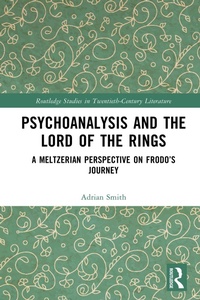
Psychoanalysis and The Lord of the Rings
A Meltzerian Perspective on Frodo's Journey
1st Edition
Published on 26. February 2026
256 pages
978-1-040-65171-1 (ISBN)
Description

Psychoanalysis and The Lord of the Rings offers a psychoanalytical perspective on The Lord of the Rings, informed by the Kleinian school within psychoanalysis, especially the work of Donald Meltzer. Treating Tolkien's work as a bildungsroman, a forming novel or come-of-age tale, this study tracks Frodo's journey as the evolving ego of the tale whilst other characters, in the main, are his internal objects. The various domains he passes through in Middle-Earth strongly correlate with Meltzer's descriptions of the compartments of the internal mother: an internal phantasy and retreat to a seemingly safe 'enclosed space', or 'Claustrum'. The book presents a coherent psychoanalytical interpretation of Frodo's journey and breaks down Meltzer's challenging ideas to make them more accessible in the context of Frodo's venture through Middle-Earth. This book is primarily for scholars of Tolkien Studies, as well as literary scholars interested in psychoanalysis and psychoanalytical approaches to twentieth-century literature.
Reviews / Votes
"Just as Freud's commentaries on Oedipus Rex and Hamlet transformed readers' experience of those plays, Adrian Smith's bold reading of J. R. R. Tolkien's The Lord of the Rings in light of Donald Meltzer's ideas will transform and deepen readers' experience of this much-loved text, in line with the psychoanalytic ethos of taking fantasy seriously. Readers drawn to the book because of an interest in Meltzer's work will also find that its exploration via Frodo's journey provides a valuable guide to navigation of Meltzer's notoriously difficult contributions."--Elizabeth Allison, DPhil, Director, UCL Psychoanalysis Unit
"Adrian Smith's ambitious and scholarly study brings together his appreciative reading of Tolkien's The Lord of the Rings with his interest in psychoanalytic understandings of the inner world of dream and fantasy, and particularly the contributions of Donald Meltzer. He takes his readers on a dizzying journey following Frodo's travels from the Shire to Mordor and home again, exploring the correlation between the landscapes and peoples he and his companions encounter, and must get to know, with the internal landscapes met within clinical practice and described by Meltzer. Smith argues that this conjunction illuminates the imaginative vision of both Tolkien and Meltzer, mutually enriching to both.
He writes beautifully, clearly inspired by a passion to share the discoveries he has made. It is truly a tour de force to weave together so eloquently such totally different kinds of writing about fundamental human problems. Lovers (and critics) of Tolkien and those interested in linking psychoanalysis and literature will discover in Smith a highly original voice."
--Margaret Rustin, Honorary Consultant Child Psychotherapist, Tavistock and Portman NHS Foundation Trust, and Child Analyst, British Psychoanalytical Society
"Adrian Smith has taken an inventive approach to the work of two authors, both known for their dense and difficult writing, and has succeeded in showing how they illuminate each other. Using Donald Meltzer's psychoanalytic ideas about the unconscious phantasy of intrusive projective identification to explore the imaginary world of J. R. R. Tolkien's The Lord of the Rings, Smith has both brought vivid life to Meltzer's ideas about the "claustrum" and used these ideas to illustrate the psychological developmental trajectory narrated in the journey described in Tolkien's epic.
This book gives readers of Tolkien a new and profound experience of his work, and it gives students of Meltzer a shockingly vital and convincing illustration of his theories. The text is detailed and challenging, but exhilarating too, because it shows how art can bring alive the mysteries of mind that psychoanalytic theory aspires to describe."
--Pamela Sorensen, PhD, Child Psychotherapist
More details
Series
Edition
1. Auflage
Language
English
Place of publication
London
United Kingdom
Publishing group
Taylor & Francis Ltd
Target group
College/higher education
Professional and scholarly
Product notice
Reflowable
File size
0,82 MB
ISBN-13
978-1-040-65171-1 (9781040651711)
Copyright in bibliographic data and cover images is held by Nielsen Book Services Limited or by the publishers or by their respective licensors: all rights reserved.
Schweitzer Classification
Other editions
Additional editions
Book
approx. 02/2026
1st Edition
Routledge
€211.20
Not yet published
Person
Adrian Smith teaches Religious Studies and Philosophy at a London independent school and has just completed his PhD at University College London. He regularly engages with literary studies through psychoanalysis and has published in the Journal of Analytical Psychology.
Content
Introduction
Chapter 1: Inside
Chapter 2: In Between
Chapter 3: Outside and Emerging
Chapter 4: Pippin's Story
Chapter 5: Gollum
Chapter 6: Merry's Story
Chapter 7: Reparation and Retreat
Conclusion
Chapter 1: Inside
Chapter 2: In Between
Chapter 3: Outside and Emerging
Chapter 4: Pippin's Story
Chapter 5: Gollum
Chapter 6: Merry's Story
Chapter 7: Reparation and Retreat
Conclusion
