

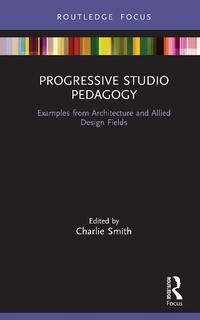
Progressive Studio Pedagogy
Examples from Architecture and Allied Design Fields
1st Edition
Published on 30. November 2020
146 pages
978-1-000-32765-6 (ISBN)
Description

Progressive Studio Pedagogy provides guidance to educators in all design fields by questioning processes and assumptions about teaching and learning, utilising examples from architecture, landscape architecture, and interior design.
Through a series of case studies, this book presents innovative approaches to learning and teaching in design studio. Traditionally, design education is perceived to be a process for acquiring skills and a site for developing creative potential. However, contemporary higher education is embracing issues that include widening participation, managing transition, and fostering independent learning and graduate employability. This book situates design learning within this varied context and offers insights into how to confront the challenge of facilitating learning through divergent contexts by presenting projects and courses that use a range of approaches that require students to think and act critically and evaluatively.
Progressive Studio Pedagogy presents new practices that readers can adapt into their own creative education, making it an ideal read for those interested in teaching design.
Through a series of case studies, this book presents innovative approaches to learning and teaching in design studio. Traditionally, design education is perceived to be a process for acquiring skills and a site for developing creative potential. However, contemporary higher education is embracing issues that include widening participation, managing transition, and fostering independent learning and graduate employability. This book situates design learning within this varied context and offers insights into how to confront the challenge of facilitating learning through divergent contexts by presenting projects and courses that use a range of approaches that require students to think and act critically and evaluatively.
Progressive Studio Pedagogy presents new practices that readers can adapt into their own creative education, making it an ideal read for those interested in teaching design.
Reviews / Votes
"This volume presents an invaluable selection of alternative approaches to the hegemonic Beaux-Arts model of architecture education. Each chapter presents practical and imaginative case studies of teaching and learning architecture, drawing upon innovative pedagogical theories from higher education and encouraging tutors to critically challenge assumed and redundant conventions."Dr. Peter Holgate, Associate Professor of Architecture / Director of Education, Northumbria University
More details
Series
Edition
1. Auflage
Language
English
Place of publication
London
United Kingdom
Publishing group
Taylor & Francis Ltd
Target group
College/higher education
Professional and scholarly
Illustrations
2 Tables, black and white; 5 Line drawings, black and white; 12 Halftones, black and white; 20 Illustrations, black and white
ISBN-13
978-1-000-32765-6 (9781000327656)
Copyright in bibliographic data and cover images is held by Nielsen Book Services Limited or by the publishers or by their respective licensors: all rights reserved.
Schweitzer Classification
Other editions
Additional editions
Book
01/2023
1st Edition
Routledge
€30.80
Shipment within 15-20 days
Book
12/2020
1st Edition
Routledge
€82.00
Shipment within 15-20 days
Person
Charlie Smith is Reader in Creative Pedagogies at Liverpool John Moores University. His research focuses on learning and teaching in creative disciplines - and on assessment and feedback in particular - to enhance and enrich the student learning experience. Research projects he has led include studying students' perceptions of the design review, students' understanding and uptake of feedback, and students' expectations and experience of higher education. He has also innovated ways in which students' studio project work can inform research projects, creating collaborative partnerships with them.
Content
Introduction Charlie Smith; Chapter One: A Framework for Enhancing the Design Skill Sets of Landscape Architecture Students Gerhard Griesel and Magda Fourie-Malherbe; Chapter Two: Integrating Critical and Rhetorical Writing in the Beginning Architecture Studio Andrew R. Tripp; Chapter Three: Refocusing the Interior Lens: Other Methods of Critical and Creative Inquiry in the Architecture Studio Anika van Aswegen; Chapter Four: Collaborative Thinking Through the Dynamics of Site and Architecture in Design Education Sean Burns; Chapter Five: Strategies for Nurturing Evaluative Judgement in Design Students Charlie Smith; Conclusions Charlie Smith
