

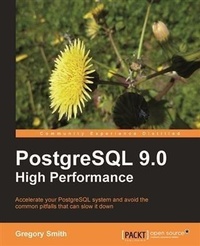
PostgreSQL 9.0 High Performance
If you'AEore an intermediate to advanced database administrator, this book is the shortcut to optimizing and troubleshooting your PostgreSQL database. With a balanced mix of theory and practice, it will quickly hone your expertise.
Published on 13. January 2025
468 pages
978-1-84951-031-8 (ISBN)
Description

If you'AEore an intermediate to advanced database administrator, this book is the shortcut to optimizing and troubleshooting your PostgreSQL database. With a balanced mix of theory and practice, it will quickly hone your expertise.
Key Features
Learn the right techniques to obtain optimal PostgreSQL database performance, from initial design to routine maintenance
Discover the techniques used to scale successful database installations
Avoid the common pitfalls that can slow your system down
Filled with advice about what you should be doing; how to build experimental databases to explore performance topics, and then move what you've learned into a production database environment
Covers versions 8.1 through 9.0
Book DescriptionPostgreSQL database servers have a common set of problems they encounter as their usage gets heavier and requirements more demanding. You could spend years discovering solutions to them all, step by step as you encounter them. Or you can just look in here.All successful database applications are destined to eventually run into issues scaling up their performance. Peek into the future of your PostgreSQL database's problems today. Know the warning signs to look for, and how to avoid the most common issues before they even happen.Surprisingly, most PostgreSQL database applications evolve in the same way: Choose the right hardware. Tune the operating system and server memory use. Optimize queries against the database, with the right indexes. Monitor every layer, from hardware to queries, using some tools that are inside PostgreSQL and others that are external. Using monitoring insight, continuously rework the design and configuration. On reaching the limits of a single server, break things up; connection pooling, caching, partitioning, and replication can all help handle increasing database workloads. The path to a high performance database system isn't always easy. But it doesn't have to be mysterious with the right guide.What you will learn
Learn best practices culled from years of work scaling PostgreSQL installations to handle demanding applications
Uncover what makes hardware good or bad for high-performance database applications
Investigate making informed speed and reliability trade-offs
Tweak your operating system for best database performance
Benchmark your whole system from hardware to application
Learn how the server parameters that impact performance work using real examples
Understand how the query optimizer makes its decisions, and what to do when it makes the wrong ones
Monitor what happens on your server, both in and outside of the database
Find the best add-on tools that extend the core PostgreSQL database
Discover how to architect replicated systems using the latest features added to PostgreSQL 9.0
Who this book is forThis book is aimed at intermediate to advanced database administrators using or planning to use PostgreSQL. Portions will also interest systems administrators looking to build or monitor a PostgreSQL installation, as well as developers interested in advanced database internals that impact application design.
Key Features
Learn the right techniques to obtain optimal PostgreSQL database performance, from initial design to routine maintenance
Discover the techniques used to scale successful database installations
Avoid the common pitfalls that can slow your system down
Filled with advice about what you should be doing; how to build experimental databases to explore performance topics, and then move what you've learned into a production database environment
Covers versions 8.1 through 9.0
Book DescriptionPostgreSQL database servers have a common set of problems they encounter as their usage gets heavier and requirements more demanding. You could spend years discovering solutions to them all, step by step as you encounter them. Or you can just look in here.All successful database applications are destined to eventually run into issues scaling up their performance. Peek into the future of your PostgreSQL database's problems today. Know the warning signs to look for, and how to avoid the most common issues before they even happen.Surprisingly, most PostgreSQL database applications evolve in the same way: Choose the right hardware. Tune the operating system and server memory use. Optimize queries against the database, with the right indexes. Monitor every layer, from hardware to queries, using some tools that are inside PostgreSQL and others that are external. Using monitoring insight, continuously rework the design and configuration. On reaching the limits of a single server, break things up; connection pooling, caching, partitioning, and replication can all help handle increasing database workloads. The path to a high performance database system isn't always easy. But it doesn't have to be mysterious with the right guide.What you will learn
Learn best practices culled from years of work scaling PostgreSQL installations to handle demanding applications
Uncover what makes hardware good or bad for high-performance database applications
Investigate making informed speed and reliability trade-offs
Tweak your operating system for best database performance
Benchmark your whole system from hardware to application
Learn how the server parameters that impact performance work using real examples
Understand how the query optimizer makes its decisions, and what to do when it makes the wrong ones
Monitor what happens on your server, both in and outside of the database
Find the best add-on tools that extend the core PostgreSQL database
Discover how to architect replicated systems using the latest features added to PostgreSQL 9.0
Who this book is forThis book is aimed at intermediate to advanced database administrators using or planning to use PostgreSQL. Portions will also interest systems administrators looking to build or monitor a PostgreSQL installation, as well as developers interested in advanced database internals that impact application design.
More details
Edition
Digital original
Language
English
Place of publication
Birmingham
United Kingdom
Target group
Professional and scholarly
Edition type
Digital original
File size
4,90 MB
ISBN-13
978-1-84951-031-8 (9781849510318)
Copyright in bibliographic data and cover images is held by Nielsen Book Services Limited or by the publishers or by their respective licensors: all rights reserved.
Schweitzer Classification
Other editions
Additional editions
Gregory Smith
PostgreSQL 9.0 High Performance
Book
10/2010
Packt Publishing
€64.40
Shipment within 3-4 weeks
Person
Smith Gregory :
Gregory Smith is a chief PostgreSQL evangelist in Charleston, South Carolina, for Crunchy Data Solutions. He's been providing database advice to clients in industries such as manufacturing, finance, and web development for 20 years. He has contributed feature additions to every PostgreSQL version since 8.3. He's also the creator of a growing set of add-on tools for the database, currently including PgTune, pgbench-tools, peg, and 2warm.
Gregory Smith is a chief PostgreSQL evangelist in Charleston, South Carolina, for Crunchy Data Solutions. He's been providing database advice to clients in industries such as manufacturing, finance, and web development for 20 years. He has contributed feature additions to every PostgreSQL version since 8.3. He's also the creator of a growing set of add-on tools for the database, currently including PgTune, pgbench-tools, peg, and 2warm.
Content
Table of Contents
