

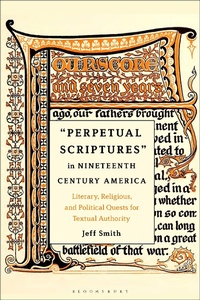
Perpetual Scriptures in Nineteenth-Century America
Literary, Religious, and Political Quests for Textual Authority
1st Edition
Published on 10. August 2023
304 pages
978-1-5013-9897-1 (ISBN)
Description

In the tumultuous decades of rapid expansion and change between the American Founding and the Civil War, Americans confronted a cluster of overlapping crises whose common theme was the difficulty of finding authority in written texts. The issue arose from several disruptive developments: rising challenges to the traditional authority of the Bible in a society that was intensely Protestant; persistent worries over America's lack of a "national literature" and an independent cultural identity; and the slavery crisis, which provoked tremendous struggles over clashing interpretations of the Declaration of Independence and the Constitution, even as these "parascriptures" were rising to the status of a kind of quasi-sacred secular canon.
At the same time but from the opposite direction, new mass media were creating a new, industrial-scale print culture that put a premium on very non-sacred, disposable text: mass-produced "news," dispensed immediately and in huge quantities but meant only for the day or hour. Perpetual Scriptures in Nineteenth-Century America identifies key features of the writings, careers and cultural politics of several prominent Americans as responses to this cluster of challenges. In their varied attempts to vindicate the sacred and to merge the timeless with the urgent present, Joseph Smith, Ralph Waldo Emerson, Margaret Fuller, Theodore Parker, Harriet Beecher Stowe, Walt Whitman, Frederick Douglass, Martin Delany, Abraham Lincoln, and other religious and political leaders and men and women of letters helped define American literary culture as an ongoing quest for new "bibles," or what Emerson called a "perpetual scripture."
At the same time but from the opposite direction, new mass media were creating a new, industrial-scale print culture that put a premium on very non-sacred, disposable text: mass-produced "news," dispensed immediately and in huge quantities but meant only for the day or hour. Perpetual Scriptures in Nineteenth-Century America identifies key features of the writings, careers and cultural politics of several prominent Americans as responses to this cluster of challenges. In their varied attempts to vindicate the sacred and to merge the timeless with the urgent present, Joseph Smith, Ralph Waldo Emerson, Margaret Fuller, Theodore Parker, Harriet Beecher Stowe, Walt Whitman, Frederick Douglass, Martin Delany, Abraham Lincoln, and other religious and political leaders and men and women of letters helped define American literary culture as an ongoing quest for new "bibles," or what Emerson called a "perpetual scripture."
Reviews / Votes
This is a work of literary, intellectual, and cultural history of unusual ambition and originality in its expansive scope, potentially of much interest to academic readers from graduate students to senior scholars in a range of Americanist fields: American religion, literature, history, politics, journalism, and such interdisciplines as print culture and history of the book studies. * Lawrence Buell, Powell M. Cabot Professor Emeritus of American Literature, Harvard University, USA * A fascinating and original exploration of the sacred and secular texts by which nineteenth-century Americans sought to define the nation and its purposes. * James Gilbert, Professor Emeritus of History, University of Maryland, USA *More details
Edition
1. Auflage
Language
English
Place of publication
New York
United States
Publishing group
Bloomsbury Publishing PLC (Digital)
Target group
Professional and scholarly
Illustrations
2 bw illus
ISBN-13
978-1-5013-9897-1 (9781501398971)
Copyright in bibliographic data and cover images is held by Nielsen Book Services Limited or by the publishers or by their respective licensors: all rights reserved.
Schweitzer Classification
Other editions
Additional editions
Jeff Smith
Perpetual Scriptures in Nineteenth-Century America
Literary, Religious, and Political Quests for Textual Authority
Book
03/2025
Bloomsbury Academic USA
€55.89
Shipment within 15-20 days
Jeff Smith
Perpetual Scriptures in Nineteenth-Century America
Literary, Religious, and Political Quests for Textual Authority
Book
09/2023
Bloomsbury Academic USA
€133.70
Shipment within 15-20 days
Person
Jeff Smith is a docent professor of English and American Studies at Masaryk University and the University of Ostrava, Czech Republic, and is the author of The Presidents We Imagine: Two Centuries of White House Fictions on the Page, on the Stage, Onscreen, and Online (2009) and Unthinking the Unthinkable: Nuclear Weapons and Western Culture (1989).
Content
Introduction: A Nation Founded on Writing
Part One: The Quest for New Prophets
1. The "World's Oldest Book" and the Crisis of Scriptural Authority
2. Revivals, Reaction, and the Ultra-Protestants
3. Scriptures as Sepulchres: Unitarians and Transcendentalists
4. Spirit and Kingdom: Language, Social Action, and the "True Reviving"
Part Two: The Quest for New Scriptures
5. American Parascriptures: The Making of a National Political Canon
6. Sacred Ephemera: News, Literature, and Uncle Tom's Cabin
7. Walt Whitman's "New Bible" and the Spiritual Vitalizing of Facts
Part Three: The Quest for National Salvation
8. Slavery, Liberty, and the Three Great Charters
9. Lincoln's Miniature Bible: Salvation History in the Gettysburg Address
Conclusion: The New American Testaments
Notes
Bibliography
Index
Part One: The Quest for New Prophets
1. The "World's Oldest Book" and the Crisis of Scriptural Authority
2. Revivals, Reaction, and the Ultra-Protestants
3. Scriptures as Sepulchres: Unitarians and Transcendentalists
4. Spirit and Kingdom: Language, Social Action, and the "True Reviving"
Part Two: The Quest for New Scriptures
5. American Parascriptures: The Making of a National Political Canon
6. Sacred Ephemera: News, Literature, and Uncle Tom's Cabin
7. Walt Whitman's "New Bible" and the Spiritual Vitalizing of Facts
Part Three: The Quest for National Salvation
8. Slavery, Liberty, and the Three Great Charters
9. Lincoln's Miniature Bible: Salvation History in the Gettysburg Address
Conclusion: The New American Testaments
Notes
Bibliography
Index
