

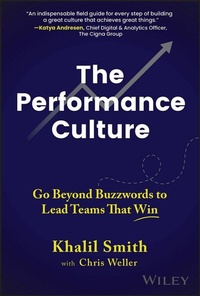
The Performance Culture
Description

A powerful framework for going beyond the corporate buzzwords to generate real business results
In The Performance Culture, leadership expert Khalil Smith and veteran storyteller Chris Weller deliver an authoritative and practical instruction manual for every leader who wants to create healthy, high-performing cultures. The authors explain how to get your employees aligned, engaged, and collaborating with each other using compelling stories and contemporary research.
In the book, you'll learn to turn the temperature down on some of business' hottest conversations, focusing on what actually creates top-tier performance without ignoring the pressing issues that influence the realities of work. You'll also find:
- Strategies for maintaining a strong focus on business results with an increasingly vocal employee base demanding action on social and political issues
- The four key ingredients to creating high-performing teams: awareness, behaviors, community, and systems
- Practical advice for making the most of your existing diversity, equity, and inclusion strategies
A can't-miss guide for today's leaders, managers, directors, executives, founders, and anyone who wants to build more successful and durable teams, The Performance Culture is an effective and essential roadmap that transforms how diverse and inclusive workplaces succeed.
More details
Other editions
Additional editions
Persons
KHALIL SMITH, MBA, MS, is the Vice President of Inclusion, Diversity, and Engagement at Akamai Technologies. He and his team oversee key elements of the employee experience, including employer branding, employee listening, employee programs, and the Akamai Foundation, a philanthropic arm of the organization.
CHRIS WELLER is the founder of 1-Across, a ghostwriting firm that works with top social scientists, business executives, and entrepreneurs to change how people see the world.
Content
Introduction xi
Work isn't working
Chapter 1 A Big Misunderstanding 1
Amid the debates over profits, politics, and buzzwords, we've missed work's best purpose
Chapter 2 The ABCS of Culture 15
Appreciating the importance of awareness, behaviors, community, and systems
Chapter 3 Start with Awareness 31
Where are you paying attention?
Chapter 4 Awareness Practice 45
Forget what you "know," ask deep questions, and do your research
Chapter 5 Behaviors Over Beliefs 57
Focus on actions over ideologies Copyrighted Material
Chapter 6 Behaviors Practice 71
Be specific, use plain language, and make it shareable
Chapter 7 Cultivating Community 83
Be a Good Neighbor to Your Colleagues ix
Chapter 8 Community Practice 97
Identify your crucial stakeholders, shift your perspective, and craft the story
Chapter 9 Systems Cement the Change 111
How to make your culture run (almost) on autopilot
Chapter 10 Systems Practice 125
Anticipate and evaluate, map the flow, and keep systems supportive
Chapter 11 Putting It All Together 141
When effective culture just looks like high performance
Epilogue 161
Building cultures that win
Notes 169
Acknowledgments 175
About the Author 177
Index 179
Introduction
Work isn't working.
As different as we are, in terms of what we value, what we enjoy, what we dream about, and wish for, one of the things we tend to share, probably even more so if you are reading this book, is that we work.
We may work mostly at home, in an office, in a local coffee shop, on the road with customers, in a warehouse, or somewhere else altogether. Whether we work for a small company or a large one, a month-old start-up or a family business passed down through generations, millions of us go to work with teams of people seeking to accomplish tasks that we couldn't achieve on our own.
But there's a problem.
In far too many instances, it feels like there are key parts of work that are broken. Too many people work on teams where they regularly feel unfulfilled, underappreciated, lack clarity around the intended outcomes of the group, and, importantly, uncertain how they fit into the entire system. Many of us grapple with the question, Is this really all there is?
Each of us bears some degree of responsibility for figuring out how to solve the challenges our current world of work has brought, especially as work continues to change and evolve. Much of the work nowadays is less about using one's hands to make a product, and much more about using one's mind to improve that product. Even in many of the jobs where the labor is primarily manual, leaders have learned that the people closest to the work and challenges also tend to be the people closest to the solutions and insights. Leaders have a unique opportunity, perhaps even an obligation, to use their position of authority to help shape a workplace where those solutions and insights are focused on helping the company and unlocking potential.
And yet, for many of us, work just isn't working.
But let me be clear: I do not believe that work is broken beyond repair. If anything, I'm incredibly optimistic, and I'm inspired by how well we as employees have found our individual and collective voices, and are now sharing what matters to us. Through feedback and active participation, core elements like benefits, autonomy, and respect have continued to become the standard in so many workplaces.
So, this is not an apocalyptic manifesto, but rather a hopeful narrative, to support leaders of all levels of experiences and seniority with executing what's increasingly become a delicate balancing act: supporting the running of a successful business while also encouraging employees to bring the fullest and most productive parts of themselves to work.
For leaders, this is all done while navigating the fact that workforces have gotten more diverse along a tremendous number of dimensions; our companies have gotten larger and more global, and the issues we face require more specialized forms of knowledge. While it can be tempting to look back on the days of assembly lines and iron mills, and romanticize how easy work once seemed, leaders at those times believed their challenges were consuming and frustrating then as well. To be sure, many of the things leaders deal with today are different, and some might argue that today's leadership challenges are more ambiguous and less definitive. But being a leader has never felt easy. How does a leader decide how they might allow for a space for employees to talk about politics in the workplace, and whether to shut down conversations when others start them? How does a leader unite people despite the numerous sources of conflict and division that surround so many topics in today's workplace discussions? Gone are the days when many employees operated with an unspoken, though sometimes explicit, agreement not to talk about sensitive topics at work because "we keep things strictly business around here." But in blurring those lines and allowing these sensitive discussions into the workplace, what now?
If you're a leader today, you have a responsibility to create the optimal workplace for employees to thrive and be productive. That requires a degree of reflection about what you believe, why you believe it, and how you can translate the goals of the company into specific actions and realities for the people who work with you.
For many, the allure of leadership has all but faded. I speak with organizations that express how they are struggling to find great people who want to take the step into management, because the work of being a people leader is more complex, dynamic, and harder to "get right" than their role as an individual contributor. In some instances, people managers are expected to balance performing their own work and deliverables while also managing the work of others. In other instances, managers are completely removed from the daily tasks that made up so much of what they enjoyed and were good at when they were individual contributors. These leaders are meant to translate strategy and vision from their senior leaders and escalate concerns and resource requests from the teams they lead. Middle managers are, well, stuck in the middle. Add to this that we as employees expect our managers to be competent, knowledgeable about the business, vulnerable and human, but not overly fallible, and genuinely supportive of our needs and development, all of which can vary widely from person to person. No wonder so many individual contributors look at the responsibilities of management and say, "No thank you."
There are still lots of talented people stepping in to lead, and the competition for senior leadership doesn't seem to have suffered the same shaking of confidence as first-line managers. But leading is hard, and leading well is even harder. At the same time, leaders are getting a diverse set of messages from a diverse set of employees. Some employees just want to show up and do their job. They may want a paycheck, some fulfillment, and a little peace and quiet. They may get opportunities to express themselves through a variety of other outlets, and their desire is to work for a company that is healthy, financially stable, and fair. Others see work as a place where they are eager to share a broader and more immersive look into who they are. They may want to work for a company that openly and loudly supports their values, trumpets their points of view, and uses the scale and reach of the company to effect change in their community.
To whom should the leader listen? Who's on the right path?
Many leaders are ill-equipped to handle these tensions. Without the pull of higher compensation, greater status, or better job security, becoming a manager can feel like a waste of time, and perhaps that the job is set up to fail. There are certainly plenty of rewards to leadership, but given all of the challenges involved, many people are forced to ask themselves: Is it worth it?
Whether you keep reading this book or exit here depends on if you care about being a better leader. If you don't actually care about leading people, creating value, or unlocking potential and turning it into performance, then this book may be interesting, but it won't be applicable, and it certainly won't be transformational.
If, however, you are eager to continue your journey toward leading better teams, then we're in for an interesting ride together. Leadership isn't a box to check, like paying taxes. It's not something you can schedule for a particular day and time, and otherwise ignore. That kind of thought is what shows up in focusing on annual appraisals, but forgetting about the everyday interactions, conversations, and investments that go into being respected and showing others that same respect. If you're a leader today, your job is an ongoing practice, a garden that needs constant watering, sunlight, fertilizer, weeding, and general care and attention. Your job isn't to keep addressing problems within your team, or even to learn better techniques for addressing problems. You want to avoid the problems altogether so that you can focus on your real job: leading. In practice, that means creating the conditions for your employees to succeed in their respective roles, with the hope that the company as a whole benefits from these aligned efforts.
Now is also a useful time to be specific about the type of leadership I'm talking about. Yes, there are leaders in every part of the business. There are people without formal leadership titles who can be more impactful in your company than the most senior leaders. There are people without budgets who actually control where money is directed and who gets what resources. There are undercurrents of influence that flow beneath the surface of the more formal leadership hierarchy that shows up on organizational charts and succession planning presentations.
While these concepts are useful to the project manager who wants to run more inclusive meetings, and the graphic designer who wants to streamline the process to go from idea to execution, the people with the greatest responsibility for the culture and performance of the company are those to whom that responsibility has been given. People leaders, managers, and executives have stepped forward and said that they will lead. They have opted into the trials and challenges of building and maintaining a company that is resilient and high performing. And as such, many times they receive a disproportionately large share of the rewards and the responsibility. I'm talking to them. While we all can lead, leaders must lead. They must reinforce and reward the right behaviors. They must manage and minimize the wrong...
