

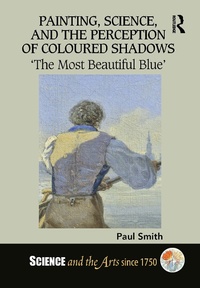
Painting, Science, and the Perception of Coloured Shadows
'The Most Beautiful Blue'
1st Edition
Published on 17. March 2021
190 pages
978-1-351-04201-7 (ISBN)
Description

Many artists and scientists - including Buffon, Goethe, and Philipp Otto Runge - who observed the vividly coloured shadows that appear outdoors around dawn and dusk, or indoors when a candle burns under waning daylight, chose to describe their colours as 'beautiful'.
Paul Smith explains what makes these ephemeral effects worthy of such appreciation - or how depictions of coloured shadows have genuine aesthetic and epistemological significance. This multidisciplinary book synthesises methodologies drawn from art history (close pictorial analysis), psychology and neuroscience (theories of colour constancy), history of science (the changing paradigms used to explain coloured shadows), and philosophy (theories of perception and aesthetic value drawn from Wittgenstein and Merleau-Ponty).
This title will be of interest to scholars in art history, art theory, and the history of science and technology.
Paul Smith explains what makes these ephemeral effects worthy of such appreciation - or how depictions of coloured shadows have genuine aesthetic and epistemological significance. This multidisciplinary book synthesises methodologies drawn from art history (close pictorial analysis), psychology and neuroscience (theories of colour constancy), history of science (the changing paradigms used to explain coloured shadows), and philosophy (theories of perception and aesthetic value drawn from Wittgenstein and Merleau-Ponty).
This title will be of interest to scholars in art history, art theory, and the history of science and technology.
Reviews / Votes
"Everyday experience affords us a miraculous vision: in this deeply-researched and original study, Paul Smith traces the cultural history of the coloured shadow, a phenomenon that haunted the imagination and the practice of European naturalist painters between the Renaissance and the late nineteenth century; he shows how it has continued to elude scientific explanation until recent times, and argues that we may find in it beauty epitomized. In the course of his argument, he re-evaluates significant aspects of the theory and science of colour, with respect to painting and perception. His book will be valued both as a stimulus to thought on these subjects, and for its detailed and incisive analyses of paintings."- Brendan Prendeville, Goldsmiths, University of London
More details
Series
Edition
1. Auflage
Language
English
Place of publication
London
United Kingdom
Publishing group
Taylor & Francis Ltd
Target group
College/higher education
Illustrations
32 Halftones, color; 40 Halftones, black and white; 32 Illustrations, color; 40 Illustrations, black and white
ISBN-13
978-1-351-04201-7 (9781351042017)
Copyright in bibliographic data and cover images is held by Nielsen Book Services Limited or by the publishers or by their respective licensors: all rights reserved.
Schweitzer Classification
Other editions
Additional editions
Book
05/2024
1st Edition
Routledge
€54.00
Shipment within 15-20 days
Book
03/2021
1st Edition
Routledge
€230.27
Shipment within 10-20 days
Book
02/2021
Routledge
Unfortunately, price unknown
Available (delivery time upon request)
Person
Paul Smith is Professor of History of Art at the University of Warwick.
Content
1. The Science 2. Light and Dark 3. Physics 4. Contrast 5. Constancy 6. The Criterion 7. Aesthetic Value 8. Conclusion
