

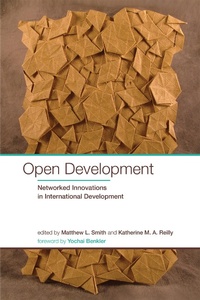
Open Development
Description

The emergence of open networked models made possible by digital technology has the potential to transform international development. Open network structures allow people to come together to share information, organize, and collaborate. Open development harnesses this power, to create new organizational forms and improve people's lives; it is not only an agenda for research and practice but also a statement about how to approach international development. In this volume, experts explore a variety of applications of openness, addressing challenges as well as opportunities.
Open development requires new theoretical tools that focus on real world problems, consider a variety of solutions, and recognize the complexity of local contexts. After exploring the new theoretical terrain, the book describes a range of cases in which open models address such specific development issues as biotechnology research, improving education, and access to scholarly publications. Contributors then examine tensions between open models and existing structures, including struggles over privacy, intellectual property, and implementation. Finally, contributors offer broader conceptual perspectives, considering processes of social construction, knowledge management, and the role of individual intent in the development and outcomes of social models.
Contributors Carla Bonina, Ineke Buskens, Leslie Chan, Abdallah Daar, Jeremy de Beer, Mark Graham, Eve Gray, Anita Gurumurthy, Havard Haarstad, Blane Harvey, Myra Khan, Melissa Loudon, Aaron K. Martin, Hassan Masum, Chidi Oguamanam, Katherine M. A. Reilly, Ulrike Rivett, Karl Schroeder, Parminder Jeet Singh, Matthew L. Smith, Marshall S. Smith
Copublished with the International Development Research Centre of Canada (IDRC)
More details
Other editions
Additional editions
Persons
Katherine M. A. Reilly is Assistant Professor in the School of Communication at Simon Fraser University.
Matthew L. Smith is Senior Program Specialist at the International Development Research Centre in Ottawa. He is coeditor of Open Development: Networked Innovation in International Development (MIT Press and IDRC).
Katherine M. A. Reilly is Assistant Professor in the School of Communication at Simon Fraser University.
Katherine M. A. Reilly is Assistant Professor in the School of Communication at Simon Fraser University.
Matthew L. Smith is Senior Program Specialist at the International Development Research Centre in Ottawa. He is coeditor of Open Development: Networked Innovation in International Development (MIT Press and IDRC).
Mark Graham is Professor of Internet Geography at the Oxford Internet Institute at the University of Oxford the editor (with William H. Dutton) of Society and the Internet: How Networks of Information and Communication Are Changing Our Lives.
Hassan Masum is a policy and technology strategist and Affiliate Researcher at the Waterloo Institute for Complexity and Innovation at the University of Waterloo.
Katherine M. A. Reilly is Assistant Professor in the School of Communication at Simon Fraser University.
