

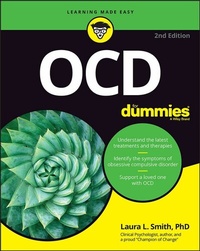
OCD For Dummies
Description

Manage OCD and live a better life, thanks to this friendly Dummies guide
People with obsessive-compulsive disorder (OCD) need skills and tools to manage their symptoms. OCD For Dummies offers help for you or your loved one when it comes to recognizing, diagnosing, treating, and living with this common mental and behavioral disorder. Dummies gives you all the information you need on getting your symptoms under control and working toward remission. This edition updates you with the latest research on OCD, new therapeutic treatments, and all the most up-to-date resources to help you along on your OCD journey. You're not alone-there are millions of people out there who understand what you're going through, and OCD For Dummies does, too. Understand obsessive-compulsive disorder and get the help you need with this book.
- Discover what causes OCD and learn how identify the symptoms and early warning signs
- Learn about the latest medications, treatments, and resources available to help manage OCD symptoms
- Differentiate between OCD and related disorders so you can get the right help
- Help a loved one who suffers from OCD and get tips on how you can be supportive
If you or someone you know has symptoms of OCD or has received a recent diagnosis, this book will gently guide you through building the skills and awareness that will let you live life to its fullest.
More details
Other editions
Additional editions
Person
Laura L. Smith is a clinical psychologist and former President of the New Mexico Psychological Association. She has presented workshops and classes to national and international audiences, including the University of New Mexico adult continuing education program (Osher). She wrote Anxiety For Dummies and Depression For Dummies.
Content
Introduction 1
Part 1: The Ins and Outs of OCD 5
Chapter 1: Facing Obsessive-Compulsive Disorder (OCD) 7
Chapter 2: Understanding What OCD Is All About 19
Chapter 3: Meeting the Associates and Relatives of OCD 43
Chapter 4: Blaming the Brain for OCD 59
Chapter 5: Developing and Living with OCD 69
Part 2: Starting Down the Treatment Path 85
Chapter 6: Overcoming OCD Obstacles to Change 87
Chapter 7: Getting Help for OCD 105
Part 3: Overcoming OCD 119
Chapter 8: Cleaning Up OCD Thinking 121
Chapter 9: Meta-Mindfulness for OCD 145
Chapter 10: Tackling OCD Behavior with ERP 161
Chapter 11: Considering Medications or Brain Stimulation for OCD 181
Chapter 12: Responding to and Recovering from Relapse 193
Part 4: Targeting Specific Symptoms of OCD 205
Chapter 13: Sanitizing Risk: Contamination OCD 207
Chapter 14: Dealing with Doubting and Checking OCD 219
Chapter 15: Subduing OCD-Driven Shame 235
Chapter 16: Messing with "Just So" OCD 249
Chapter 17: Shrinking Superstitious OCD 261
Chapter 18: Uncovering OCD Accomplices 273
Chapter 19: Dealing with OCD-Related Impulsive Problems 283
Part 5: Assisting Others with OCD 295
Chapter 20: Wondering about Children and OCD 297
Chapter 21: Helping Your Child Conquer OCD 307
Chapter 22: Helping Family and Friends Cope with OCD 319
Part 6: The Part of Tens 329
Chapter 23: Ten Quick OCD Tricks 331
Chapter 24: Ten Steps for After You Get Better 337
Chapter 25: Ten Dirty Little Secrets about Dirt 343
Index 347
Chapter 1
Facing Obsessive-Compulsive Disorder (OCD)
IN THIS CHAPTER
Finding out about OCD
Seeing how media influences OCD
Discovering treatments for OCD
Helping others who suffer from OCD
Depending on how you define the terms, almost everyone has a few obsessive or compulsive tendencies. Obsessive is a word often used to describe someone's intense interest in something. For example, a person could be obsessed with making money, putting money ahead of all other goals in life. Someone could have an intense interest in collecting coins or stamps, spending hours looking through catalogues, dreaming of the next rare find. Some people are obsessed with sports teams, never missing a game. Obsessions are common in everyday life and are not necessarily reflective of a mental health problem.
Compulsive refers to rigid patterns of behavior. For example, someone could be compulsive about always cleaning the house on Saturday - never on Monday, only on Saturday. Another person could compulsively walk the dog on the same route every day. Yet another compulsion could involve never stepping on cracks in the sidewalk. Compulsive behaviors are not deemed abnormal when they don't cause harm or distress.
Thus, some people with ordinary obsessions or compulsions manage quite well. For example, many major-league sports figures have elaborate good-luck rituals that look pretty strange. Some feel compelled to listen to the same song prior to the game; others eat exactly the same food. You've probably watched pitchers straighten their hats, smooth out the dirt on the mound, and spit in the sand before each pitch. Many baseball hitters have elaborate rituals they carry out with their bats. Other athletes have strange beliefs, good-luck charms, or compulsive acts that they must perform, allegedly to help their performance. If you are a major-league sports player making zillions of dollars to play a game, you can indulge in a few weird behaviors. No one will question you.
But mental-health professionals define these terms quite differently. In the mental-health field, obsessions are considered to be unwanted thoughts, images, or impulses that occur frequently and are quite upsetting to the person who has them. Compulsions are various actions or rituals that a person performs in order to reduce the feelings of distress caused by obsessions. These obsessions and compulsions consume hours of the day and interfere with essential tasks of life.
Anyone can have a few obsessions or compulsions, and, in fact, most people do. But it isn't obsessive-compulsive disorder (OCD) unless the obsessions and compulsions consume considerable amounts of time and interfere significantly with the quality of your life.
This chapter introduces you to OCD. The disorder debilitates individuals who have it and costs society plenty. The chapter also provides an overview of the major treatment options. With guidance and assistance, much can be done to help those with OCD. Finally, because OCD treatment can be enhanced by the help of friends and family, this chapter offers tips on what you can do to help someone you care about who has OCD.
What Is OCD?
OCD has many faces. Millions of people are held prisoner by the strange thoughts and feelings caused by this disorder. Between 1 and 2 percent of the worldwide population has OCD. Most people with OCD are bright and intelligent. But doubt, uneasiness, and fear hijack their normally good, logical minds.
Whether or not you have OCD, you can probably recall a time when you felt great dread. Imagine standing at the edge of an airplane about to take your first parachute jump. The wind is blowing; your stomach is churning; you're breathing hard. Suddenly the pilot screams, "Stop! Don't jump! The chute is not attached!"
You waver at the edge, terrified, and fall back into the plane, shaking. That's how many people with OCD feel every day. OCD makes their brains believe that something horrible is about to happen. Some people fear that they left an appliance on and the house will burn down. Others are terrified that they may get infected with some unknown germ. OCD causes good, kind people to believe that they might do something horrible to a child, knock over an elderly person, or run over someone with their car.
Those with OCD almost always struggle with one or more of the following concerns: shame; the intense desire to avoid all risks; and constant, nagging doubt. The next three sections describe these issues.
Suffering shame
Because the thoughts and behaviors of those with OCD are so unusual or socially unacceptable, people with OCD often feel deeply embarrassed and ashamed. Imagine having the thought that you might be sexually attracted to a statue of a saint in your church. The thought bursts into your mind as you walk by the statue. Or consider how you would feel if you stood at a crosswalk and had an image come into your mind of pushing someone into oncoming traffic.
However, the frightening, disturbing thoughts of OCD are not based on reality. People with OCD have these thoughts because their OCD minds produce them, not because they are evil or malicious. It is extremely rare for someone with OCD to actually carry out a shameful act.
Throughout this book you'll see references to the "OCD mind" rather than you or someone you care about with OCD. The purpose of doing that is to emphasize that you are not your OCD. You have these thoughts, urges, impulses, and rituals because of a problem with the way your brain works. OCD is not your fault, and it doesn't make you a bad person.
Wrestling with risk
The OCD mind attempts to avoid risks of all kinds almost all the time. That's why those with contamination OCD spend many hours every single day cleaning, scrubbing, and sanitizing everything around them. People with superstitious OCD perform rituals to keep them safe over and over again. Interestingly, most OCD sufferers focus on reducing risks around specific themes such as contamination, household safety, the safety of loved ones, or offending God. But those with contamination fears don't necessarily worry about damnation. And those who worry about turning the stove off usually don't obsess about germs.
Risks of all kinds abound in life. And no one can ever know when something horrible might happen. All people eventually suffer from a variety of risky situations and outcomes such as illness, accidents, tragedy, war, grief, and ultimately death. But the OCD mind tries to create the illusion that almost all risks can be anticipated and avoided.
In truth, OCD doesn't provide significant protection in spite of extraordinary efforts to reduce risks. In chapters to come I give you many ideas about how to accept a certain amount of risk in order to live a full life, no matter how long or short that life is.
Dealing with doubt
Doubt permeates the OCD mind. It's difficult to be 100 percent certain of almost any situation in life. The OCD brain takes advantage of that fact and goes to town. Someone with OCD often has worries such as:
- Am I sure I locked the door?
- Is it possible that I might lose control and shout obscenities?
- Could I actually be sexually attracted to animals?
- Might this be dirty and make me sick?
- If I don't count by 3s, will bad luck follow me?
- If I don't alphabetize my cans, will I be able to function?
- Am I sure I won't harm my children?
- Am I positive I won't get sick if I touch that dish?
With thoughts like that, who wouldn't be worried all of the time?
Counting the Costs of OCD
People with OCD suffer. They are more likely than others to have other emotional disorders such as depression or anxiety. Due to embarrassment, they often keep their symptoms secret for years, which prevents them from seeking treatment. Worldwide, it is estimated that almost 60 percent of people with OCD never get help.
The pain of OCD is accompanied by loneliness. OCD disrupts relationships. People with OCD are less likely to marry, and, if they do, they are more likely to divorce than others. Those who do hang on to their families often have more conflict.
OCD also costs money. These costs include money spent on treatment, lost productivity on the job, and lost days at work. Costs of treatment are often high in part because many with OCD don't get effective treatment for years. They may enter treatment and be too ashamed to tell the therapist their symptoms. Or well-meaning therapists may not be trained to provide effective OCD treatment.
Someone with fears of contamination may be late for work because they can't get out of the shower quickly enough because of excessive washing. A person who believes that they may have possibly hit someone with their car may circle around multiple times to check, resulting in once again being late for work. Someone else may have to recheck that the door is locked multiple times. A person who has a need for perfection may not be able to turn in completed work in a timely manner because of repeatedly checking for mistakes. And someone else with a need for symmetry may spend endless hours arranging their desk.
OCD and the Media
Media, especially social media, depends on sensationalism to gain viewers. News is mostly negative...
