

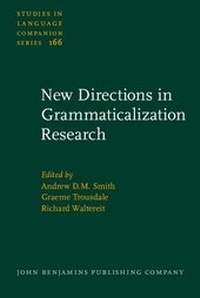
New Directions in Grammaticalization Research
1st Edition
Published on 15. March 2015
XV, 292 pages
978-90-272-6904-1 (ISBN)
Description

The articles in this volume examine a number of critical issues in grammaticalization studies, including the relationship between grammaticalization and pragmaticalization, subjectification and intersubjectification, and grammaticalization and language contact. The contributions consider data from a broad range of spoken and signed languages, including Greek, Japanese, Nigerian Pidgin, Swedish, and Turkish Sign Language. The authors work in a variety of theoretical frameworks, and draw on a number of research traditions. The volume will be of primary interest to historical linguists, though the diversity of approaches and sources of data mean that the volume is also likely have considerable general appeal.
More details
Other editions
Additional editions
Andrew D.M. Smith | Graeme Trousdale | Richard Waltereit
New Directions in Grammaticalization Research
Book
04/2015
John Benjamins Publishing Co
€100.70
Shipment within 10-15 days
Persons
Content
- New Directions in Grammaticalization Research
- Editorial page
- Title page
- LCC data
- Table of contents
- Preface
- References
- The grammaticalization of headshakes
- 1. Introduction
- 2. Basic ingredients: Non-manuals and grammaticalization
- 2.1 Non-manuals in sign languages
- 2.2 Grammaticalization in sign languages
- 3. Headshakes in spoken discourse
- 3.1 On the origin of the headshake (and head nod)
- 3.2 Uses of headshakes
- 4. Headshakes in signed discourse
- 4.1 Gestural headshakes
- 4.2 Linguistic headshakes
- 4.2.1 Manual dominant systems
- 4.2.2 Non-manual dominant systems
- 4.2.3 Summary
- 5. From gesture to grammar
- 5.1 A typological perspective on sign language negation
- 5.1.1 Typology of negation
- 5.1.2 Particles and affixes in manual vs. non-manual dominant systems
- 5.2 Headshake in Jespersen's Cycle
- 5.2.1 Jespersen's Cycle
- 5.2.2 From manual dominant to non-manual dominant system
- 6. Conclusion
- Appendix: Notational conventions
- References
- The Swedish connective så att 'so that'
- 1. Background and aims
- 2. The syntax and semantics of så att
- 3. Theory
- 4. Data and method
- 5. Corpus-based analysis
- 6. Conclusions and future prospects
- Acknowledgements
- References
- The lexicalization-grammaticalization-pragmaticalization interface
- 1. Introduction
- 2. Preliminaries - discourse markers
- 2.1 Mental state predicates of the I think-type
- 3. Case study - Mainland Scandinavian jeg tror
- 3.1 Sources and method
- 3.2 Results
- 3.2.1 Qualificational and non-qualificational meanings
- 3.2.2 Person
- 3.2.3 That-deletion and that-complementation
- 3.2.4 Position
- 3.2.5 Overall results
- 4. Analysis
- 4.1 Composite changes
- 4.2 Definitions
- 4.3 The lexicalization-grammaticalization-pragmaticalization interface
- 5. Summary and conclusions
- Acknowledgements
- References
- Evidential/epistemic markers of the type verb + complementizer
- 1. Introduction
- 2. Romance developments of the type Verb+C
- 2.1 Spanish dizque
- 2.1.1 The early history of dizque
- 2.1.2 Latin American Spanish dizque
- 3. Like-parentheticals in contemporary American English
- 4. Romance Verb+C combinations and English like-parentheticals as cases of grammaticalization
- 5. Some theoretical implications
- 5.1 On the predictive power of grammaticalization
- 5.2 On the developmental relation between clausal parentheticals and complex clause structures
- 6. Closing remarks
- Corpora used
- References
- The Neg-Raising Phenomenon as a product of grammaticalization
- 1. Introduction
- 2. Previous approaches to NRP
- 2.1 Transformational approach
- 2.2 Logical approach
- 2.3 Pragmatic approach
- 3. NRP as grammaticalization
- 3.1 Grammaticalization of parenthetical expressions
- 3.2 NRP as grammaticalized expressions
- 4. Delimitation of NRP predicates
- 4.1 Relation between NRP and parentheticals
- 4.2 Characterization of NRP predicates
- 4.3 Japanese case
- 5. Conclusion
- Acknowledgments
- References
- Periphery of utterances and (inter)subjectification in Modern Japanese
- 1. Introduction
- 2. Background
- 2.1 (Inter)subjectification and periphery
- 2.2 Japanese kara and node in the peripheries of a clause
- 3. Research question and methodology
- 4. Development of kara and node in the peripheries of a clause
- 4.1 Kara and node in present-day spoken Japanese
- 4.2 Kara and node in the history of Japanese
- 4.3 Diachronic study of (da)kara and (na)node in terms of periphery
- 4.4 Various forms of the LP dakara around 1900
- 4.5 Summary of kara and node in the peripheries of a clause in Modern Japanese
- 5. Discussion
- 5.1 (Inter)subjectification and grammaticalization
- 5.2 (Inter)subjectification and shift to the LP and RP of the clause
- 6. Conclusion
- Acknowledgements
- Abbreviations
- Symbols
- Notations
- Corpora
- Text references
- References
- Left vs. right periphery in grammaticalization
- 1. Introduction
- 2. Corpora
- 3. Functional differences between the left and the right periphery
- 4. Grammaticalization
- 5. Present-Day English anyway in the LP and RP
- 6. The grammaticalization of peripheral anyway
- 7. Grammaticalization in the peripheries
- 8. Conclusion
- Corpora
- References
- The diachrony of subjective amenazar 'threaten'
- 1. Introduction
- 2. Exploring data and research questions
- 3. Exploring the French path
- 4. A case of functional borrowing from Latin
- 5. Conclusions
- References
- Annex. The complements of amenazar in the Admyte corpus (13th-15th century)
- Contact-induced grammaticalization in older texts
- 1. Introduction
- 2. The Greek analytic comparatives
- 2.1 Background
- 2.2 Overview of the data
- 3. Contact-induced grammaticalization?
- 3.1 Pre-requisites for a language contact account
- 3.2 Data discussion
- 3.3 Double comparatives and pathways of grammaticalization
- 4. Contact-induced grammaticalization as a historical process
- 5. Conclusions
- Primary sources
- References
- Complexity in gradience
- 1. Introduction
- 2. What is a serial verb construction?
- 3. The synchronic gradience of take in Nigerian Pidgin
- 3.1 Lexical take as a main verb
- 3.2 Serial take in instrumental SVCs
- 3.3 Take in three-verbs serial constructions as expression of purpose
- 3.4 The modal take
- 4. Conclusions: Synchronic gradience and diachronic evolution of take in NigP
- References
- Grammaticalisation as paradigmatisation
- 1. Introducing the paradigm
- 2. Identifying a series of paradigms: Polish preterite
- 3. Speaker and community, abruptness and gradualness
- 4. Reconstructing a paradigm: The subjunctive in Russian
- 5. The marginal status of word order in grammaticalisation
- 5.1 Danish V2-borne contrasts
- 5.2 Predicative contrasts in Italian and Russian
- 5.3 Sun & Traugott's view
- 6. Topological positions expressing grammatical categories
- 7. The paradigmatic organisation of constructions
- 8. The concept of a frame
- 9. Conclusion
- References
- Subject Index
- Language Index
- Author Index
