

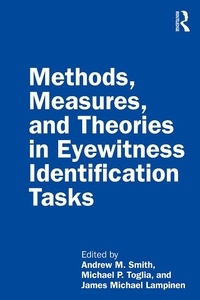
Methods, Measures, and Theories in Eyewitness Identification Tasks
1st Edition
Published on 25. February 2021
422 pages
978-1-000-33415-9 (ISBN)
Description

Methods, Measures, and Theories in Eyewitness Recognition Tasks provides a comprehensive review of the fundamental issues surrounding eyewitness recognition phenomena alongside suggestions for developing a more methodologically rigorous eyewitness science.
Over the past 40 years, the field of eyewitness science has seen substantial advancement in eyewitness identification procedures, yet theoretical and methodological developments have fallen behind. Featuring contributions from prominent international scholars, this book examines methodological and theoretical limitations and explores important topics, including how to increase the accuracy of identifying perpetrators when using CCTV images, how to create more identifiable facial composites, and the differences in accuracy between younger and older eyewitnesses.
Providing in-depth discussion on the limitations of traditional lineups, eyewitness memory fallibility, and the complications that arise when using laboratory simulations, along with suggestions for new methods, this book will be an invaluable resource for researchers in eyewitness recognition, lawyers, players in the criminal justice system, members of innocence commissions, and researchers with interests in cognitive psychology.
Over the past 40 years, the field of eyewitness science has seen substantial advancement in eyewitness identification procedures, yet theoretical and methodological developments have fallen behind. Featuring contributions from prominent international scholars, this book examines methodological and theoretical limitations and explores important topics, including how to increase the accuracy of identifying perpetrators when using CCTV images, how to create more identifiable facial composites, and the differences in accuracy between younger and older eyewitnesses.
Providing in-depth discussion on the limitations of traditional lineups, eyewitness memory fallibility, and the complications that arise when using laboratory simulations, along with suggestions for new methods, this book will be an invaluable resource for researchers in eyewitness recognition, lawyers, players in the criminal justice system, members of innocence commissions, and researchers with interests in cognitive psychology.
Reviews / Votes
"This is a domain in which scientific results lead immediately to real-world applications, and so our science has to be comprehensive and sophisticated. That's why we need volumes like this one, weaving together theory, careful discussion of measures, and thoughtful scrutiny of all our research." - Daniel Reisberg, Reed College, U.S.A."A ground breaking examination highlighting contemporary methods and emerging topics in eyewitness recognition. Each chapter promotes a unique learning opportunity for understanding the science, theories, and methods contributing to eyewitness identification accuracy." - Garrett Berman, Roger Williams University, U.S.A.
"If you are an eyewitness researcher or someone who uses eyewitness research in your line of work, this book is an invaluable resource and a must read. Nowhere else will you find such a compelling and up-to-date compendium of how to conduct and evaluate eyewitness studies. As a researcher in the eyewitness field for over 20 years, I can strongly attest to the significance of this publication and salute the authors for this tremendous body of work. It is a much needed resource that will no doubt guide the future of scientific discovery in this field." - Jennifer E. Dysart, John Jay College of Criminal Justice, New York, U.S.A. "This is a domain in which scientific results lead immediately to real-world applications, and so our science has to be comprehensive and sophisticated. That's why we need volumes like this one, weaving together theory, careful discussion of measures, and thoughtful scrutiny of all our research." - Daniel Reisberg, Reed College, U.S.A.
"A ground breaking examination highlighting contemporary methods and emerging topics in eyewitness recognition. Each chapter promotes a unique learning opportunity for understanding the science, theories, and methods contributing to eyewitness identification accuracy." - Garrett Berman, Roger Williams University, U.S.A.
"If you are an eyewitness researcher or someone who uses eyewitness research in your line of work, this book is an invaluable resource and a must read. Nowhere else will you find such a compelling and up-to-date compendium of how to conduct and evaluate eyewitness studies. As a researcher in the eyewitness field for over 20 years, I can strongly attest to the significance of this publication and salute the authors for this tremendous body of work. It is a much needed resource that will no doubt guide the future of scientific discovery in this field." - Jennifer E. Dysart, John Jay College of Criminal Justice, New York, U.S.A.
More details
Edition
1. Auflage
Language
English
Place of publication
London
United Kingdom
Publishing group
Taylor & Francis Ltd
Target group
College/higher education
Professional and scholarly
Illustrations
25 Tables, black and white; 18 Line drawings, black and white; 14 Halftones, black and white; 32 Illustrations, black and white
ISBN-13
978-1-000-33415-9 (9781000334159)
Copyright in bibliographic data and cover images is held by Nielsen Book Services Limited or by the publishers or by their respective licensors: all rights reserved.
Schweitzer Classification
Other editions
Additional editions
Andrew M. Smith | Michael P. Toglia | James Michael Lampinen
Methods, Measures, and Theories in Eyewitness Identification Tasks
Book
02/2021
1st Edition
Routledge
€193.50
Shipment within 10-20 days
Andrew M. Smith | Michael P. Toglia | James Michael Lampinen
Methods, Measures, and Theories in Eyewitness Identification Tasks
Book
02/2021
1st Edition
Routledge
€80.50
Shipment within 10-20 days
Persons
Andrew M. Smith is Assistant Professor of Psychology at Iowa State University. Andrew's research on eyewitness memory has been published in several top psychology outlets and has attracted funding from the Laura and John Arnold Foundation, the Natural Sciences and Engineering Research Council of Canada, and the National Science Foundation.
Michael P. Toglia is Human Development Professor at Cornell University. His extensive publications on adult cognition topics and lifespan themes in eyewitness memory include 11 books, most recently The Elderly Eyewitness in Court. Toglia is a Fulbright Scholar and a Fellow in several professional societies, including APA's Division 41, Psychology and the Law.
James Michael Lampinen is Distinguished Professor of Psychological Science at the University of Arkansas. Dr. Lampinen's work focuses on applications of basic research on memory and face perception to legal issues including eyewitness identification, missing and wanted persons, and forensic age progression. He is author of two books, The Psychology of Eyewitness Identification, and Memory 101.His work has been funded by grants from the National Science Foundation and the Laura and John Arnold Foundation.
Michael P. Toglia is Human Development Professor at Cornell University. His extensive publications on adult cognition topics and lifespan themes in eyewitness memory include 11 books, most recently The Elderly Eyewitness in Court. Toglia is a Fulbright Scholar and a Fellow in several professional societies, including APA's Division 41, Psychology and the Law.
James Michael Lampinen is Distinguished Professor of Psychological Science at the University of Arkansas. Dr. Lampinen's work focuses on applications of basic research on memory and face perception to legal issues including eyewitness identification, missing and wanted persons, and forensic age progression. He is author of two books, The Psychology of Eyewitness Identification, and Memory 101.His work has been funded by grants from the National Science Foundation and the Laura and John Arnold Foundation.
Content
Introduction
1. Toward the Development of a More Methodologically Rigorous Eyewitness Science (Michael P. Toglia, Andrew M. Smith, & James Michael Lampinen)
Finding Persons
2. A Proposed Solution to the Problem of Identifying people from CCTV and Other Images (Richard I. Kemp, Gary Edmond, & David White)
3. Forensic Facial Composites (Charlie D. Frowd)
4. Methodological Considerations in Prospective Person Memory (Kara N. Moore, Andrew C. Provenzano, William Blake Erickson, & James Michael Lampinen)
Identifying Persons
5. Methodological Considerations in Eyewitness Identification Experiments (Adele Quigley-MacBride & Gary L. Wells)
6. Concepts and Theories That (Should) Inform the Use of Face Images in Forensic Science (Vicki Bruce & Karen Lander)
7. A Process Perspective: The Importance of Theory in Eyewitness Identification Research (Rachel E. Dianiska, Krista D. Manley, & Christian A. Meissner)
8. Measuring Performance from Eyewitness Identification Procedures (Andrew M. Smith, Laura Smalarz, & Shaela T. Jalava)
9. Ratings-Based Identification Procedures (James D. Sauer & Neil Brewer)
10. Dealing with Data from Real Witnesses: Methodological and Analytical Considerations (Ruth Horry & Daniel B. Wright)
11. Measuring the Relationship Between Eyewitness Identification Confidence and Accuracy (Neil Brewer, Carmen A. Lucas, James D. Sauer, & Matthew A. Palmer
12. Utility Approaches and Eyewitness Identification Reforms (James Michael Lampinen, Brittany Race, Andrew Provenzano, Nia Gipson, & Amber Giacona)
13. Eyewitness Identification Around the World (Ryan J. Fitzgerald, Eva Rubinova, & Stefana Juncu)
Special Considerations for Older and Younger Eyewitnesses
14. False Memory: What are the Effects, How Does Fuzzy-Trace Theory Predict Them, and How Does this Matter for Eyewitness Testimony? (Daniel M. Bialer, Valerie F. Reyna, & Charles J. Brainerd)
15. Methodological Considerations for Lifespan-Focused Identification Research (Joanna Pozzulo, Emily Pica, & Chelsea Sheahan)
Conclusion
16. Eyewitness Memory: The Next 40 Years (James Michael Lampenin, Andrew M. Smith, & Michael P. Toglia)
1. Toward the Development of a More Methodologically Rigorous Eyewitness Science (Michael P. Toglia, Andrew M. Smith, & James Michael Lampinen)
Finding Persons
2. A Proposed Solution to the Problem of Identifying people from CCTV and Other Images (Richard I. Kemp, Gary Edmond, & David White)
3. Forensic Facial Composites (Charlie D. Frowd)
4. Methodological Considerations in Prospective Person Memory (Kara N. Moore, Andrew C. Provenzano, William Blake Erickson, & James Michael Lampinen)
Identifying Persons
5. Methodological Considerations in Eyewitness Identification Experiments (Adele Quigley-MacBride & Gary L. Wells)
6. Concepts and Theories That (Should) Inform the Use of Face Images in Forensic Science (Vicki Bruce & Karen Lander)
7. A Process Perspective: The Importance of Theory in Eyewitness Identification Research (Rachel E. Dianiska, Krista D. Manley, & Christian A. Meissner)
8. Measuring Performance from Eyewitness Identification Procedures (Andrew M. Smith, Laura Smalarz, & Shaela T. Jalava)
9. Ratings-Based Identification Procedures (James D. Sauer & Neil Brewer)
10. Dealing with Data from Real Witnesses: Methodological and Analytical Considerations (Ruth Horry & Daniel B. Wright)
11. Measuring the Relationship Between Eyewitness Identification Confidence and Accuracy (Neil Brewer, Carmen A. Lucas, James D. Sauer, & Matthew A. Palmer
12. Utility Approaches and Eyewitness Identification Reforms (James Michael Lampinen, Brittany Race, Andrew Provenzano, Nia Gipson, & Amber Giacona)
13. Eyewitness Identification Around the World (Ryan J. Fitzgerald, Eva Rubinova, & Stefana Juncu)
Special Considerations for Older and Younger Eyewitnesses
14. False Memory: What are the Effects, How Does Fuzzy-Trace Theory Predict Them, and How Does this Matter for Eyewitness Testimony? (Daniel M. Bialer, Valerie F. Reyna, & Charles J. Brainerd)
15. Methodological Considerations for Lifespan-Focused Identification Research (Joanna Pozzulo, Emily Pica, & Chelsea Sheahan)
Conclusion
16. Eyewitness Memory: The Next 40 Years (James Michael Lampenin, Andrew M. Smith, & Michael P. Toglia)
